


More news on this day
Dublin Airport has scrapped the long-standing 100 millilitre liquid limit for hand luggage after completing a rollout of next-generation C3 scanners, just as the hub prepares for a record summer with around 11 million passengers forecast between June and August.
Get the latest news straight to your inbox!
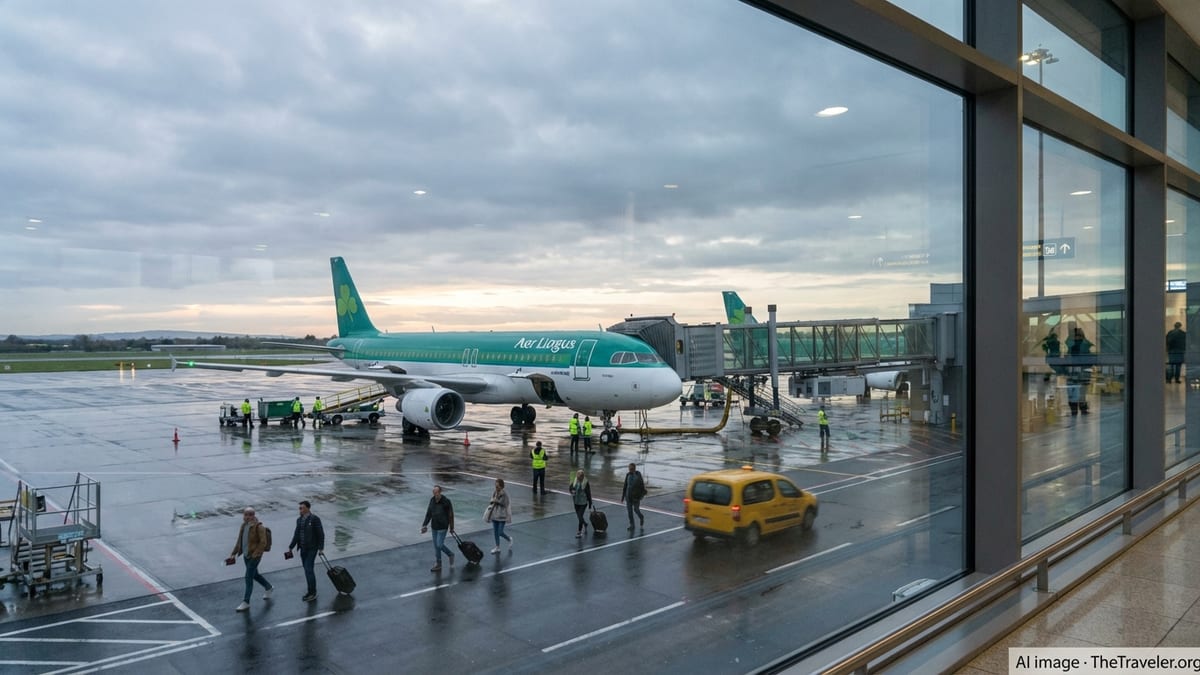
New scanners transform security for Aer Lingus and global carriers
Publicly available information from Dublin Airport shows that passengers can now carry liquids and gels in containers of up to two litres in cabin bags, and may leave both liquids and electronics inside their hand luggage during screening. The change follows the full deployment of C3 computed tomography scanners in both terminals, bringing Dublin into line with a small group of early-adopter European hubs.
The new regime applies regardless of airline, which means Aer Lingus joins Ryanair, British Airways, Lufthansa, United Airlines, Delta Air Lines and American Airlines in benefiting from faster, less intrusive security checks at their Dublin departures. For travellers connecting across airline alliances and codeshares, this removes one of the most visible pain points of using Ireland’s busiest gateway as a transfer point.
Airport operator daa has highlighted in recent reporting that the scanners use 3D imaging similar to hospital CT technology to analyse cabin bags in detail. That higher resolution is designed to preserve or improve security standards while allowing far more flexibility on liquids than the emergency rules introduced across Europe after 2006.
However, the relaxed limits are specific to Dublin’s security checkpoints. Travellers who start or continue their journeys through airports that still rely on older X-ray equipment will continue to face the traditional 100 millilitre rule for the foreseeable future.
Record summer volumes put the new system to the test
Industry analyses of daa traffic data suggest that Dublin Airport handled around 36 million passengers in 2025 and is on track for another record peak this summer. Local travel coverage indicates that about 11 million passengers are expected to pass through the terminals between June and August alone, with daily totals frequently exceeding 100,000 travellers.
The new liquid rules are central to the airport’s strategy for keeping those flows moving. By cutting the need to decant toiletries into small plastic bags and removing laptops at the belt, security lines typically move more quickly and with fewer secondary checks. Aviation commentators in Ireland have noted that previous holiday peaks already demonstrated shorter average queue times once the C3 lanes were fully operational.
For Aer Lingus, which is based at Dublin and uses it as a primary transatlantic hub, smoother security is especially important in peak season when banks of morning departures to the United States and major European cities run close together. Low-cost carrier Ryanair, which operates a large short-haul network from Terminal 1, is also expected to benefit from higher throughput at the main screening points during early-morning and late-evening waves.
The summer surge will also feed into wider political debates around Dublin’s long-standing passenger cap and runway capacity. Recent briefing papers for Ireland’s parliament have noted that the airport has already exceeded earlier caps in recent years, adding pressure to balance environmental limits with strong demand for both inbound tourism and outbound leisure travel.
What changes for U.K., U.S. and European passengers in practice
For most travellers, the headline change is simple: at Dublin Airport security, the previous 100 millilitre maximum per container no longer applies, and liquids and gels in containers of up to two litres can remain packed in cabin bags. Toiletry kits, bottled drinks bought landside, baby supplies and small electronic liquids such as contact lens solutions are all easier to carry through the checkpoint.
U.K. and European travellers should be aware that Dublin is ahead of much of the region in this transition. Official guidance from European Union institutions still describes the standard 100 millilitre rule as the default across member states, pending full deployment of similar scanners elsewhere. That means a passenger flying from Dublin to a European airport that has not yet upgraded equipment will still face the traditional liquid limits when departing or connecting on the return leg.
For U.S.-bound travellers, an extra nuance applies. Dublin hosts a U.S. preclearance facility, where passengers clear American entry controls before boarding. While the initial Irish security check now allows larger liquid volumes, travel forums and recent passenger reports indicate that the U.S. screening stage may continue to enforce the 100 millilitre restriction, requiring liquids above that threshold to be packed in checked baggage or left behind.
Passengers connecting from the United States or Britain into Dublin and onward to Europe should therefore treat the Irish security regime as one stage in a multi-airport journey. The most restrictive liquid rule along the route will effectively govern what can stay in cabin bags from start to finish.
Implications for Aer Lingus and partner airline networks
The new security rules are particularly significant for Aer Lingus, which positions Dublin as a one-stop bridge between regional U.K. and European cities and major U.S. gateways. The ability to keep liquids and electronics inside hand luggage can shave minutes off processing times for transfer passengers rushing to make tight connections across the Atlantic.
Legacy carriers such as British Airways and Lufthansa, which serve Dublin primarily as a spoke into their own hubs, gain a competitive boost in the local point-to-point market. Faster security at Dublin can make their flights more attractive for Irish travellers heading to London Heathrow, Frankfurt or beyond, especially at peak morning and evening times when business travellers are most sensitive to delays.
For U.S. carriers United, Delta and American Airlines, the simplified screening may help reduce congestion before their transatlantic departures, where many passengers travel with additional hand luggage and duty free purchases. Combined with U.S. preclearance, Dublin continues to market itself as an efficient entry point into North America for European travellers looking to avoid long immigration queues on arrival.
Low-cost giant Ryanair, operating under a different business model, is also expected to see operational gains. High-density boarding patterns and tight turnaround times at Dublin have historically been vulnerable to small delays at security. Any shortening of queue times supports the airline’s efforts to keep on-time performance high and aircraft utilisation rates elevated.
Key tips before you fly through Dublin this summer
Travel organisations and airport advisories emphasise that the scrapping of the 100 millilitre rule at Dublin reduces, but does not eliminate, the need for careful packing. Liquids and gels are now permitted in larger containers within hand luggage, yet overall cabin baggage size and weight limits set by airlines such as Aer Lingus, Ryanair, British Airways, Lufthansa, United, Delta and American Airlines remain unchanged.
Passengers should check whether any other airports on their itinerary still apply the traditional liquid rules. A traveller flying from a regional U.K. airport to Dublin and on to mainland Europe, for example, will have to comply with local restrictions at the departure point, even if the transit through Dublin itself is more relaxed.
Food, powders and certain specialist items can still attract additional screening, and there may be tighter rules for particular destinations, including the United States, irrespective of Dublin’s own limits. Travellers carrying medicines, baby food or duty free alcohol in larger volumes are advised by consumer groups and airline guidance to keep receipts and original packaging handy in case of questions at security or at the gate.
With record passenger numbers forecast over the summer months, early arrival at the airport remains prudent. Dublin Airport’s own guidance continues to recommend at least two hours for short-haul and three hours for long-haul departures, with extra margin during busy holiday weekends. Even with faster scanners and relaxed liquid rules, sheer volume means that well-prepared travellers are still likely to have the smoothest journey through Ireland’s main international gateway.