


Dubrovnik’s Old Town is compact enough to cross in ten minutes, yet layered with centuries of history, tight limestone alleys and some of the heaviest visitor crowds in Europe. This guide walks you through Stradun, the main gates, key squares and side streets, with concrete tips on restaurants, crowd dodging, timing your visit and simple walking routes that make the historic center feel manageable instead of overwhelming.
Get the latest updates straight to your inbox!
Understanding Dubrovnik Old Town’s Layout
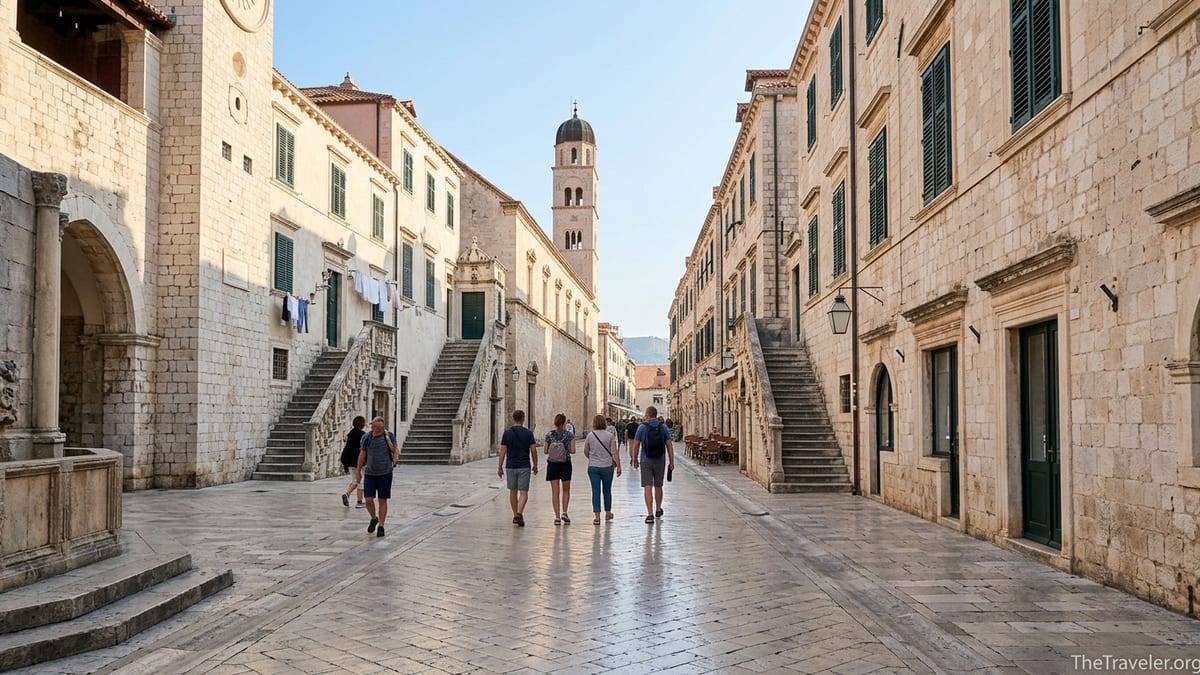
Dubrovnik’s Old Town sits behind massive stone walls on a small peninsula, with the main pedestrian axis, Stradun, running west to east across its base. Stradun is about 300 meters long, paved in polished limestone and bookended by two main gates, Pile Gate on the west side and Ploče Gate on the east. Once you grasp that Stradun is the spine and everything else rises in terraces of steps to the north and slopes more gently toward the old harbor in the south, navigation becomes much less intimidating.
The northern half of the Old Town is steep, especially if you enter via Pile Gate and turn left up the side streets. Many lanes here are essentially staircases, climbing toward Prijeko Street and the upper alleys that look down over Stradun. Travelers with mobility issues generally find it easiest to stay close to Stradun itself or use the slightly less steep streets that lead toward the harbor and Rector’s Palace instead of tackling the full flights of steps behind the Franciscan Monastery.
The Old Town is fully pedestrianized, so there are no cars, scooters or bikes inside the walls. Airport buses and local buses drop passengers outside Pile Gate, while some airport shuttles and taxis can also stop closer to Ploče Gate on the eastern side. From either entrance you are funneled quickly into Stradun, which is why it feels crowded even when the rest of the town’s alleys are relatively quiet.
The main sights cluster around three nodes: Pile Gate and the western end of Stradun; the central stretch around the bell tower, Sponza Palace and nearby squares; and the eastern end near the Dominican Monastery and Ploče Gate. Once you identify these hubs, you can plan walks that link them through quieter backstreets instead of repeatedly battling the densest parts of Stradun.
Stradun: The Polished Spine of the City
Stradun, also known as Placa, is the iconic postcard view of Dubrovnik: a gleaming stone boulevard flanked by uniform houses with green shutters, framed at one end by the Franciscan Monastery and at the other by the city bell tower. Underfoot, centuries of footsteps have polished the stone to a marble-like sheen, so on rainy days you will notice locals walking deliberately and in sturdy shoes. The street is lined with cafes, gelato stands and souvenir shops, with a handful of hotels and high-end boutiques toward the eastern end.
Prices on Stradun reflect its prime location. A simple espresso at one of the pavement cafes can cost significantly more than the same drink two streets back, and sit-down lunches here tend to be targeted at day trippers and cruise passengers. For a practical comparison, travelers often report paying the equivalent of a few extra euros for a coffee on Stradun compared with neighborhood bars outside the walls. The trade-off is the people-watching: sit at a table in front of the Franciscan Monastery in late afternoon and you can watch tour groups empty out, locals hurrying home and early-evening strollers all gliding over the stone.
To experience Stradun without the shoulder-to-shoulder crowds, timing is crucial. In high season, photographers regularly arrive around 6.30 to 7.00 in the morning and find the street virtually empty apart from cleaning crews and a few locals heading to work. By 9.30 or 10.00, the first big tours and cruise ship passengers have usually arrived, and by late morning the street can feel like a slow-moving river of people. After 8.00 in the evening the atmosphere softens again as day trippers leave and lights from restaurants spill into side alleys.
Stradun also serves as your main orientation tool. Landmarks like the Large Onofrio Fountain near Pile Gate, the clock and bell tower at the opposite end, and the side alley signs pointing to attractions such as the Jesuit Steps or Prijeko Street make it easy to re-center yourself. If you ever feel lost in the maze of lanes, simply walk downhill or follow any alley that seems to slope toward the sound of the crowds and you will almost always emerge back onto Stradun.
Pile Gate, Ploče Gate and Other Entrances
Most visitors enter Dubrovnik’s Old Town through Pile Gate, a stone gateway on the western side accessed via a short stone bridge over what was once a defensive moat. City buses from modern Dubrovnik and airport shuttles typically terminate here, which means that mid-morning and late afternoon can bring short bursts of intense congestion under the arch. The gate opens directly onto a bottleneck where people pause to take photos of the drawbridge, Latin inscription over the gate and the first glimpse of Stradun, often blocking the flow.
Ploče Gate on the eastern side tends to be slightly less crowded, particularly early in the day. It also offers one of the most photogenic approaches to the Old Town: you cross a stone bridge with views back to the harbor and the city walls climbing up to the Minčeta Tower. Some airport transfers and taxis can drop passengers near Ploče, and local buses also serve this side, so if your accommodation or city walls entrance is closer to the east, starting here can save time and stress. From Ploče Gate it is a gentle downhill stroll along the inner wall to the central square.
There are smaller entrances as well. The Buža gate in the northern wall, near the upper streets above Stradun, delivers you straight into a quieter residential area where laundry hangs between windows and small bars tuck into the old fortifications. This gate is handy if you are staying in guesthouses on the upper streets or visiting the cliffside “buža” bars outside the walls. On the harbor side, stone archways lead directly into the old port area, where excursion boats to Lokrum Island and the Elaphiti Islands depart.
Choosing the right entrance can dramatically change your first impression of Dubrovnik. For example, arriving at Pile Gate at 11.00 on a day when multiple cruise ships are in port can mean queuing just to cross the bridge, while entering through Ploče around 8.00 gives you room to pause on the bridge for photos and walk almost alone under the walls. Before your trip, it is worth checking the local cruise ship schedule and planning your entrance accordingly so that your first steps into the Old Town feel like a reveal, not a crush.
Squares, Fountains, Churches and Hidden Corners
The Old Town’s major squares are natural gathering points, but each has its own character. Immediately inside Pile Gate stands the Large Onofrio Fountain, a circular stone structure with sixteen carved masks that once supplied drinking water to the city. Today, it is where groups meet their guides and children cool off under the spouts. Because it is located where the gate, Stradun and several alleys intersect, it can become one of the most congested points in the Old Town. If you want to admire the fountain’s details, try passing by again in the early evening when the crowd has thinned.
At the eastern end of Stradun, Luža Square opens up around the bell tower, Sponza Palace and the Church of St. Blaise, Dubrovnik’s patron saint. This is where festivals and processions often start, and where you are likely to find street musicians and a higher density of formal walking tours. A few steps away, the Rector’s Palace and Cathedral of the Assumption anchor another quieter square that is especially atmospheric at night, when the stone facades glow under warm lighting and restaurant terraces spill into nearby alleys.
Beyond these headline sites, the real charm lies in the small chapels, cloisters and hidden corners. The Franciscan Monastery just inside Pile Gate houses one of the oldest functioning pharmacies in Europe, where travelers still duck in to buy simple remedies or just take in the cool cloister. On the opposite end of town, the Dominican Monastery by Ploče Gate sits slightly apart from the heaviest foot traffic and offers a peaceful stone courtyard that feels worlds away from the cruise ship crowds.
For a quieter moment, seek out the narrow lanes that run parallel to Stradun one or two streets up. Here you will find tiny squares with a single café table in the shade of an orange tree, stone staircases lined with potted plants and the occasional neighborhood church door left ajar. You can easily spend an hour turning corners at random, discovering dead-end alleys that end at small viewpoints over rooftops or down over the harbor, then using the distant sound of the bell tower or the slope of the steps to reorient yourself.
Alleys, Stairs and How to Escape the Crowds
Dubrovnik’s side alleys are more than just picturesque backdrops; they are your best tools for dodging crowds. The rule of thumb is simple: if Stradun feels packed, move one or two streets away and then either uphill or downhill. For example, from the Onofrio Fountain you can duck north up the stepped alleys toward Prijeko Street, where outdoor tables from small konobas stretch along a relatively calm lane. Similarly, from Luža Square near the bell tower, heading south toward the harbor brings you into streets that many large tour groups skip.
Stairs are part of daily life here, and the most dramatic example is the Jesuit Steps, an elegant baroque staircase leading up to the Church of St. Ignatius in the southern quarter. In the middle of the day it can feel like a photo shoot set, but if you visit around 7.00 in the morning, travelers routinely report standing there alone, with morning light just catching the edges of the stone balustrades. From the top, narrow alleys run west toward the upper residential streets and east toward the sea gate, both much quieter than Stradun below.
Another strategy is to walk “behind” the main line of the walls inside the city, following whichever higher lane seems to parallel Stradun. Because the northern alleys involve more climbing, many short-stay tourists avoid them, leaving stretches where you can hear nothing but your footsteps and the distant murmur from below. You might pass laundry lines, tiny wine bars with just a handful of tables and small play areas where local children ride scooters on the flat terraces.
When you need a true break from people, consider stepping just outside the walls. From the Pile side, you can cross to Fort Lovrijenac, which gives an elevated view back onto the Old Town and allows you to appreciate the density of Stradun’s crowds from a distance. On the seaside, cliffside bars perched on the rocks below the walls offer late afternoon sea breezes, where the constant roar of waves helps mute the sound of tour groups on the parapets above.
Eating and Drinking Inside the Walls
Old Town Dubrovnik is packed with restaurants, and quality varies from memorable Dalmatian cooking to forgettable tourist plates. A broadly reliable rule is to avoid the most aggressively touting spots directly on Stradun and to look instead along side streets like Prijeko or the quieter lanes leading toward the harbor. Travelers consistently find that moving just a hundred meters from the main drag improves both food quality and value.
Concrete examples help when planning. For seafood in a refined setting, long-established restaurants tucked into alleys off Stradun focus on grilled Adriatic fish, shellfish from nearby Mali Ston Bay and black risotto made with cuttlefish ink. A few steps from the bustle, modern spots such as Restaurant Dubrovnik hide on upper-terrace courtyards where you dine under stone walls and potted citrus trees rather than in the flow of foot traffic. Casual konobas along Prijeko Street and in the northern lanes specialize in simpler fare like grilled calamari, pasta with truffle shavings and platters of local cheeses and pršut.
For more relaxed or budget-conscious meals, look for family-run places just off Stradun where lunchtime menus might include a plate of pasta, salad and a drink for a price that undercuts the main square seating. Fast-casual spots near Pile Gate and up side streets like Petilovrijenci focus on burgers, wraps and salads, popular with younger visitors who want to grab food and head for the rocks by the sea. Many travelers also choose to eat their main meals outside the walls, in neighborhoods like Gruž or Lapad, and treat Old Town dining as a special-occasion dinner with views.
Drink prices vary as sharply as food. A glass of wine on a quiet side street terrace might only be slightly above average European city prices, while cocktails at cliffside bars or on Stradun can be significantly higher. If you want to sample Croatian craft beer or local wines more affordably, consider having a pre-dinner drink at a bar outside the Old Town, then heading inside for a single glass with your meal. Within the walls, small wine bars tucked into upper alleys offer curated lists of Dalmatian whites and robust reds from the Pelješac Peninsula, often with the owner happy to explain the labels.
Managing Crowds and Choosing the Best Time to Visit
Dubrovnik’s Old Town has become a symbol of overtourism, and managing crowd levels is now an integral part of trip planning. The city and port authorities have introduced measures to cap cruise ship arrivals and aim to keep the number of visiting cruise passengers in the Old Town at manageable levels, but on days when two large ships and several smaller vessels are in port, the streets can still feel saturated. The heaviest congestion usually runs from around 10.00 to 16.00 when ship passengers and day trippers from regional resorts overlap.
To see the city at its best, think in three layers: time of year, day of week and time of day. In broad terms, July and August are the most crowded and most expensive months, with shoulder seasons in late April to June and September to mid-October offering a better balance of pleasant weather and slightly lower visitor numbers. Within those months, weekends when multiple cruise ships dock can feel markedly busier than midweek days with lighter port schedules. Some travelers now check online cruise timetables before finalizing accommodation dates so they can prioritize lighter days for Old Town exploration.
On any given day, the quietest windows inside the walls are early morning and late evening. Visitors who set alarms and enter the Old Town around 6.30 or 7.00 often find Stradun nearly empty, the Jesuit Steps deserted and city wall entrances without queues. By mid-morning, lines for city walls tickets can stretch across the square and the bottlenecks at Pile Gate, Onofrio Fountain and Luža Square become pronounced. After about 20.00, especially outside peak summer, the feel shifts; cruise ships are leaving, day trippers heading back to coastal resorts and locals reclaiming the streets for their own evening stroll.
If you must visit on a particularly crowded day, refocus your plan. Spend the middle of the day on Lokrum Island, at a nearby beach or on a boat trip to the Elaphiti Islands, returning to the Old Town in the early evening. Another option is to explore less congested interior spaces such as monasteries, churches or museums during peak hours, then walk the city walls or Stradun at opening or closing times. Simple tactics like pre-purchasing city walls tickets online through official vendors, carrying a refillable water bottle to use at public fountains and wearing shoes with grip for both polished stone and steep steps will make crowd navigation safer and less stressful.
Suggested Walking Routes Through the Historic Center
Because the Old Town is compact, you can create short themed walks that cover major highlights without feeling like you are zigzagging randomly through the crowds. One classic route, ideal for first-timers, starts at Pile Gate around 8.00. After you enter, pause briefly at the Large Onofrio Fountain, then walk the length of Stradun while it is still relatively quiet, noting side alleys you want to revisit. At Luža Square, turn right to visit Sponza Palace and the Church of St. Blaise, then continue to the Rector’s Palace and Cathedral. From the cathedral, drift down toward the old harbor, where you can watch excursion boats departing and see the walls from water level.
A second route focuses on the upper alleys and viewpoints. From Pile Gate, instead of continuing along Stradun, immediately turn left up the stairs behind the Franciscan Monastery into the northern residential quarter. Work your way along Prijeko Street, peeking down each descending alley to see Stradun from above. This route brings you past small konobas setting tables for lunch and glimpses into private courtyards. Continue east until you reach the area above the Dominican Monastery, then descend toward Ploče Gate and exit the walls. From here, you can walk out to viewpoints that frame the Old Town with the sea and Lokrum Island.
For a quieter, more atmospheric evening walk, enter through Ploče Gate around sunset and stroll slowly along the inside of the walls toward the bell tower and Luža Square, then head up the Jesuit Steps when the light is soft and crowds thinning. Loop back via the narrow lanes above Stradun, dropping down occasionally to cross the main street and return to Pile Gate. This kind of loop allows you to experience both the main axes and the quieter second-layer streets without retracing your steps too often.
If you plan to walk the city walls, consider them part of your route rather than an isolated activity. A common, efficient approach is to start at Pile Gate when the walls first open, complete the full circuit in a couple of hours, and then descend straight into the back streets near your preferred lunch spot. From the ramparts you will have had time to identify courtyards, churches and alleyways that look appealing, so you can aim for those as you exit instead of filtering back through the busiest squares by default.
FAQ
Q1. What is the best time of day to visit Dubrovnik’s Old Town to avoid crowds?
Early morning between about 6.30 and 9.00 is generally the quietest, with late evening after 20.00 also calmer once cruise passengers and day trippers have left.
Q2. Is it better to enter the Old Town through Pile Gate or Ploče Gate?
Pile Gate is more convenient for most buses but also more crowded. Ploče Gate is often slightly quieter and offers a more scenic, gradual entry into the Old Town.
Q3. Do I need to worry about the stairs in Dubrovnik’s Old Town?
Yes, if you have mobility issues. Many northern streets are long staircases. Staying close to Stradun and the harbor side keeps climbs gentler and routes more manageable.
Q4. Are restaurants on Stradun worth the higher prices?
They are excellent for people-watching but often more expensive and more tourist-focused. Many visitors find better value and more character one or two streets off Stradun.
Q5. How long does it take to see the main sights in the Old Town?
A focused half day covers Stradun, main squares and churches, but a full day allows time for the city walls, quieter alleys, a sit-down meal and harbor views.
Q6. When is the best season to visit Dubrovnik to balance weather and crowds?
Late April to June and September to mid-October usually offer warm weather, swimmable seas and somewhat lower visitor numbers compared with peak July and August.
Q7. Is it necessary to book restaurants in the Old Town in advance?
For popular or fine-dining spots in high season, reservations are strongly recommended, especially for terrace seating. Casual konobas often accept walk-ins earlier in the evening.
Q8. Can I visit Dubrovnik’s Old Town on a cruise ship stop and still avoid the worst crowds?
It is possible if you leave the ship as soon as it clears, explore the Old Town early, then spend midday on a nearby island or beach before returning in the evening.
Q9. Are there quiet places to rest inside the Old Town during busy hours?
Yes. Cloisters of the Franciscan or Dominican monasteries, small side-square cafés and some shaded church steps provide calmer spots away from Stradun’s main flow.
Q10. Do I need cash inside the Old Town, or is card payment widely accepted?
Cards are widely accepted in most restaurants, bars and shops, but it is sensible to carry some cash for small cafés, gelato stands or public restrooms that may be cash-only.