


Rising directly behind Dubrovnik’s UNESCO-listed Old Town, Mount Srđ is where the city’s famous red rooftops, medieval walls and the Adriatic Sea line up in a single unforgettable panorama. Whether you ride the cable car for an easy sunset, hike the zigzag path from town, or combine views with a visit to historic Fort Imperial, this is the vantage point that appears on postcards, Instagram feeds and tourism posters. This guide walks you through exactly how to get there, what to expect at the top, and how to make the most of the light, views and atmosphere.
Get the latest updates straight to your inbox!
Getting Oriented: Why Mount Srđ Matters
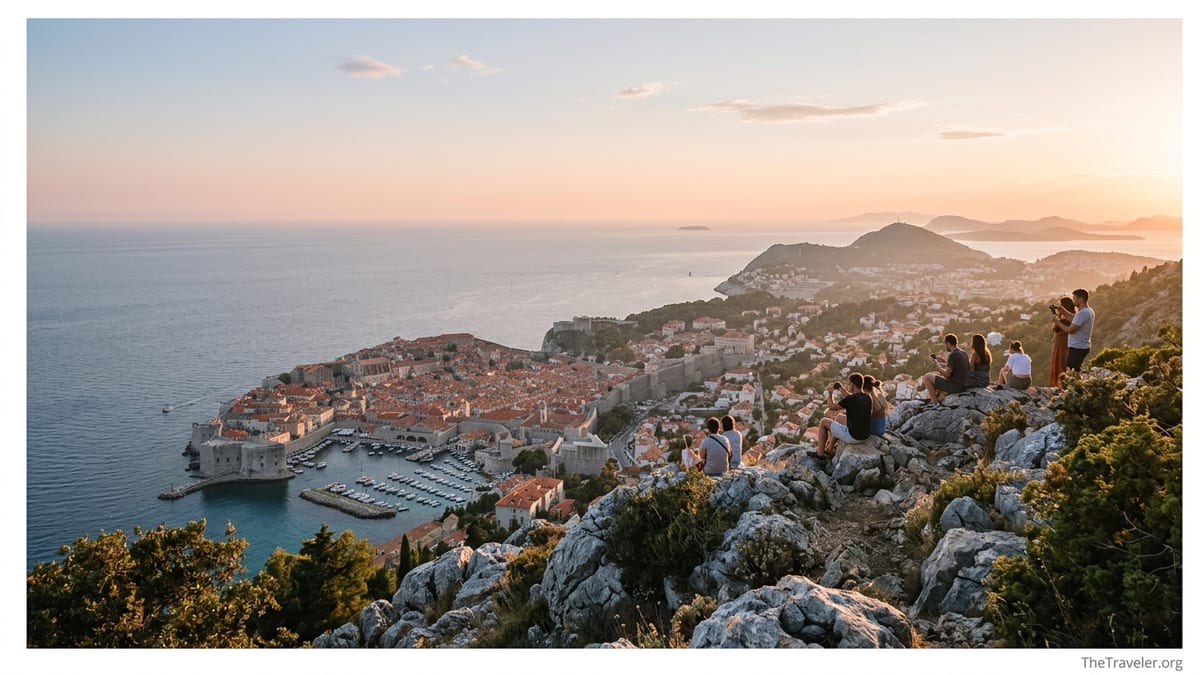
Mount Srđ is a low mountain, just over 400 meters high, that rises immediately behind Dubrovnik. Because it is so close to the Old Town, the summit feels like a natural balcony over the city. You look almost straight down at the terracotta roofs and stone walls, with Lokrum Island to the left, the Elafiti Islands in the distance, and the open Adriatic fading into the horizon. On clear days you can see far along the Dalmatian coast, and on hazy summer evenings the light softens into gold and pastel tones that make this one of the most photographed viewpoints in Croatia.
The summit area is small but packed with things to do. You will find the upper station of the Dubrovnik Cable Car, a bar and restaurant with a terrace facing the sea, several informal rocky lookouts away from the main crowds, the historic Fort Imperial that now houses the Homeland War Museum, and the top stations for activities like ziplining and ATV tours. Even if you spend just an hour, it offers a compact mix of history, scenery and classic holiday atmosphere.
Because so many cruise ship passengers and day trippers are funneled here, timing your visit is crucial. Arrive at the wrong hour in July or August and you may find queues for the cable car, jammed viewing platforms and restaurant tables booked for sunset. With a bit of planning, you can avoid the worst of the crowds, find quieter viewpoints, and still enjoy the iconic views that brought you here.
Reaching the Summit: Cable Car, Hike or Taxi
The simplest and most popular way to reach Mount Srđ is the Dubrovnik Cable Car. The lower station sits just above the Old Town, about a 5 to 10 minute uphill walk from Pile Gate or Buža Gate. As of mid 2026, an adult round-trip ticket costs around 30 euros, and a one-way ticket around 17 euros, with reduced prices for children. The cable car usually runs from April through November, opening in the morning and extending late into the evening in peak season, with last rides often close to midnight in July and August. Services can pause in strong winds or thunderstorms, so on blustery days check operations before you set out.
If you prefer to combine the views with some exercise, the classic hiking trail climbs from just outside the city to the top of Srđ in a steady series of zigzags. The path is well defined and made of gravel and stones, with low walls at many of the switchbacks. Most reasonably fit people take 45 to 60 minutes to reach the summit from the trailhead, gaining around 400 meters. Many travelers choose to hike up in the late afternoon, enjoy sunset at the top, then take the cable car or a taxi down after dark to spare their knees.
A third option is to go by taxi or ride-hailing service. From the Old Town gates, the road to the summit typically takes 10 to 15 minutes, depending on traffic. Prices vary with season and demand, but many visitors report paying the equivalent of 15 to 25 euros one way for an ordinary licensed taxi. Drivers are used to this run and will often wait briefly while you take a quick photo or arrange a set pick-up time for your return, which can be useful if you are visiting at night or outside cable car operating months.
For more flexibility, some travelers rent a scooter or a small car for a day and drive themselves. The road is paved and in good condition, but includes tight bends and limited lighting after dark. If you plan to drive up for sunset, arrive early enough to park and get oriented in daylight, then take your time on the way down once the sky has fully darkened.
Hiking the Zigzag Trail: What to Expect
The hiking trail up Mount Srđ is one of Dubrovnik’s most rewarding short walks. It starts behind the city, near the main road and residential area above the port, then climbs in a series of sweeping switchbacks. Each turn opens a slightly higher perspective over the Old Town and the sea, so even if you do not complete the full route, you can still enjoy excellent views partway up. Local tourism brochures often describe it as suitable for most visitors with comfortable shoes, but it is still a proper uphill hike, not a casual stroll on a city promenade.
Underfoot, the path is mostly compacted dirt and rocks, with some loose stones. Standard trainers or light hiking shoes are fine in dry conditions, but flip-flops are a poor idea. There is almost no shade, so in July and August the stones can radiate heat. Many experienced visitors suggest starting the ascent around 5 or 6 in the evening in midsummer, when the worst heat has passed but you still have daylight. Carry water; even a single 0.5 liter bottle per person can make the difference between an enjoyable climb and an uncomfortable slog.
Time-wise, most people who are moderately fit and stop to take photos reach the top in on the order of an hour. Very fit hikers can do it faster, families with young children or anyone who pauses often for pictures and breathers may take longer. One practical approach is to hike up during the late afternoon, watch the sunset, then ride down on the cable car on a one-way ticket. That way you avoid a steep descent in the dark and still enjoy the full satisfaction of reaching the summit under your own power.
Safety-wise, the path is straightforward in good weather, but can be slippery after heavy rain and is exposed in case of thunderstorms. Evening hikers sometimes bring a small headlamp or use a phone flashlight for the final part if they linger for sunset and then walk down. If you plan to descend on foot after dark, double-check your route at the start, and remember that the views are less visible at night so the reward lies mostly in the climb and the quiet.
Fort Imperial and the Homeland War Museum
Fort Imperial sits at the very top of Mount Srđ, just a minute’s walk from the cable car station. Built in the early nineteenth century during the Napoleonic era, it later became one of the key defensive positions during the siege of Dubrovnik in the early 1990s. Today, the stone walls and courtyards of the fort house the Dubrovnik Homeland War Museum, which focuses on the city’s experience during the Croatian War of Independence.
Inside you will find photographs, documents, maps and objects such as weapons and personal items that tell the story of the siege and defense of Dubrovnik between 1991 and 1995. Many visitors describe it as a sobering but important counterbalance to the postcard-perfect views outside. English language information is present on many panels, and it is possible to absorb the core of the exhibition in 45 to 60 minutes if you are combining the visit with a sunset on the terrace.
As of 2026, individual tickets to the Homeland War Museum at Fort Imperial cost in the region of 5 euros for adults, with reduced prices for students and schoolchildren and free entry for young children. Opening hours vary by season, but in the high season months from April through September, the museum typically opens in the morning and stays open into the evening, often around 10 pm. In winter the hours shorten, with closing times in the late afternoon. If the museum is a priority, it is worth checking current hours earlier in the day and planning your cable car or taxi so that you arrive with enough time to explore before sunset.
The fort’s exterior platform offers one of the best slightly elevated viewpoints over the main cable car terrace. Even if you do not tour the museum, walk along the walls and peer through the old embrasures at the city below. It gives a sense of how the defenders once watched over the same view that millions of visitors now enjoy peacefully.
Sunset Strategy and Photography Spots
For many travelers, Mount Srđ is a sunset destination first and foremost. On a clear summer evening the sky behind the Elafiti Islands glows orange and pink, while the Old Town gradually lights up below. The combination of warm sky colors, cool stone, and the sparkle of streetlights makes this the prime time for photos. However, it is also when the largest crowds arrive, especially on days with multiple cruise ships in port or during school holidays.
If you want the classic postcard shot but fewer people, consider arriving an hour or more before the scheduled sunset time. For example, in July when sunset is around 8:30 pm, a 7 pm cable car ride gives you time to explore the viewpoints, settle on a good spot, and capture the changing colors. Photographers often prefer the hour leading up to sunset rather than the moment the sun hits the horizon, as the city and walls are still fully illuminated while the sky softens. Staying 20 to 30 minutes after sunset can also be rewarding, as the sky turns a deep blue and the city lights stand out sharply.
The main cable car terrace is convenient but can become crowded, with people clustering along the railings and tripods fighting for space. For a calmer atmosphere and slightly different angles, many repeat visitors suggest walking a few minutes away from the station. If you head to the right along the dirt paths, you will find rocky outcrops and low scrub with fewer people, where you can sit on the stones with a drink and unobstructed view. Others walk behind Fort Imperial to look back toward the city from a higher, more distant perspective, which works particularly well for wide-angle lenses.
In terms of camera settings, a standard smartphone will handle most scenes, but if you enjoy photography, a mirrorless camera or DSLR with a 24 to 70 millimeter lens covers the main compositions. A wider focal length captures the sweep of the coast, while a short telephoto around 50 to 70 millimeters lets you compress the city, walls and sea into a tighter frame. As the light fades, stabilize your camera on the terrace wall or a compact travel tripod and keep an eye on shutter speeds so your shots remain sharp.
Managing Crowds, Costs and Practicalities
Dubrovnik is famously busy, and Mount Srđ reflects that. On peak summer evenings it is common to see queues forming at the lower cable car station from about an hour before sunset. Families with small children, cruise groups on organized excursions, and independent travelers with prebooked tickets all funnel into the same line. If you want a stress-free experience, either arrive earlier in the afternoon or avoid the busiest months entirely by visiting in late May, June outside school holidays, or September.
If you are watching your budget, remember that the cable car is one of Dubrovnik’s more expensive single attractions. For a family of four, round-trip tickets can easily reach over 75 euros. In that case, a good compromise is to buy one-way tickets and hike down, or hike up and pay only for the return if children are tired. Another low-cost alternative is to skip the cable car completely and either hike both ways or share a taxi with other visitors from near the Old Town gates. Many travelers report casually arranging this with people waiting near Pile Gate or at the summit parking area.
Food and drink at the summit restaurant and bar command premium prices compared with cafes inside the Old Town. It is common to pay several euros more for a cocktail or glass of wine. To keep costs down while still enjoying the view, some visitors bring their own bottled water, soft drinks or supermarket snacks, then buy a single drink at the terrace or simply sit on a nearby rock. You should, however, be considerate and pack out any rubbish, as the area is exposed to wind and trash can easily blow into the shrubs.
In terms of accessibility, the cable car and main terrace are reasonably manageable for most visitors, including those who prefer to avoid steep steps, though fully wheelchair accessible vantage points may be limited. The hiking trail is not suitable for wheelchairs or anyone unsteady on rocky ground. If mobility is a concern, use a taxi or cable car and stick to the paved or compacted paths around the station and Fort Imperial.
Best Time of Year and Day to Visit
The best time to visit Mount Srđ depends on what you value most. For warm evenings, buzzing terraces and long golden hours, late May through early October is ideal. July and August bring the most reliable beach weather, but also the largest crowds and the strongest sun, which can make mid-day hikes uncomfortable. In those months, early morning and late evening are by far the best times for both hiking and photography.
In spring and autumn, from April to early June and from late September into October, you will usually find milder temperatures, clearer air and slightly fewer visitors. On many days you can hike in comfortable conditions from mid-afternoon onward without suffering the intense heat of summer. Sunsets at these times can be particularly beautiful, as weather fronts and changing air masses create more textured cloud formations and dramatic light.
Winter visits are quieter still. The cable car does not typically operate throughout the coldest months, so you may need to reach the summit by road or on foot. On crisp, clear days the views can be exceptionally sharp, with snow sometimes visible on distant inland mountains. However, days are short, some facilities may be closed or operating on reduced hours, and sudden changes in weather are more likely. If you visit in the off-season, bring an extra layer, check conditions, and treat the mountain as more of a vantage point than a full evening destination.
Within any given day, the consensus among both locals and repeated travelers is that the best times are early morning shortly after sunrise and the period from late afternoon into sunset. Midday visits offer strong sunlight and simple logistics if you are on a fixed schedule, but the light is harsher, temperatures higher in summer, and crowds more concentrated from organized tours. If your itinerary allows only one slot, choose the golden hour before sunset and plan the rest of your Dubrovnik day around it.
The Takeaway
Mount Srđ is not just a viewpoint, but a compact introduction to how Dubrovnik fits into its landscape and history. From the zigzag hiking trail and the steep cable car ride to the austere walls of Fort Imperial, it blends natural scenery and human stories in a way that stays with many visitors long after they leave. The practical details matter, but the essence is simple: give yourself time, choose your moment, and let the changing light over the sea and stone work its quiet effect.
Whether you arrive in a taxi with a family in tow, climb on foot with a water bottle and camera, or glide up in the cable car as the sun starts to dip, the experience is easily tailored to your style and energy level. With a little planning to avoid the largest crowds and the hottest hours, you can still find personal corners and quiet minutes even at this famously popular vantage point. In a city that sometimes feels almost too photogenic, Mount Srđ is the place where it all comes together in a single sweeping view.
FAQ
Q1. How long does it take to reach the top of Mount Srđ?
Most visitors riding the cable car are at the summit in under five minutes once boarded, while hiking from the trailhead typically takes between 45 minutes and one hour for an average walker.
Q2. Is the Mount Srđ hike suitable for children and beginners?
The trail is steep but straightforward, and many families do it with school-age children, provided everyone has proper shoes, water and enough time to rest in the heat.
Q3. How much does the Dubrovnik Cable Car cost?
As of 2026, adult round-trip tickets cost roughly 30 euros and one-way tickets about 17 euros, with reduced fares for children; prices can change, so always check locally.
Q4. Do I need to book the cable car in advance?
Advance booking is not strictly required for most days, but in peak summer or on cruise-heavy dates it can help you avoid waiting at busy times close to sunset.
Q5. What is the best time of day to visit Mount Srđ for photography?
The hour before sunset offers the most flattering light on the Old Town and sea, while the 20 to 30 minutes just after sunset often give a rich blue sky and glowing city lights.
Q6. Can I visit Fort Imperial and the Homeland War Museum on the same trip?
Yes, Fort Imperial is right by the cable car station, and most visitors comfortably combine a museum visit of 45 to 60 minutes with time for photos and sunset views.
Q7. Are there places to eat and drink at the top of Mount Srđ?
There is a restaurant and bar near the upper cable car station with terrace seating over the city, although prices are higher than in many Old Town cafes.
Q8. Is it safe to walk down from Mount Srđ after dark?
Many people ride the cable car or take a taxi down after sunset, but those who hike usually bring a flashlight and stick to the main trail; in all cases, sensible precautions and good footwear are important.
Q9. What should I wear for a visit to Mount Srđ?
Comfortable closed shoes are strongly recommended, especially if hiking, along with sun protection in summer and a light layer or windbreaker for cooler evenings or off-season visits.
Q10. Is Mount Srđ worth visiting if I have only one day in Dubrovnik?
For many travelers the panorama from Mount Srđ is a highlight of the city, so even on a tight schedule it is often worth allocating a couple of hours for a cable car ride and sunset view.