


Few cities in Europe combine historic drama and easy sea access as perfectly as Dubrovnik. Within 30 minutes of the Old Town you can be swimming beneath medieval walls, wading into kid-friendly shallows on Lapad, or slipping into clear water from a quiet cove at Sveti Jakov. This guide focuses on the city’s most useful beaches for visitors without a car, with realistic detail on crowds, prices, access and what each spot is like in practice.
Get the latest updates straight to your inbox!
How Dubrovnik’s Beach Scene Works
Dubrovnik beaches are mostly small coves rather than long sandy strips. Expect pebbles or rock platforms, with the occasional pocket of coarse sand. The upside is very clear water and usually quick depth for swimming. The downside is that space is limited, so in July and August it is normal for popular spots like Banje, Lapad and Copacabana to feel crowded from late morning onwards.
For visitors staying near the Old Town without a car, the good news is that several excellent swimming areas are within a 10 to 25 minute walk or a short city bus ride. Banje and the swimming areas by the city walls are closest, while Sveti Jakov and Bellevue are a bit further but still realistic on foot if you can handle steps and hills. Lapad Bay and Copacabana require a bus ride but reward you with a more relaxed, resort-style feel.
Facilities vary widely. Some beaches are essentially open public shorelines where you lay a towel on the rocks and maybe grab a drink from a small kiosk. Others operate as semi-commercial beach clubs with rows of rental loungers, full restaurant menus and DJ sets. You can almost always access a portion of the shore for free, but you may have to walk past or around paid sections to find a place to spread your towel.
Prices change each summer, but as of the 2025 and 2026 seasons visitors report paying around 25 to 35 euros for a pair of loungers and an umbrella at the most central, polished spots like Banje, and roughly 10 to 20 euros per lounger at family beaches on Lapad and Babin Kuk. A basic coffee or soft drink usually runs 3 to 5 euros, with cocktails and beach-club food considerably more. If you are visiting on a budget, plan to bring your own water and snacks, and use paid facilities selectively.
Banje Beach: Famous, Central and Crowded
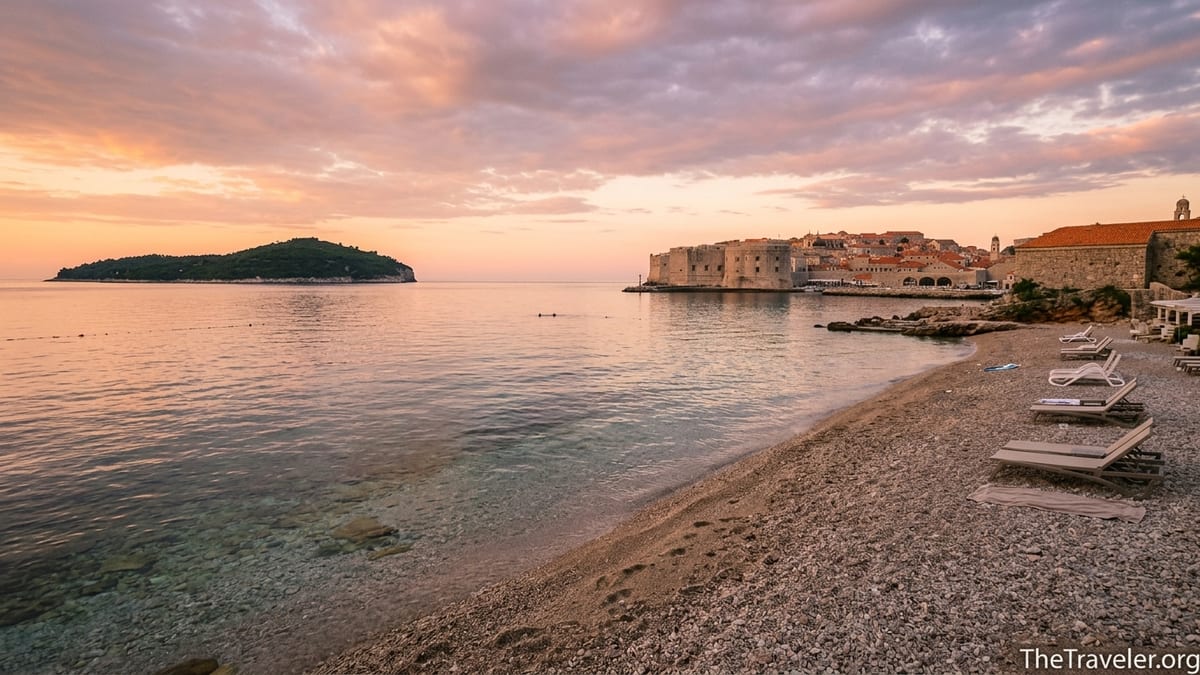
Banje is the beach almost every first-time visitor sees in photos: a curve of pale pebbles directly opposite the Old Town walls, looking straight at the harbor and Lokrum Island. From the Ploče Gate it is about a 5 to 10 minute downhill walk along the main coastal road. The access involves a flight of steps down from street level to the water, which is worth noting if you have mobility issues or a stroller.
The upper part of the beach is free, where you simply lay a towel on the pebbles. The lower, seafront section in front of the main venue functions as a beach club, with paid loungers, umbrellas and canopy daybeds. Recent price lists show single sunbeds around 30 euros for the day and umbrellas around 10 euros, with premium lounge beds well above that. This commercial section provides waiter service, restaurant food and cocktails, plus water-sports such as jet skis and boat tours.
Swimming at Banje is straightforward. The sea floor is pebbly, deepening fairly quickly, and the water is generally calm in summer. There is a roped-off swimming zone, but because of boat traffic nearby it is important to stay inside that area when the sea is busy. Water clarity is usually excellent, and on calmer days you can snorkel around the edges of the swimming zone and towards the small pier at one end.
On the downside, Banje is rarely quiet in peak season. On a July afternoon you can expect packed rows of loungers, a steady flow of cruise visitors and occasional loud music from the beach bar. If you want the iconic Old Town view with fewer people, aim for an early-morning swim before 9:00, or come outside high summer when the water is still pleasant but the crowds thin out. This is also one of the easiest spots for visitors staying in Ploče or the eastern part of the city to use as a default daily swim.
Sveti Jakov: Big Views, Fewer People
About a 20 to 30 minute coastal walk east from the Old Town, Sveti Jakov offers much of what visitors wish Dubrovnik had more of: space, views and a calmer atmosphere. The beach sits below the small church of St. James, looking back at the Old Town and Lokrum from a distance. The approach from town takes you along the main coastal road past a series of viewpoints, before you descend a long stairway from the church level to the sea.
Because of those steps, Sveti Jakov naturally filters out some of the crowds. Families with very small children, visitors with heavy luggage and those just off cruise ships tend to stay closer to Banje, so you often find a quieter scene here even on busy days. Travelers in 2025 and early 2026 often describe it as a place where they escaped Old Town congestion, sat in the shade of a rented umbrella and watched the city from afar looking surprisingly peaceful.
The beach itself is a sweep of pebbles with some coarser sand near the waterline. Depth increases more gradually than at some rocky coves, so it works better for cautious swimmers and older kids than sheer rock entries. There is usually at least one beach bar or simple restaurant behind the pebbles, offering drinks, light meals and lounger rentals. Prices are generally a bit lower than at Banje, although still very much in line with Dubrovnik’s broader cost level.
If you are staying in or near the Ploče district and do not have a car, Sveti Jakov is a practical “day at the beach” option: you can walk there in under half an hour, swim in clear water with a postcard view of the Old Town, rent a couple of loungers for part of the day, then climb the steps back up and either walk or take a local bus home. Do bring water shoes if you have sensitive feet and be realistic about the staircase; it is long enough that you will feel it on the way back up, especially in summer heat.
Lapad Bay & Copacabana: Best for Families and Longer Stays
The Lapad peninsula, northwest of the Old Town, is where Dubrovnik feels most like a small seaside resort. Uvala Lapad (Lapad Bay) and nearby Copacabana Beach on Babin Kuk are the main choices here. Reaching them without a car is straightforward: city bus line 6 runs frequently from the Pile Gate area, and the ride to Lapad typically takes around 15 minutes. Many apartment rentals and mid-range hotels are clustered in this area precisely because the beaches and promenade are so accessible.
Lapad Bay is framed by a pedestrian promenade lined with cafes and hotels. The main section, often called Sunset Beach, combines pebble and imported sand with a gently shelving entry. Marked swimming zones keep you separate from boat traffic, and in summer there may be a floating play park just offshore. Parents appreciate that you can sit at a cafe with a coffee while children play in the shallows, and that there is level stroller access directly to the beach, unlike steeper spots such as Sveti Jakov or Bellevue.
Copacabana, on the Babin Kuk side of the peninsula, is even more explicitly family-focused. It is a wide arc of pebbles with relatively shallow water near the shore, inflatable water features in high season, kayak and paddleboard rentals, and a full set of facilities. Recent guides describe it as Dubrovnik’s main family beach, with lifeguards in season, showers, accessible walkways and at least one sizable beach bar-restaurant complex. Lounger and umbrella rentals here are typically somewhat cheaper than at Banje, and you have more free space at the edges where you can lay your own towel.
For visitors planning a week in Dubrovnik without a car, basing yourself in Lapad or Babin Kuk can make daily swimming easy and less expensive. You can ride bus 6 into the Old Town for sightseeing in the morning, then retreat to the bay for afternoon swims and sunset walks. Food and drink along the Lapad promenade and behind Copacabana also tend to include more casual, family-friendly options such as pizza, ice cream and takeaway sandwiches, which helps keep daily costs manageable.
Bellevue, Danče & Swimming Near the Walls
Bellevue Beach sits in a steep cove immediately below Hotel Bellevue, roughly a 15 to 20 minute walk west of the Old Town. Access is via a long stairway and a path down from the main road. Once you reach sea level you find a small shingle and sand pocket surrounded by high cliffs, with exceptionally clear water. The cove feels almost enclosed, which creates a dramatic setting but also means waves can become powerful in storms, so the beach is best on calmer days.
This is a favorite with stronger swimmers and those who enjoy a wilder feel. When the sea is calm you can swim across the bay, explore the edges with a mask and snorkel, or, if conditions allow and you are experienced, watch locals jump from the lower rocks along the sides. There are usually a few ladders and basic facilities, but the emphasis here is more on swimming than on full-service lounging. Expect pebbles, not sand; water shoes help with entry.
Closer to the Old Town, Danče and Šulić (near the Pile Gate) are traditional local swimming spots carved into the rocky shoreline. They offer concrete platforms, ladders into deep water and small pebbly inlets. You will share space with Dubrovnik residents coming for quick swims before or after work, teenagers practicing jumps and visitors who have sought out something less polished than Banje. These places are ideal for confident swimmers who prefer jumping into deep water over wading into shallows.
Directly below the Old Town walls, the most iconic swimming and sunbathing spots are the rocky terraces around Buža and the Porporela breakwater by the harbor. Here you do not get a classic “beach” at all but tiered stone ledges cut into the cliffs, with ladders descending into very deep, clear water right under the fortifications. Small cliff bars serve cold drinks, and reviews in 2025 and 2026 consistently describe Buža as a superb place for a late-afternoon swim and sunset drink, albeit with high prices and very limited seating. Space is scarce, so arrive earlier in the day if you want a comfortable rock ledge for your towel.
Beach Clubs, Crowds and How to Find Space
Beach clubs are an important part of Dubrovnik’s coastal scene, especially around Banje, parts of Lapad Bay and Copacabana. They provide loungers, umbrellas, daybeds, food and drinks, and often a curated soundtrack. For some travelers this is exactly the point: you pay for comfort, service and a lively atmosphere. Others find the dense rows of rentals and higher prices overwhelming and would rather lay a simple towel on a quieter patch of shore.
The most commercialized feel is at Banje, where a significant portion of the beach can be reserved by the attached restaurant and lounge. If you want to secure a sunbed there in high summer, it is common to arrive before late morning or even pre-book double loungers. At Lapad and Copacabana, the atmosphere is slightly more relaxed; there are still organized lines of loungers but usually larger free sections at the ends where you can sit without paying, especially outside the peak midday window.
Crowds fluctuate throughout the day. On a typical July day, Banje and the swimming spots by the Old Town walls become busy from about 10:00 and stay that way until late afternoon, especially when large cruise ships are in port. In contrast, local-favorite spots like Danče, Šulić and parts of Lapad often feel calmer in the late evening, when residents come for a quick dip and visitors disperse for dinner. If you want to experience these places at their most atmospheric, consider a pre-breakfast swim or a sunset visit rather than the noon rush.
To increase your chances of finding space without a car, think in terms of timing and micro-locations. Even on very crowded days, you can usually find room on the outer edges of Copacabana, the less obvious terraces near Porporela, or the further reaches of Lapad’s promenade. Packing a lightweight beach mat, a small umbrella or sun hat, and water shoes allows you to comfortably use these more improvised spots rather than relying entirely on paid loungers.
Best Beaches in Dubrovnik Without a Car
One of Dubrovnik’s strengths is that most notable beaches and swimming areas are reachable by foot or bus. If you are basing yourself in the Old Town, you can treat Banje, the Buža and Porporela rocks, Danče, Šulić and even Bellevue and Sveti Jakov as part of your walkable neighborhood, provided you are comfortable with stairs. For many travelers, a realistic routine is to explore the Old Town in the cooler early hours, then spend the hottest part of the day swimming at one of these spots.
For a car-free stay that emphasizes swimming but avoids the worst of peak-season crowds, a popular strategy in recent years has been to sleep in Lapad or Babin Kuk, near Uvala Lapad or Copacabana. Here you have multiple beaches, playgrounds and shaded promenades within a short walk, plus frequent bus connections to the Old Town. Families in particular appreciate being able to do a half-day of sightseeing with the Dubrovnik Pass and then retreat to a less intense area for playtime and dinner.
If your priority is atmosphere and views rather than facilities, aim for Sveti Jakov and the rocky platforms near the city walls. At Sveti Jakov you get a classic postcard panorama of the Old Town and Lokrum while swimming from a proper beach. At Buža or Porporela you are effectively swimming in the moat of a medieval city, surrounded by stone fortifications and passing kayaks. Both experiences are uniquely Dubrovnik and do not require a car, only a willingness to walk and climb some steps.
Travelers who enjoy a more active style of swimming can stitch together routes between several spots. Confident open-water swimmers sometimes use Bellevue, Danče and Šulić as starting or ending points for longer sea swims along the rocky shore, always being cautious about boat lanes and changing conditions. Others combine walking and swimming, following the Lapad promenade and dropping into the water at small coves and hotel platforms whenever the sea looks inviting.
Practical Tips for Swimming in Dubrovnik
Water quality along the Dubrovnik coast is generally very good, with clear, clean sea in normal conditions. Even so, it is worth paying attention to local notices: lifeguards at major beaches, hotel reception staff and tourist information centers can advise you if there has been a temporary issue after storms or heavy rain. In summer the sea typically warms enough for comfortable swimming from June through September, with May and October swimable for many but cooler.
Because most beaches are pebbly or rocky, practical footwear makes a big difference. Simple water shoes or sturdy sandals protect your feet on hot stone terraces, sea urchins on rock shelves and the steep pebble banks at the shoreline. A small dry bag is useful at platforms like Buža, Danče and Porporela, where flat space is limited and splashes are likely. Sun protection is crucial: there is often little natural shade, so a hat, high-SPF sunscreen and perhaps a compact umbrella will make longer stays more comfortable.
Public facilities such as showers and toilets exist at the main organized beaches, especially Lapad Bay, Copacabana and Banje, but are minimal or absent at many rocky swimming spots. Plan to use facilities in nearby cafes or hotels where appropriate, and carry drinking water. At Buža and similar cliff bars, note that prices are higher than on city streets; a bottle of beer or cider can easily cost several euros more than in a supermarket or inland cafe.
Finally, treat the sea with respect. Many entry points in Dubrovnik are into deep water from rocks or ladders, with little intermediate depth. Only jump from heights you are fully comfortable with, watch where locals land, and avoid cliff jumping entirely in rough seas or after drinking. If you are swimming near the walls or outside marked zones, stay aware of kayaks, excursion boats and changing currents. With a bit of caution and preparation, Dubrovnik rewards swimmers with some of the most memorable urban sea swims in Europe.
FAQ
Q1: Which Dubrovnik beach is best if I am staying in the Old Town without a car?
Banje is the closest classic beach, but many visitors prefer the rocky swimming spots at Buža and Porporela or the quieter Sveti Jakov if they are willing to walk and handle steps.
Q2: Are there any sandy beaches in Dubrovnik?
Most beaches are pebbly or rocky. Lapad Bay and parts of Copacabana have areas of imported or coarse sand, which feel softer underfoot but are not long natural sand strands.
Q3: Is Dubrovnik suitable for families with small children who want easy beach days?
Yes. Lapad Bay and Copacabana on the Lapad peninsula are especially family-friendly, with gently shelving water, promenades, playgrounds and cafes a short walk from many apartments and hotels.
Q4: How expensive are sunbeds and umbrellas at Dubrovnik beaches?
Prices vary, but at central beaches such as Banje recent seasons have seen single loungers around 25 to 30 euros and umbrellas around 10 euros, with somewhat lower prices on Lapad and Babin Kuk.
Q5: Can I use Dubrovnik’s beaches for free if I do not want to pay for a lounger?
Yes. All the main beaches have free areas where you can lay a towel, though you may need to walk to the edges of organized sections or use rocky platforms instead of wide open strands.
Q6: How do I reach Lapad and Copacabana beaches without a car?
Frequent city buses, especially line 6 from the Pile Gate area, connect the Old Town with Lapad and Babin Kuk. The ride typically takes 15 to 20 minutes, and from the final stops it is a short walk to the water.
Q7: Is swimming near the Old Town walls safe?
Swimming at Buža, Porporela and nearby platforms is popular and generally safe when the sea is calm, but the water is deep and you must use ladders or low jumps for entry, so it suits confident swimmers best.
Q8: When is the best time of day to avoid crowds at Dubrovnik beaches?
Early mornings and late evenings are usually the quietest. Midday and early afternoon, especially on days with cruise ship calls, are the most crowded times at Banje and near the Old Town.
Q9: Do I need water shoes for Dubrovnik beaches?
They are not essential but highly recommended, as most entries are pebbly or rocky and some areas have sea urchins. Water shoes make walking and wading much more comfortable.
Q10: Are there lifeguards at Dubrovnik beaches?
Major organized beaches such as Banje, Lapad Bay and Copacabana typically have lifeguards on duty during the main summer season, but smaller rocky coves and platforms usually do not, so you swim there at your own risk.