


More news on this day
Rail passengers across central England are being urged to reconsider journeys after a fatal collision involving two East Midlands Railway services near Bedford triggered major disruption on one of the country’s key north–south routes.
Get the latest news straight to your inbox!
Fatal collision on busy London corridor
Reports from the Bedford area indicate that two southbound East Midlands Railway passenger services, both bound for London St Pancras, were involved in a serious collision late on Friday afternoon. Early information from published coverage suggests that one of the train drivers was killed and dozens of passengers sustained injuries of varying severity.
The crash is understood to have occurred on the Midland Main Line just south of Bedford, a critical stretch of track that links the East Midlands and parts of northern England with the capital. Images shared in UK and international media show at least one high-speed EMR train partially derailed and significant damage to the leading carriages.
Initial accounts from passengers and rail commentators online describe a sudden impact and a violent jolt that threw people from their seats. Emergency services were reported to have declared a major incident, with a large-scale response involving paramedics and fire crews to treat casualties at the scene and to support an evacuation of both trains.
While full details have not yet been confirmed by investigators, coverage from several outlets indicates that one London-bound service from Corby struck the rear of an earlier Nottingham to St Pancras train that had either slowed or stopped on the line. The circumstances that led to the second train approaching at speed are expected to form a central part of the formal investigation.
Wide-reaching travel warning and service disruption
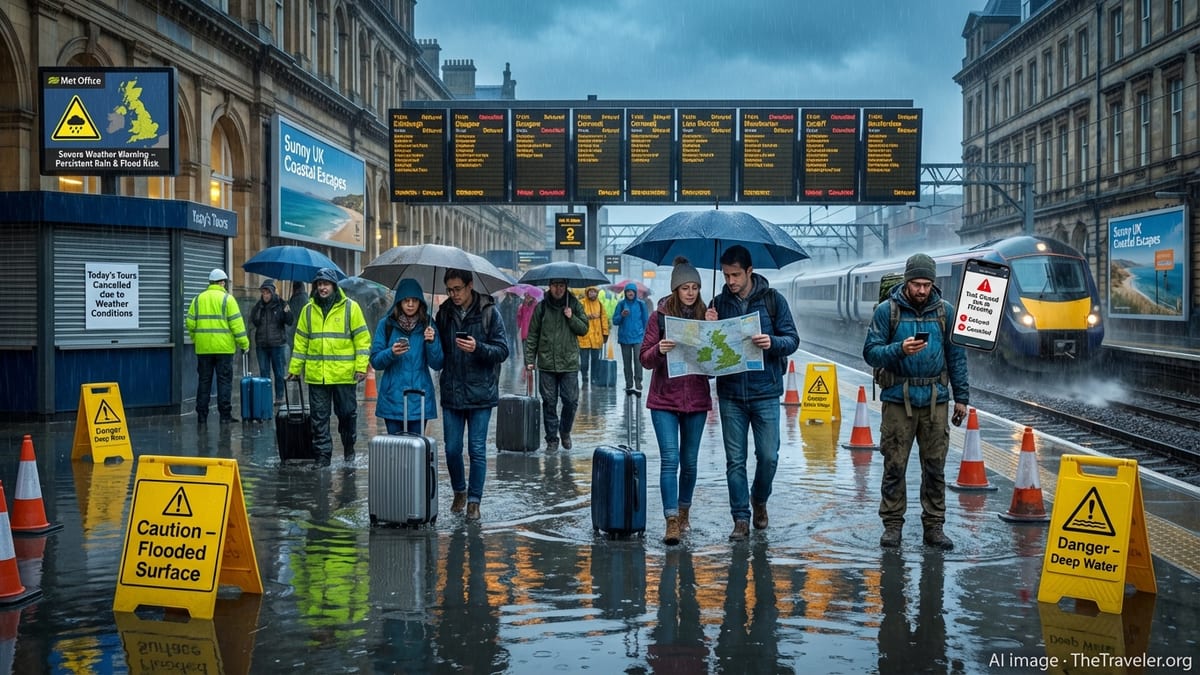
In the hours following the collision, National Rail and train operator updates signalled severe disruption across the Midland Main Line, with East Midlands Railway and Thameslink services both heavily affected. Publicly available information on travel alerts shows that trains between London St Pancras, Bedford, Leicester, Nottingham and Sheffield are subject to cancellations, delays and diversions.
East Midlands Railway has issued a strong warning for passengers to check their journey before setting out and, where possible, to avoid non-essential travel on the affected corridor. Journey planners and departure boards show knock-on delays extending into the evening, as lines remain blocked or partially closed around the crash site to allow emergency and recovery operations to continue.
Passengers already en route have reported being held on trains north of Bedford for extended periods or being diverted via alternative routes, leading to significantly longer travel times. Replacement road transport is expected to be limited during the initial response, and crowding has been reported at key interchange stations as travellers attempt to re-plan journeys at short notice.
For travellers heading to or from London, the disruption is likely to have a ripple effect on connecting services, including local and regional routes that feed into major hubs in the East Midlands. Travellers are being advised via public channels to allow additional time, to be prepared for last-minute platform changes and to consider postponing trips if they are not time critical.
What passengers on the route need to know
For those planning to use East Midlands Railway or Thameslink services over the coming hours, journey planning websites and station information screens indicate that the most heavily affected section lies between Bedford and London St Pancras. Trains that are running may be diverted, operate on reduced frequency or terminate short of their usual destination.
Some long-distance EMR services from cities such as Nottingham and Sheffield may start or finish at alternative stations, or run only as far as the East Midlands before passengers are asked to transfer to other operators. In addition, timetable alterations can change at short notice while recovery trains access the site and while safety checks are carried out along the route.
Travellers holding advance or off-peak tickets are being encouraged, via publicly available guidance from the operator and industry sites, to travel on later services where permitted or to defer journeys to another day. Rail users who must travel are advised to carry water, snacks and essential medications in case of extended delays on board.
International visitors arriving via London and connecting to the East Midlands by rail may be particularly affected, as the crash occurred on a key artery often used to reach regional cities. Tourism businesses in destinations along the line can expect late arrivals and last-minute cancellations while the network stabilises.
Investigation and safety focus after first reports
Rail safety specialists are expected to examine a range of factors, including signalling data, train speed, braking performance and communication between control centres and train crews in the minutes before the collision. Reports in UK media and specialist forums have already highlighted suggestions that an onboard safety system alert may have contributed to one of the trains coming to a stand on the line, but this has not been formally confirmed.
The Rail Accident Investigation Branch customarily conducts independent inquiries into serious rail incidents in Britain. Past reports from the organisation on previous collisions have led to changes in signalling design, driver training and the configuration of onboard protection systems, and a similar level of scrutiny is anticipated in this case.
The incident near Bedford comes at a time when the rail industry frequently highlights the relative rarity of serious train-to-train collisions in the United Kingdom, following substantial investment in modern signalling and automatic protection over recent decades. The fatality and high number of reported injuries are likely to renew public attention on how these systems perform under real-world conditions and how quickly any emerging risks can be addressed.
Travel industry observers note that while rail remains one of the safest ways to move large numbers of people, major incidents such as this have a powerful impact on passenger confidence, particularly among occasional leisure travellers and families planning summer trips.
Impact on regional mobility and summer travel plans
The Midland Main Line is a vital corridor for commuters, students and leisure travellers linking London with communities across Bedfordshire, Northamptonshire, Leicestershire, Nottinghamshire and South Yorkshire. Even a short period of disruption can affect work commutes, hospital appointments, events and family visits along the route.
With summer holidays approaching, the collision has arrived at a sensitive time for tourism across the East Midlands, where historic cities, national attractions and countryside destinations rely on reliable train connections from the capital. Local businesses, including hotels and visitor attractions, may see immediate cancellations or delays as travellers reassess plans in light of uncertainty on the rail network.
Transport watchers suggest that once the immediate disruption passes, attention will likely turn to how quickly services can return to a robust timetable and what temporary measures might be needed to manage capacity. Past experience from other major incidents indicates that interim speed restrictions and infrastructure checks can lead to days of residual delays, even after lines have technically reopened.
For now, anyone planning to use East Midlands Railway or connecting operators is being urged, through public service announcements and travel updates, to stay alert to changes throughout the day, to verify their journey repeatedly before departure and to be prepared for significant alterations to normal travel patterns across the region.