


Just 18 miles east of Rome, on a ridge above the town of Tivoli, the ruins of Hadrian’s Villa stretch across a landscape of cypresses and silvery olive trees. To many modern visitors it looks like a scattered collection of crumbling walls and pools. Yet in the early second century this was one of the most ambitious architectural experiments in the Roman world: a private retreat where Emperor Hadrian reimagined the empire in miniature, blending Greek, Egyptian, and Roman ideas into a single, walkable vision. Understanding the story behind this vast complex turns a half-day trip from Rome into a journey inside the mind of one of antiquity’s most fascinating rulers.
Get the latest updates straight to your inbox!
From Hilltop Retreat to Ideal City
Hadrian’s Villa, or Villa Adriana, began taking shape around 118 AD, shortly after Hadrian became emperor in 117. He chose a site near ancient Tibur, today’s Tivoli, where cool breezes tempered the summer heat and abundant springs fed pools, fountains, and baths. Over the next two decades the complex swelled to more than 120 hectares, roughly the size of a small town, with palaces, libraries, barracks, theaters, and formal gardens spread across the rolling terrain.
Ancient sources suggest Hadrian was deeply involved in the design, and the site still feels more like a thought experiment than a conventional country estate. UNESCO describes the villa as an “ideal city,” a place where the emperor could step away from Rome’s politics and stage his own version of the empire in stone and water. Walking the site today, you do not move through a rigid palace floor plan so much as drift along axes of views: a colonnade here suddenly opens onto a long reflecting pool; a slope of grass drops to the remains of a theater-like space; arches frame distant mountains beyond Tivoli.
For travelers, that scale is part of the experience. Many visitors arrive on a regional train from Rome to Tivoli, then transfer to a local bus or taxi up to the entrance. Once inside, there are few shaded walkways, so the sheer expanse is felt in every step. In high summer, guides often recommend starting early in the morning, giving yourself at least three hours to connect the scattered monuments into a coherent story.
Excavations over the last few centuries, and especially modern surveys, have shown that the villa did not spring from bare ground. Archaeologists have identified an earlier Republican-era villa buried beneath parts of the imperial complex, evidence that Hadrian built on a site already favored by Rome’s elite. Recent discoveries beneath the so-called Palazzo area have revealed older walls and floors, giving a sense of how the emperor layered his vision onto existing structures rather than wiping the slate clean.
Hadrian the Traveler and Architect
To understand why Hadrian’s Villa looks the way it does, it helps to know the man behind it. Born in 76 AD, Hadrian rose from a provincial family in Hispania to become emperor and ruled from 117 to 138. Unlike many predecessors, he spent much of his reign on the move, visiting provinces from Britain to Egypt. His long journeys left a deep mark on his taste. He was famously philhellene, enamored with Greek art, philosophy, and urban planning, and he invested heavily in restoring and embellishing Greek cities like Athens.
Hadrian was also an enthusiastic, even obsessive, builder. He oversaw monumental projects such as Hadrian’s Wall in northern Britain and the rebuilding of the Pantheon in Rome, with its vast concrete dome. At his villa near Tivoli, however, he stepped out of the constraints of public commissions and experimented more freely. Here he could try bold spatial compositions, curved colonnades, and theatrical water features that might have seemed eccentric in the rigid geometry of a Roman forum.
Travelers sometimes compare the villa to a physical travel diary. Many of the most famous areas are named after distant places Hadrian visited or admired, such as the Canopus, evoking an Egyptian canal, and the so-called Greek Theatre. While modern scholars debate how literally these names reflect the emperor’s intentions, the overall impression is clear: this was a landscape of memories, a place where Hadrian could revisit his journeys without leaving Italy.
When you stand on a terrace above the Canopus or walk the curve of the Maritime Theatre, it is easy to imagine the emperor pacing out distances with architects, tweaking alignments, and testing reflections in the water. Contemporary visitors get a hint of this creative process through on-site models and reconstructions in the small museum near the entrance, where fragments of column capitals, cornices, and statues are arranged to suggest the original richness of the decoration.
The Maritime Theatre: A Villa Within the Villa
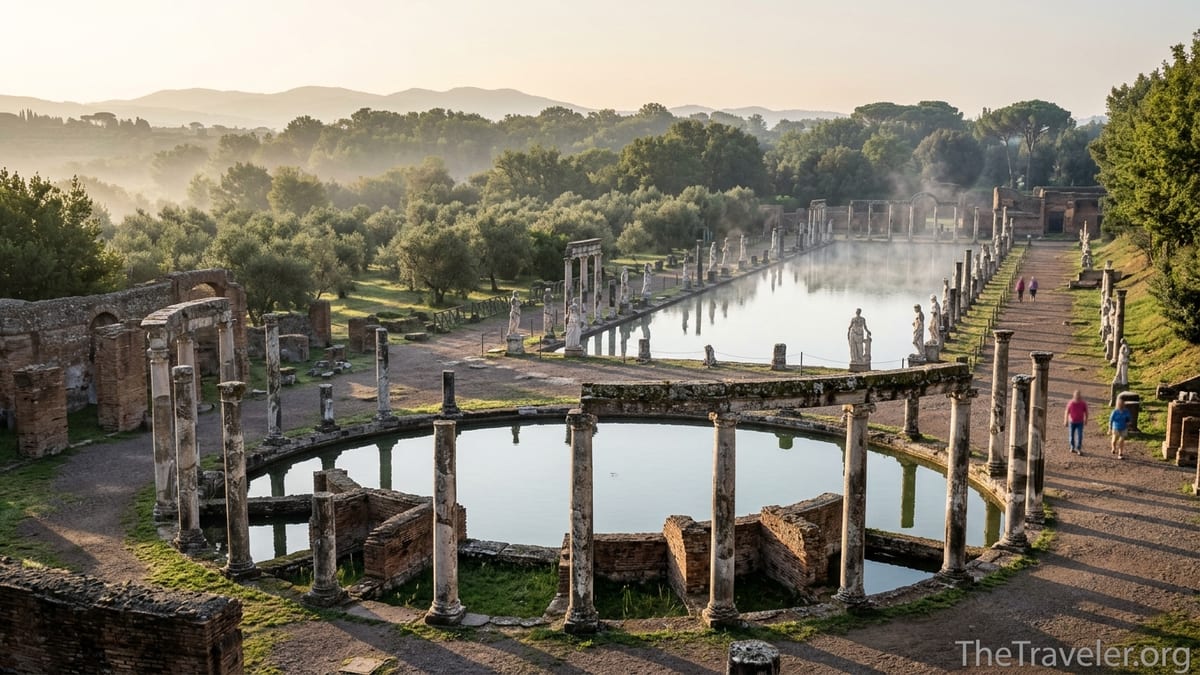
At the heart of Hadrian’s Villa sits one of its most intriguing structures, commonly called the Maritime Theatre. From above, it appears as a concentric composition: a circular moat-like pool encloses a ring of columns, which in turn surrounds a small island with the traces of a miniature house. Two narrow bridges once linked the island to the outer ring, and may have been removable, giving the emperor complete privacy when he desired it.
Despite the name, this was not a theater in the performance sense. The term likely arose in the Renaissance, when early scholars tried to make sense of the unusual form. Modern archaeologists interpret it as an intimate residential space, a sort of experimental retreat within the larger retreat. The island contained small rooms, perhaps a study, a bedroom, and service spaces, arranged around a tiny peristyle. Curved and straight lines alternate as you walk the outer ring, creating constantly shifting views of columns reflected in the water.
Visitors today encounter the Maritime Theatre early in a typical circuit. Paths lead up from the ticket office through pine trees before the circular pool suddenly appears. On summer mornings you may find small groups gathered with licensed guides pointing out the subtle footing of the bridge piers or the traces of painted plaster on the inner walls. Standing along the perimeter, the play of light on the water offers a rare sense of tranquility, even when tour groups are present elsewhere on the site.
The influence of this little island complex escaped Tivoli in antiquity. Archaeologists have noted echoes of the Maritime Theatre’s form in later Roman villas, including a second-century residence at Marathon in Greece traditionally linked to Herodes Atticus. For today’s traveler, though, the structure’s power lies closer to home: it makes palpable Hadrian’s desire to carve out an oasis of reflection even within his own massive sanctuary.
The Canopus and Antinous: Egypt Remembered
On the eastern side of the property stretches another of Hadrian’s signature creations, the Canopus. This long, narrow pool, approximately 120 meters by 18, is framed by columns and statues and terminates in a semicircular exedra carved into the hillside. Ancient writers knew Canopus as a canal and resort area near Alexandria in Egypt, infamous for its nighttime revelry. Hadrian visited Egypt during his travels, and the villa’s Canopus appears to be a deliberate nod to that landscape, filtered through Roman eyes.
Today, as you walk along the Canopus, you pass rows of sculpted figures: replicas of caryatids inspired by the Erechtheion in Athens, armored deities, Silenoi bearing baskets, and images that recall Egyptian cults. Many of the originals were removed in earlier centuries to museums in Rome and across Europe, so what you see on site are often casts or later copies. Yet the effect remains striking. The statues stand out against the water, and on calm days the reflections double the colonnade in the pool’s surface.
The Canopus also intersects with one of the most personal episodes of Hadrian’s life: his relationship with Antinous, the young Bithynian companion who drowned in the Nile in 130 AD. In the years after Antinous’s death, Hadrian scattered his image and Egyptian-style monuments across the empire. At the villa, excavations have uncovered statues of Antinous in pharaonic pose and objects associated with Egyptian cult, suggesting that parts of the complex, including the Canopus area, became a stage for mourning and commemoration.
For visitors, this blend of memory, religion, and spectacle gives the Canopus a particularly poignant atmosphere. Local guides sometimes pause at the curved northern end, where the ruins of banqueting spaces stand, and invite travelers to imagine night-time feasts with torches reflecting in the water, music echoing under the arcades, and perhaps the emperor himself looking toward a symbolic Nile as he remembered his lost companion.
Libraries, Palaces, and Daily Life at the Villa
Beyond the headline monuments, Hadrian’s Villa functioned as a working residence and administrative hub. The complex included multiple palatial suites, baths, service quarters, and what contemporary scholars identify as libraries. In the central zone, archaeologists refer to twin structures as the Latin and Greek Libraries, reflecting Hadrian’s passion for literature and philosophy in both languages. Even in ruin, the arrangement of semicircular niches and wall recesses suggests where book scrolls and statues of authors once stood.
In this same core, you find the so-called Imperial Palace and Winter Palace, a cluster of rooms, halls, and courtyards that likely housed the emperor and his closest circle during the cooler months. Hypocaust systems, visible under some floors where archaeologists have left segments open, hint at how warm air once circulated, making marble-clad spaces habitable in winter. For modern travelers, seeing the brick infrastructure beneath the vanished flooring offers a reminder that this seemingly serene retreat was supported by substantial engineering and labor.
Hadrian did not inhabit the villa alone. A large staff of slaves, freedmen, guards, cooks, gardeners, and clerks lived and worked here. Barracks-like buildings on the outskirts housed soldiers of the imperial guard, while service courts stored supplies arriving from Rome and the surrounding countryside. When travel groups walk along the broad processional ways between the central palaces and the baths, they are tracing routes once used by courtiers and messengers bringing news from the capital.
Today, small details resurrect that daily life. In the bath complexes, you may notice fragments of mosaics under protective covers, or the sharp change in temperature when you step into a partially intact vaulted hall that still traps cool air. Signage in Italian and English, along with occasional QR codes, helps visitors distinguish between luxuriously appointed spaces and utilitarian corridors. The contrast between the emperor’s experimental architecture and the straightforward pragmatism of service areas is part of the site’s enduring fascination.
From Ruined Quarry to Protected World Heritage
Hadrian’s Villa did not remain a living residence for long after the emperor’s death in 138. Later rulers preferred other suburban palaces closer to Rome, and over the centuries the complex declined. By the Middle Ages, the ruins had become a convenient quarry. Builders in Tivoli and even Rome carted away columns, marble veneers, and statuary to adorn churches, villas, and fountains. Many masterpieces that originated here now stand in major collections, from the Vatican Museums to national museums in Italy and beyond.
The villa’s romantic potential, however, never entirely vanished. Renaissance antiquarians and artists visited the ruins, sketching collapsed arches and half-buried statues among vines and olive trees. Seventeenth and eighteenth century travelers on the Grand Tour, including British and French aristocrats, came to Tivoli specifically to see the picturesque rubble, often pairing it with a visit to the later Renaissance marvel of Villa d’Este nearby. Their engravings and travel diaries helped spread the image of Villa Adriana as a place where nature and antiquity intertwined.
Modern archaeological work began in earnest in the nineteenth and twentieth centuries, as Italian authorities and international scholars surveyed, excavated, and partially restored key areas. In 1999, UNESCO declared Villa Adriana a World Heritage Site, recognizing it as an exceptional example of Roman imperial architecture and a unique synthesis of cultural influences. More recently, the site has also gained enhanced protection status under international conventions, intended to shield it in times of conflict or crisis.
For contemporary visitors, this history of loss and rescue shapes the experience on the ground. You will see partially reconstructed walls stabilized with unobtrusive brickwork, fenced-off areas where ongoing digs are active, and interpretive panels explaining how archaeologists piece together building phases. Conservation staff strictly regulate new construction around the archaeological zone, and the Italian culture ministry encourages visitors to stay on signed paths to help protect fragile remains, especially in areas where unexcavated layers lie just below the surface.
Experiencing Hadrian’s Vision Today
Most travelers encounter Hadrian’s Villa as a half-day or full-day excursion from Rome. A typical visit in 2026 starts with purchasing a timed-entry ticket either online or at the gate in Tivoli, with combined tickets often available that include neighboring Villa d’Este. Entry prices can vary for EU and non-EU citizens and by age, so it is worth checking current details before you go, but foreign adult visitors should expect a moderate fee comparable to other major Italian archaeological sites.
On arrival, you pass through a modern visitor center with restrooms, a small bookshop, and sometimes a café kiosk offering espresso and bottled water. Outside, the archaeological area quickly opens up, and the lack of heavy shade makes practical preparation essential. Regulars recommend wearing sturdy, closed-toe shoes suitable for uneven paths, carrying at least one liter of water per person in summer, and bringing a hat and sunscreen. Guided tours in English, Italian, and other languages can be booked through licensed operators in Rome or Tivoli, or you can rent an audio guide at the entrance.
As you move through the site, certain vantage points communicate Hadrian’s overarching vision more clearly than any plaque. Standing by the Maritime Theatre, you feel his desire for isolation and experimentation. Walking the length of the Canopus, you sense his fascination with distant provinces and foreign cults. Climbing up toward the so-called Piazza d’Oro, with its grand courtyard and reflecting basin, you glimpse his taste for spectacle and geometry. The villa’s scattered layout, which can initially feel confusing, begins to read as a deliberate choreography of experiences.
Travelers who want to deepen that understanding often pair their visit with time in Rome’s museums, where many original pieces from Villa Adriana are displayed in climate-controlled galleries. Seeing a caryatid or a statue of Antinous in polished marble, then recognizing its cast or empty niche back at Tivoli, helps connect the fragments of Hadrian’s world. Several recent public exhibitions in Italy and northern Europe have also highlighted artifacts from the villa, underlining its continuing importance to scholars and the public alike.
The Takeaway
Hadrian’s Villa is more than a pleasant ruin outside Rome. It is one of the clearest surviving expressions of an emperor’s inner landscape, translated into architecture and water. By scattering references to Greece, Egypt, and the broader Mediterranean across a single hillside, Hadrian transformed personal memory and imperial ideology into a three-dimensional map, one that travelers can still walk today.
Visiting the site with this story in mind changes the experience. Instead of isolated monuments, you encounter a network of spaces that speak to themes of power, retreat, cultural curiosity, and grief. The Maritime Theatre becomes a refuge within a refuge. The Canopus transforms into a symbolic Nile and a memorial. The libraries and palaces read as a working brain of the empire, not just a country house.
For modern travelers willing to linger, read the on-site explanations, and perhaps invest in a knowledgeable guide, Hadrian’s Villa offers a rare chance to step into the mind of a ruler who cared deeply about architecture as a language. In the shifting light over the pools and broken columns of Tivoli, the outlines of that vision are still legible, inviting each visitor to trace their own route through an ancient, carefully designed dream.
FAQ
Q1. Where is Hadrian’s Villa and how far is it from central Rome?
Hadrian’s Villa, or Villa Adriana, sits near Tivoli in the Lazio region, roughly 18 miles east of central Rome, reachable by train and local bus or taxi.
Q2. Why did Emperor Hadrian build such a large villa outside Rome?
Hadrian wanted a cooler, quieter retreat from the capital where he could experiment with architecture and recreate places from his travels across the Roman Empire.
Q3. How much time should I plan for a visit to Hadrian’s Villa?
You should allow at least three hours on site, and many travelers prefer half a day to explore key areas like the Maritime Theatre and the Canopus at a relaxed pace.
Q4. What are the must-see areas inside Hadrian’s Villa?
Most visitors prioritize the Maritime Theatre, the Canopus, the central palatial zone with its baths and libraries, and the grand courtyard often called the Piazza d’Oro.
Q5. Is Hadrian’s Villa suitable for children or travelers with limited mobility?
The site is large with uneven paths and slopes, which can be tiring. Some main routes are manageable with care, but those with mobility issues should plan breaks and check accessible paths in advance.
Q6. Can I visit Hadrian’s Villa and Villa d’Este on the same day?
Yes, many travelers combine both Tivoli sites in one day, visiting Hadrian’s Villa in the cooler morning hours and Villa d’Este’s fountains and gardens later in the afternoon.
Q7. Are guided tours worth it, or can I visit on my own?
You can walk the site independently, but a licensed guide or a well-made audio guide helps make sense of the scattered ruins and explains how each area fits into Hadrian’s overall vision.
Q8. When is the best time of year and day to visit?
Spring and autumn offer milder temperatures and softer light. In summer, starting early in the morning or late in the afternoon helps you avoid the strongest heat and crowds.
Q9. Are there facilities like food, water, and restrooms on site?
There are restrooms and usually a small café or snack point near the entrance, but options inside the archaeological area are limited, so bring water and light snacks.
Q10. Do I need to buy tickets in advance for Hadrian’s Villa?
It is often possible to buy tickets on arrival, but in busy periods and for combined tickets with other Tivoli sites, reserving in advance can save time and reduce stress.