


More news on this day
A train driver has died and dozens of passengers have been injured after two London-bound trains collided near Bedford in central England, prompting major disruption on a key north–south rail corridor and renewed questions over rail safety on one of the country’s busiest routes.
Get the latest news straight to your inbox!
Collision on busy London corridor
Initial reports from national and local outlets indicate that the crash occurred on the evening of Friday 19 June 2026 on the Midland Main Line, just south of Bedford, a critical stretch linking northern and eastern England with London St Pancras International. Two southbound passenger services were involved as they headed toward the capital during the evening peak.
According to published coverage drawing on rail tracking data, the trains were operated by East Midlands Railway and were running from Corby and Nottingham to London. One train is understood to have struck the rear of another at relatively low speed compared with high-speed main line operations, yet the impact was still powerful enough to cause extensive interior damage and serious injuries.
Images shared by passengers and reproduced in news reports show carriages remaining broadly upright on the tracks, but with visible distortion at the point of impact and smashed windows. Inside, travellers described scenes of confusion as people were thrown from seats and luggage fell from overhead racks.
Rail commentators note that main line collisions in the United Kingdom are rare, with modern signalling and automatic protection systems designed to prevent trains occupying the same section of track. The circumstances that allowed two passenger services to collide on one of the most intensively monitored routes are now expected to be a central focus of investigators.
Casualties and emergency response
Publicly available information from regional police and ambulance service statements, as relayed in national media, confirms that the driver of one of the trains was killed in the collision. The individual was at the front of the rear train at the time of impact, in the part of the formation that appears to have borne the brunt of the crash forces.
Reports also indicate that a significant number of passengers sustained injuries, with figures suggesting dozens hurt and a substantial subset classified as serious. Many of the wounded were treated at the scene before being taken to hospitals across the wider Bedfordshire and Hertfordshire area, placing temporary strain on local emergency departments.
Multiple ambulance crews, an air ambulance, fire and rescue teams and specialist hazardous incident units were deployed to the site along the four-track main line. Access was complicated by the railway’s position in a corridor of embankments and cutting, meaning responders had to work along the trackside to reach the most heavily damaged carriages.
Passenger accounts collected by broadcasters describe rapid on-board first aid from fellow travellers, some of whom used clothing as makeshift bandages while waiting for paramedics to arrive. Others reported that rail staff moved quickly to guide people through the train and assist those with mobility issues in evacuating to track level.
Disruption for rail passengers and operators
The collision occurred on one of the principal rail arteries feeding London from the Midlands and northern England, and the impact on services was immediate. Information supplied by Network Rail and train operators and carried in travel bulletins shows that all lines through the area were initially closed while emergency work and safety assessments were under way.
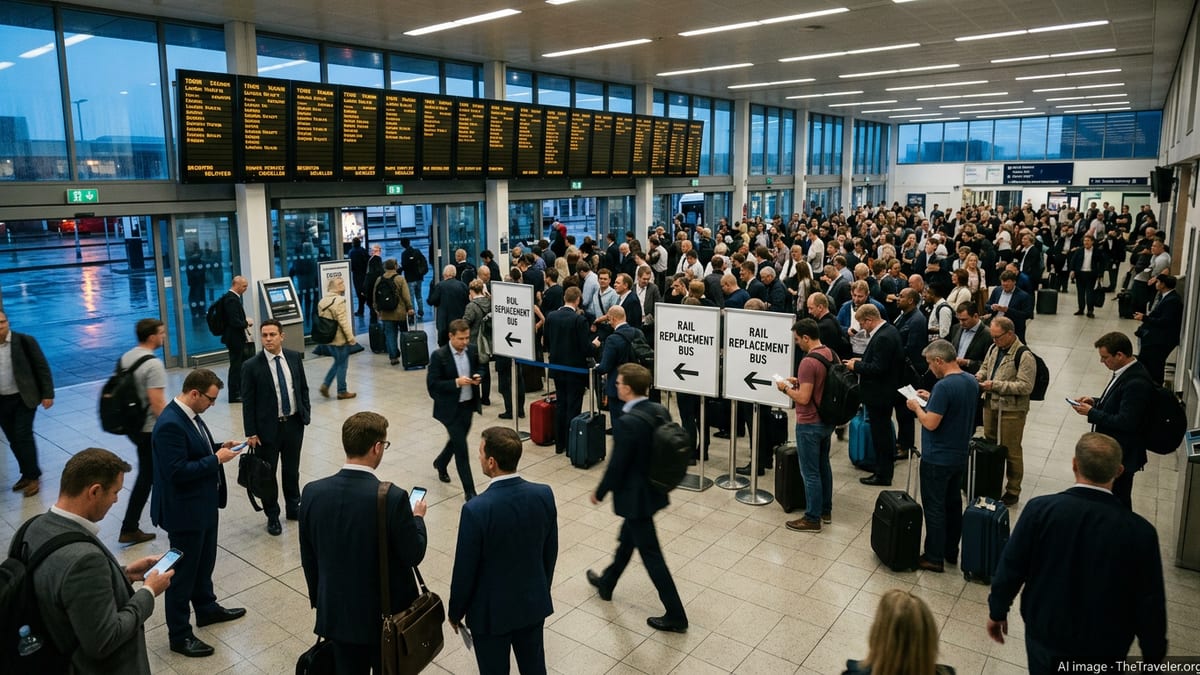
Services operated by East Midlands Railway and Thameslink were among the most heavily affected, with long-distance trains terminating short of London and suburban services suspended or diverted via alternative routes. Passengers attempting to reach the capital on Friday evening and into Saturday morning faced cancellations, severe delays and crowded replacement road transport.
Travel reports circulated overnight advised that disruption could continue into the weekend while damaged rolling stock was removed, track and signalling equipment inspected, and investigators completed initial site work. Travellers heading between London, Bedford, Luton and destinations further north were urged to check live updates and consider alternative routes where available.
The incident also created knock-on effects at London St Pancras International, where platform capacity is shared between domestic and international services. With several inbound trains unable to reach the station, operators reworked timetables and reassigned rolling stock to protect early-morning services on other parts of the network.
Investigation and safety questions
Under established UK procedure, the Rail Accident Investigation Branch is expected to carry out a detailed inquiry into the circumstances of the Bedford crash. While no official findings have yet been released, transport analysts note that the collision bears hallmarks of recent investigations in Britain and elsewhere in Europe that have highlighted the complex interplay between signalling design, adhesion conditions and human factors.
Earlier in the week, a Rail Accident Investigation Branch report into a 2024 head-on collision in mid Wales drew attention to the role of low wheel-rail adhesion and the failure of sanding systems designed to improve braking performance in poor conditions. Commentators are already drawing comparisons, while emphasising that it is too early to link that case directly to events near Bedford.
Technical specialists following the initial coverage suggest that investigators will scrutinise signalling data, train protection systems and any recorded communications between signallers and drivers. Detailed examination of the braking performance and the condition of the rails at the time of the incident is also anticipated, particularly given reports that both trains were travelling in the same direction.
UK main line rail has recorded relatively few serious collisions in recent decades, and industry figures often highlight the country’s strong safety record compared with road transport. The death of a driver and the high number of injuries near Bedford are therefore likely to intensify existing debates about how to further reduce residual risks, particularly on intensively used corridors approaching major cities.
Implications for travelers and the wider rail network
For rail passengers, the Bedford collision serves as a stark reminder that, while incidents remain rare, disruption can be sudden and wide-ranging. Travellers planning journeys along the Midland Main Line over the coming days are being advised through operator channels to monitor service updates closely, allow additional time, and be prepared for route changes or short-notice cancellations.
The incident also arrives at a time of heightened public attention on rail safety, following a series of high-profile crashes in Spain and Indonesia earlier in 2026 in which drivers were among those killed. Together, these events are prompting international comparisons of signalling systems, driver training and the pace of investment in modern train protection technologies.
In the UK, passenger groups are likely to press for clear communication on the progress of the Bedford investigation and any interim safety measures put in place on similar sections of track. Rail unions, meanwhile, have been campaigning on matters such as staffing levels, fatigue management and the design of driving cabs, all of which may feed into public discussion once more detailed information about the crash emerges.
While the full picture of what happened south of Bedford on 19 June 2026 will only become clear over time, the collision has already had a profound human impact for the driver’s family, the injured passengers and the communities that rely on this key route. For travelers and industry alike, the focus now turns to understanding the causes and restoring confidence on one of Britain’s most important rail lifelines.