


More news on this day
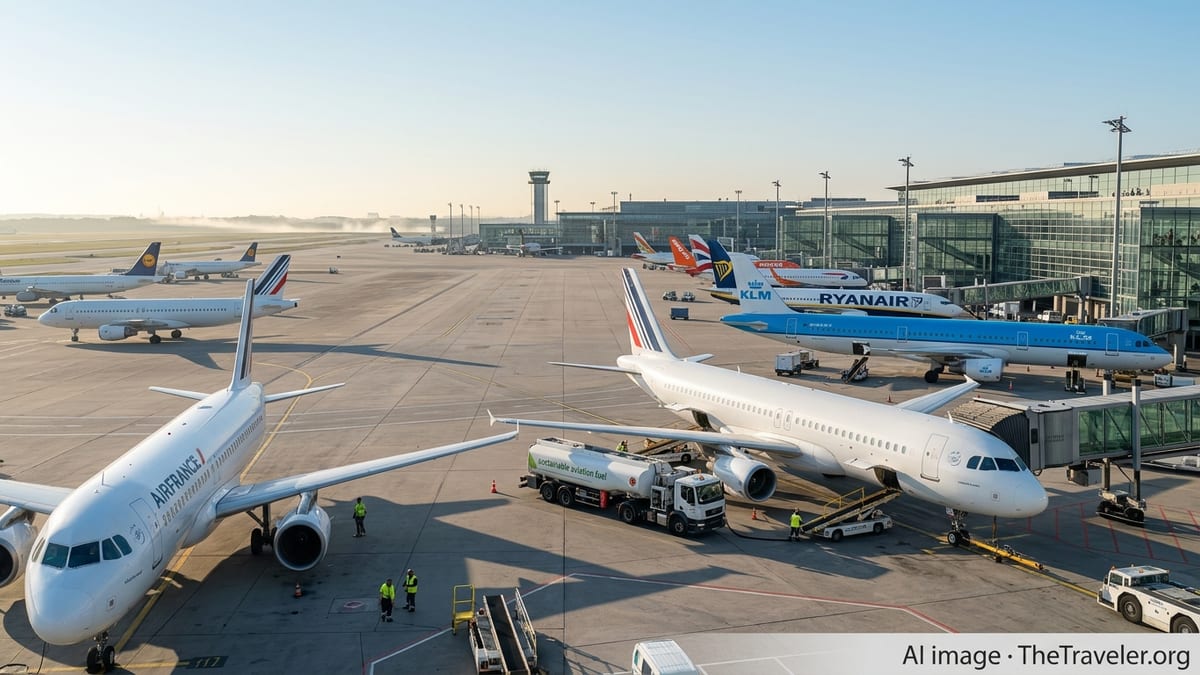
Airlines are racing to market greener flights as passengers demand climate conscious options, yet sustainable aviation fuel still represents a fraction of global jet consumption, exposing a widening gap between expectations and the fuel reality.
Get the latest news straight to your inbox!
Surging Climate Awareness Meets Sparse Green Fuel
Surveys released in 2024 and 2025 by aviation industry bodies and major travel platforms indicate that a growing share of passengers say environmental impact now influences their booking decisions. Many travelers report a willingness to pay extra for lower carbon flights or to choose airlines that advertise sustainability commitments. This shift is helping to turn what was once a niche concern into a mainstream marketing focus for carriers.
At the same time, publicly available data shows that sustainable aviation fuel, or SAF, remains a tiny slice of the global fuel mix. Analysis from international aviation organizations suggests SAF accounted for roughly 0.5 to 0.6 percent of airline fuel use in 2024 and 2025, even after several years of rapid growth in output. Projections cited by industry groups suggest global production could reach about 2 million to 2.4 million tonnes around 2025 to 2026, still under 1 percent of estimated jet fuel demand.
This disconnect is becoming more visible to travelers. Many carriers now allow passengers to pay to “green” their journeys through SAF contributions or carbon programs, but the physical volume of fuel available for blending is modest compared with the billions of gallons of fossil jet fuel burned each year. As a result, the environmental promises attached to individual bookings depend heavily on accounting systems and future supply growth, not on a one to one switch in the aircraft tank today.
Mandates and Incentives Push Airlines Toward SAF
Governments are responding to the supply demand imbalance with a mix of mandates and financial incentives designed to scale up SAF. In Europe, the ReFuelEU Aviation regulation entered into force with a binding requirement that suppliers at EU airports blend in a minimum 2 percent share of SAF from 2025, rising to 6 percent by 2030 and reaching around 70 percent by mid century. Official documentation notes that these targets are intended to trigger investment across the value chain, from feedstock collection to new refineries.
Authorities on both sides of the Atlantic are complementing mandates with subsidies and tax credits. In the United States, guidance under the Inflation Reduction Act offers a time limited sustainable aviation fuel credit from 2025 to 2027 for fuels that achieve at least a 50 percent lifecycle emissions reduction compared with conventional kerosene. Public information from the US Treasury and Internal Revenue Service describes the credit as part of a package that also channels hundreds of millions of dollars into SAF research, production and distribution.
Industry outlooks from the International Air Transport Association and other groups emphasize that such policy support is central to their net zero roadmaps. These pathways assume that SAF will deliver the majority of in sector emissions reductions by 2050, with efficiency measures and new aircraft technologies filling in the remainder. Without clear and stable incentives, analysts warn that investors may hesitate to back the costly new plants needed to deliver the volumes implied by airline climate pledges.
Supply Chain Bottlenecks Limit Rapid Scale Up
Despite accelerating policy momentum, the near term bottlenecks are substantial. Technical assessments and recent academic work highlight that the most mature SAF pathway today, based on hydroprocessed esters and fatty acids derived from waste oils and fats, faces strict limits on sustainable feedstock availability. Competing demand from road biodiesel and renewable diesel producers further tightens the market, driving price volatility and constraining long range planning.
Studies published in 2024 and 2025 also underline the slow ramp up of large scale production facilities. A Nature Communications analysis of operating and announced SAF plants found that global output in 2024 was roughly 1 million tonnes, with higher volumes possible by 2030 if every project under development proceeds on schedule. The authors caution that this assumption is optimistic, as a number of proposed sites have already been paused or cancelled due to cost pressures and uncertain offtake agreements.
To overcome these limits, policymakers and companies are backing alternative routes such as alcohol to jet and so called power to liquid fuels using green hydrogen and captured carbon. However, these technologies remain at earlier stages of deployment and currently come with even higher production costs. Industry datasets cited by the International Energy Agency indicate that closing the price gap between SAF and fossil jet fuel will require not only technological advances but also cheaper renewable electricity, streamlined permitting and more predictable demand signals from airlines and corporate buyers.
Corporate Travel and “Book & Claim” Try to Bridge the Gap
With physical SAF volumes scarce, the travel sector is experimenting with new purchasing models designed to connect climate concerned customers with early stage supply. One of the most prominent tools is “book and claim,” under which a corporate buyer or traveler pays for SAF to be used on flights from a particular airport, while the environmental benefit is accounted to that buyer even if they are flying elsewhere.
Specialist SAF suppliers and airline partnerships have expanded these schemes in recent years, targeting corporate travel programs, events and premium leisure customers. Market outlooks from companies active in this space suggest that demand from large firms seeking to cut Scope 3 emissions already exceeds the available certified volumes. Sustainability reports from several major airlines describe how corporate contributions are helping to underwrite long term SAF offtake contracts, effectively functioning as an early demand guarantee.
Critics, including some environmental organizations and independent researchers, question whether book and claim risks confusing travelers about the actual emissions of their own flights. Supporters counter that the mechanism is a pragmatic way to channel money into new projects when physical distribution constraints make it impossible to deliver SAF to every route. For now, the model highlights the central reality that individual eco friendly bookings are operating within a system where green fuel supply remains severely constrained.
Airfares, Competition and the Risk of a Two Speed Transition
The cost of SAF compared with conventional jet fuel is another fault line shaping how the transition is experienced by passengers. Aviation fuel price trackers and airline disclosures consistently show SAF trading at several times the cost of standard jet, with some estimates putting the premium at two to three times or more depending on feedstock and pathway. Even when governments help narrow the gap with credits or allowances, the remaining cost can be significant for carriers operating on thin margins.
Analysts note that airlines have limited options: absorb the costs and squeeze profitability, pass them on through higher fares, or limit their SAF use to the minimum required under regulations and voluntary commitments. In competitive markets, carriers risk losing price sensitive passengers if they raise ticket prices to cover expensive green fuel. This dynamic could encourage a patchwork outcome in which well capitalized airlines and premium heavy routes adopt higher SAF blends, while budget segments move more slowly.
Regulators are attempting to avoid market distortions by combining SAF blending mandates with rules that prevent carriers from refueling outside regulated airports to dodge higher costs. In the European Union, anti tankering provisions tied to ReFuelEU require airlines to uplift most of their yearly fuel needs at the airports where they operate, reducing the incentive to carry extra cheaper fuel from elsewhere. How effectively these measures level the playing field will be closely watched as more jurisdictions consider similar policies.
For travelers, the next several years are likely to bring more visible green options at the time of booking, but with only gradual changes in the actual fuel powering most flights. Unless SAF production accelerates far beyond current trajectories, the tension between rising demand for eco friendly travel and the reality of tiny sustainable fuel supply will remain a defining challenge for the sector.