


The night my northern lights tour finally delivered the sky I had been chasing for years did not begin with drama. It began with silence: a low, grey ceiling over Tromsø, a worried group of travelers clutching paper cups of coffee, and a guide who kept saying, “Trust the weather maps, not the city sky.” By midnight, under a fjord-side clearing two hours away and a sky I could not believe, those doubts were gone, replaced by waves of green and violet that made even the guides fall quiet.
Get the latest updates straight to your inbox!
Setting Off Under a Dead Sky
I had chosen Tromsø in northern Norway partly because the odds are in your favor here. The city sits well above the Arctic Circle and right in the auroral oval, so on any clear winter night between roughly late September and late March, there is a realistic chance of aurora activity. Yet as our small group gathered outside a hotel near Tromsø’s harbor just after 6 p.m., the sky looked hopeless: thick cloud, a wet wind off the water, and not a single visible star.
The tour I booked was a small-group minibus “chase” run by a local operator that promised flexibility rather than a fixed location. This kind of tour usually costs the equivalent of about 160 to 220 US dollars per person, which typically includes transport, a thermal suit, hot drinks, sometimes a simple dinner like reindeer soup, and professional photos. The higher price compared with big coach tours buys you one thing that matters more than anything in the Arctic: the ability to move quickly when the forecast changes.
Inside the office, our guide had three screens open: a cloud cover model for northern Norway and Finland, a live aurora oval map, and a real-time Kp index readout, the magnetic activity scale that runs from 0 to 9. The Kp that evening sat around 2, which looked unimpressive. “Kp is only part of the story,” he reminded us, pointing to a narrow band of predicted clear sky inland. “With Tromsø’s coastal clouds, we chase gaps, not numbers.” It was my first hint that a successful northern lights night is often won in the details long before the first color appears.
By 6:30 p.m. we were zipped into thick thermal overalls and heavy boots, shuffling into the minibus with a dozen strangers: a honeymoon couple from Spain, a solo traveler from Singapore, a retired teacher from Scotland, and two friends from Chicago who had already failed to see the lights on a cruise excursion the night before. None of us said this out loud, but we were all wondering the same thing: had we paid a lot of money to sit under clouds for six hours?
Chasing Gaps in the Arctic Night
Within minutes of leaving Tromsø’s streetlights behind, the night became properly dark. The bus climbed past wooden houses and snowbanks toward Kvaløya, an island of fjords and rounded mountains that many operators favor as a first option on cloudy nights. Our driver and guide kept checking an iPad on the dashboard, flipping between satellite imagery and fresh radar frames while the rest of us peered out through frosted glass looking for any hint of stars.
We passed other tour vehicles pulled into lay-bys. Some were larger coaches whose passengers stood on the roadside under the same solid ceiling we had seen in the city. Our guide kept going. “These guys might stay here all night,” he said quietly, nodding at one coach company he clearly knew. “We are going further. There is a gap forming toward the Finnish border.” This is where a flexible small-group tour really shows its value: instead of committing to one camp with a bonfire and hoping for the best, we pushed deeper inland, trading comfort for better odds.
After about ninety minutes, the bus crossed a low pass where the weather changed almost instantly. The overcast thinned to a high haze, then broke into scattered cloud, and suddenly we could see Orion and the Pleiades hanging over a frozen lake. You could feel the energy in the bus change. People leaned forward, pressed their faces to the glass, and one of the Chicago friends whispered, “Okay, this might actually happen.” Still, the sky was empty of color.
We stopped beside a wide valley rimmed with dark, rounded peaks and stepped onto snow that squeaked underfoot in the dry cold. The ambient temperature was somewhere around minus 10 degrees Celsius, the kind of chill that bites exposed skin within minutes. While our guide unpacked tripods and a kettle, he took a quick test photo toward the north with his DSLR camera. On his screen, a faint pale band appeared near the horizon, invisible to our eyes. “We have aurora already,” he said, smiling. “It is just shy. Give it time.”
When the Sky Pretends Nothing Is Happening
The next hour was a quiet lesson in patience. To a newcomer, the sky still looked like any clear winter night. The Milky Way stretched overhead, the snow reflected a hint of starlight, and a few thin clouds drifted low over the mountains. If you had driven past in a car, you might never have known the northern lights were there. But our guide kept checking his photos, showing us where the camera’s long exposure was catching soft green arcs that our eyes could barely distinguish from grey.
He explained that this is one of the most common surprises for first-time aurora chasers: the lights do not always arrive as a dramatic curtain. On many nights they start as a low, milky band on the northern horizon, easily mistaken for cloud. A 10 to 20 second exposure at a wide aperture, something like f/2.8 on a 14 to 24 millimeter lens, will often reveal color long before you consciously see it. It is why most good tours carry extra tripods and help guests set up manual camera settings instead of leaving things in auto mode, which generally underestimates the darkness and misses the subtle glow.
Under this seemingly inactive sky, small practical details began to matter. The thermal suits meant we could stand still for long stretches without shivering. Hand warmers passed from guest to guest kept fingers nimble enough to operate camera dials. The guide moved from group to group, adjusting ISO settings, focusing lenses on distant stars to avoid blurry images, and answering questions about how likely the forecast was to improve. “We sometimes get nothing,” he said candidly when someone pressed for guarantees. “But this looks promising. The solar wind speed is rising. If we stay patient, a substorm could break at any time.”
To keep everyone relaxed, the team lit a small campfire in a snow hollow, far enough from the main vantage point that headlamps and flames would not spoil long exposures. We crowded around mugs of hot chocolate and bowls of vegetable soup ladled from a pot, talking about where we had traveled from and how long we had wanted to see this phenomenon. The retired teacher confessed she had tried once before in Iceland and gone home empty-handed after four nights of cloud. “If I only get a tiny bit of green, that is enough,” she said. An hour later, the sky proved her wrong.
The Moment the Sky Opened
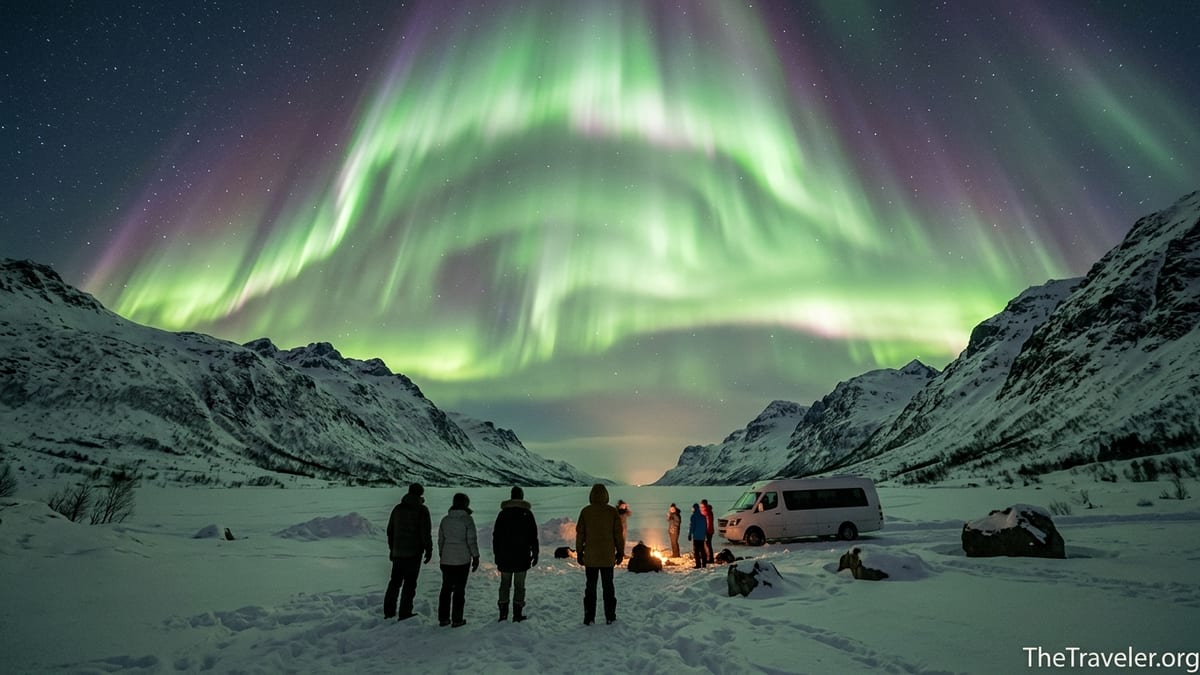
It began so quietly that half of us missed it. A faint, vertical streak climbed behind the dark silhouette of a mountain to the northeast, like a pale searchlight in slow motion. Someone pointed, another person gasped, and suddenly we were all moving away from the fire toward the open valley floor. Within seconds, the streak widened into a soft green curtain, then split into multiple parallel bands that arched overhead.
Standing there, the change felt almost physical, as if someone had turned a dimmer switch in the sky. The once-static arc along the northern horizon brightened, thickened, and began to move, first in slow ripples, then in faster waves. The color deepened from faint green to a saturated lime, and hints of purple and pink appeared at the edges where the particles were colliding with higher-altitude gases. Even the guide, who said he spends more than a hundred nights a winter under these skies, lifted his camera and muttered, “This is very good. Very, very good.”
For the next twenty minutes, the valley turned into a kind of outdoor planetarium. Curtains of light stretched from one mountain ridge to another, folding and unfolding in silence. Above us, the aurora formed a corona, converging at a point near the zenith where streaks of light seemed to stream directly outward like spokes of a wheel. People around me responded in different ways. One of the Spanish honeymooners cried softly. The two friends from Chicago hugged and laughed. The solo traveler from Singapore, who had been quiet all evening, simply whispered, “I cannot believe this is real,” over and over.
From a technical perspective, the Kp index during the peak of that display only climbed to around 4, a moderate storm level that is not especially rare at high latitudes. Yet combined with the local magnetic conditions and our position under the auroral oval, it was enough to fill the sky with color. The guide later explained that short-lived intensifications like this, called substorms, often do not show up neatly in advance in phone apps. Being already in place under clear skies, with cameras mounted and batteries warm inside inner pockets, meant we could make the most of every second.
Living Inside a Photograph
At some point, the show changed from something we were watching into something we were inside. The snow around us picked up a pale green tint. Shadows stretched and shifted as the aurora brightened and dimmed. When I looked down at my boots, they glowed faintly, reflecting light that had traveled from the sun, hit Earth’s magnetic field, and finally crashed into the upper atmosphere above our heads. For a moment, it was hard to remember that only a few hours earlier we had been standing under drizzle in Tromsø, doubting whether we would see anything at all.
Photographers on the tour worked quickly, juggling remote shutters and lens cloths. In conditions like this, any exposed glass fogs instantly, so a good guide will remind you to keep lenses capped between shots and to store spare batteries close to your body. Several guests used mid-range mirrorless cameras with kit lenses, and the guide helped them push their settings: ISO 3200 or 4000, shutter speed around 5 to 10 seconds, aperture as wide as their lenses allowed. Others relied on modern smartphones set to night mode or long exposure, which, while not perfect, still captured surprisingly good results when held absolutely still on a tripod.
The professional photos the guide took were part of the tour package, something many operators now offer as a standard inclusion. For travelers who do not own dedicated camera gear, this service is more than a bonus. It reduces the stress of “getting the shot,” letting you put the camera down and simply look up. Several times I forced myself to step away from my tripod, plant my feet in the snow, and take mental pictures instead. The real gift of a night like this, I realized, is not just the proof that you saw the northern lights, but the memory of what it felt like to stand underneath them.
Eventually, the activity faded back to a soft arc on the horizon. The valley dimmed, the snow returned to its natural white, and conversation slowly resumed. We warmed our hands over the last embers of the fire while the guide checked the latest satellite frames. “We might get another pulse later,” he said, “but we already have a full night.” No one argued. We packed up tripods, shrugged back into the minibus, and began the long drive home through a landscape that now felt subtly changed.
How to Give Yourself the Same Chance
Looking back on that night, what stayed with me was not just the spectacle but how carefully the odds had been stacked in our favor. The most important decision I made was to treat the northern lights as a multi-night project rather than a single all-or-nothing event. In practical terms, that meant booking four nights in Tromsø in mid-winter, when the nights are long and tour companies run daily chases, and planning my daytime activities so I could be flexible if the weather shifted.
On the ground, I chose a small-group minibus chase rather than a static camp or a large cruise ship excursion. In Tromsø, these chase-style tours typically advertise sighting rates across the season of well over 90 percent, not because every night is extraordinary, but because the guides are willing to drive for hours to find a break in the clouds, sometimes crossing into neighboring Finland if that is where the clear skies are. You pay more for fewer people and a moving strategy, but if your main goal is to witness a big display at least once, the added flexibility is worth serious consideration.
Before traveling, I also spent time learning the basics of aurora forecasting so that the charts on my phone felt less mysterious. Instead of obsessing over a single number like Kp, I learned to think in layers: solar wind speed and direction, short-term predictions of geomagnetic storms, and, most critically for a coastal city like Tromsø, regional cloud cover forecasts updated throughout the day. That knowledge did not give me control over the outcome, but it spared me from the emotional roller coaster of watching an app swing from “0 percent chance” to “high probability” in a single afternoon.
Equally important were the practical preparations that kept discomfort from undermining the experience. Good base layers of merino wool, a windproof outer shell, and proper winter boots meant I could stand still for long stretches without losing feeling in my toes. Hand and foot warmers, a thin balaclava under my hat, and touch-screen compatible gloves made it possible to operate camera equipment in sub-zero temperatures. None of this gear guarantees a show, of course, but it ensures that if the sky does erupt, you will be physically able to stay outside long enough to enjoy it.
Expectation, Reality, and the Emotional Arc
Perhaps the least discussed part of a northern lights trip is the emotional journey that comes with it. Online photos often show perfect arcs of neon color reflected in glassy lakes with no clouds in sight. On the ground, the experience is usually messier. Some nights are complete washouts. Others offer only a faint glow that the camera sees more clearly than your eyes. And then, if you are persistent and lucky, you might receive one of those all-sky performances that feels almost unreal while it is happening.
Our small group on that tour embodied the full spectrum of these expectations. One couple openly said they would be disappointed with anything less than a dramatic, multi-colored display. Another traveler insisted that simply stepping onto snow under Arctic stars was reward enough, aurora or not. In the end, the sky delivered something so strong that even the most cautious among us were astonished. But watching everyone react in real time made it clear how important it is to arrive with a flexible mindset.
Guides in places like Tromsø often encourage visitors to frame the northern lights as part of a larger Arctic experience rather than the sole purpose of the trip. That might mean filling your days with dog sledding, reindeer encounters, or fjord cruises, and treating any aurora you see at night as a bonus instead of a pass-or-fail test. In practical terms, this mental shift can make the difference between a trip that feels like a gamble and one that feels rich even if the weather does not cooperate.
For me, the emotional high point was not just the peak of the aurora, but the contrast with how the evening started. The doubt outside the hotel, the long drive under solid cloud, the quiet hour when only the camera saw anything at all: all of that set the stage for the moment when the sky finally opened. Without the slow build-up and the risk of failure, the reward would have landed differently. In hindsight, the tour’s arc mirrored that of the aurora itself: a subtle beginning, a long period of waiting, a sudden eruption, and a gentle fade into memory.
The Takeaway
If there is one lesson I carried home from that night, it is that a memorable northern lights experience is less about chasing the brightest forecast and more about stacking small, sensible choices on top of one another. Choose a location with historically reliable aurora activity and accessible dark skies. Give yourself multiple nights instead of betting everything on one. Book a tour that values flexibility over fixed plans, especially in coastal regions where cloud cover is unpredictable. Dress so warmly that you can afford to stand still and simply look up.
Equally important is the willingness to surrender the final outcome. The sun will do what it does. The Earth’s magnetic field will twist and shift on its own schedule. Clouds will form and break according to physics, not travel plans. The only part you control is how well prepared you are when a quiet grey evening turns, without warning, into a sky you will never forget.
On my tour, the night began with a low ceiling and nervous jokes about having paid for “the world’s most expensive bus ride.” It ended with strangers hugging under a glowing corona of green and violet and a guide who admitted, on the drive back, that it ranked among his best nights of the season. You cannot script an aurora, but you can put yourself in the right place, with the right people, and stay long enough for the sky to surprise you.
FAQ
Q1. When is the best time of year to see the northern lights in Tromsø?
In Tromsø, the practical viewing season runs roughly from late September to late March, when nights are dark enough for aurora hunting and tour operators run regular trips.
Q2. How many nights should I plan if seeing the northern lights is a priority?
Aim for at least three to four nights in an aurora destination so you can work around changing weather and solar activity instead of relying on a single evening.
Q3. Are small-group minibus tours really better than big coach tours?
Small-group minibus tours usually cost more but offer greater flexibility to chase clear skies, visit multiple locations in one night, and receive personal help with photography and gear.
Q4. What should I wear on a winter northern lights tour?
Dress in layers: a moisture-wicking base, insulating mid-layer, and windproof outer shell, plus warm boots, thick socks, hat, gloves, and a scarf or balaclava. Many tours also provide thermal suits.
Q5. Can I photograph the aurora with a smartphone?
Modern smartphones can capture decent aurora images if they offer a night or long-exposure mode and are mounted on a tripod, but a camera with manual settings still gives more control.
Q6. What is the Kp index, and how much should I care about it?
The Kp index measures overall geomagnetic activity from 0 to 9. It is helpful background, but in high-latitude places like Tromsø, cloud cover and local conditions matter just as much.
Q7. Do tours offer refunds if the lights do not appear?
Policies vary. Some operators offer discounted rebookings or a second chance at a lower price, while others do not refund because you are paying for the guiding and transport, not a guarantee of aurora.
Q8. How cold does it really feel on a northern lights tour?
Temperatures around minus 5 to minus 15 degrees Celsius are common in winter, and standing still makes it feel colder, so good clothing and hand warmers are important for comfort.
Q9. Is it worth renting a car to chase the lights on my own?
Self-driving can work for experienced winter drivers who are confident on icy roads and can read weather maps, but many visitors prefer tours for safety, local knowledge, and reduced stress.
Q10. Will the aurora look as bright and colorful as professional photos?
Sometimes yes, especially during strong displays, but often the camera sees more color than your eyes. Managing expectations makes any visible aurora feel more special.