


More news on this day
A revised blueprint for the Teruel–Sagunto rail connection on Spain’s Cantabrian–Mediterranean corridor has abandoned earlier ambitions for a double-track, high-capacity freight line, sparking sharp criticism from regional leaders who warn the decision will cement a long-term bottleneck on one of the country’s most strategic logistics routes.
Get the latest news straight to your inbox!
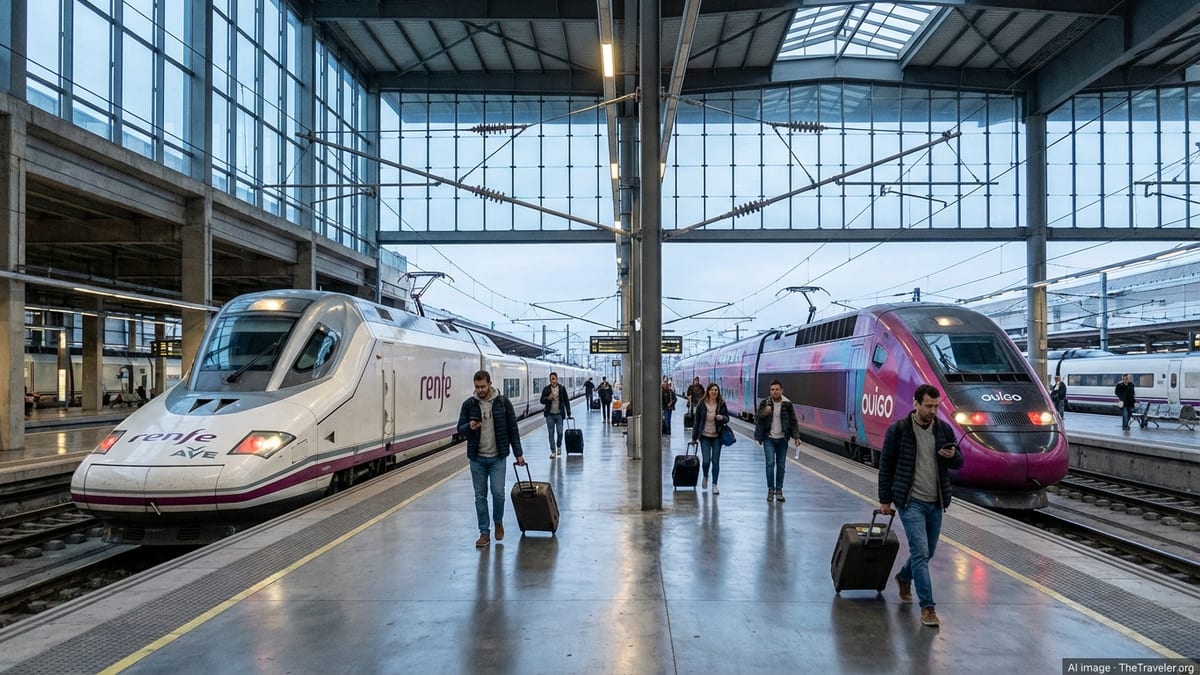
Single-track option chosen on Cantabrian–Mediterranean corridor
According to publicly available planning documents, Spain’s Ministry of Transport and Sustainable Mobility has endorsed a single electrified track between Teruel and Sagunto within the broader Cantabrian–Mediterranean freight and passenger corridor. The choice follows the release of an updated information study that is now in public consultation.
The corridor is being advanced in two main sections. Between Zaragoza and Teruel, plans still envisage a higher-capacity double track designed to support faster services and larger freight volumes. South of Teruel, however, the preferred alternative now relies on a single line with passing loops, creating what regional stakeholders describe as a “two-speed” corridor where one of the most critical stretches will carry less capacity than the rest.
Technical documentation indicates the single-track scheme uses a platform width of around 8.6 metres, below the typical 13 to 14 metres associated with double-track alignments. Signalling arrangements would allow only one train at a time between crossing points, placing tight constraints on timetabling and recovery from disruptions, particularly for long and heavy freight trains.
To partly offset the limitations, the plan leans on widespread use of double traction, with two locomotives hauling heavier freight consists over steep gradients. Industry observers note that while this can increase payloads, it does not remove the capacity constraints created by a single-track layout on a busy mixed-traffic corridor.
Cost concerns weigh against capacity and resilience
The reworked plan is framed around cost-efficiency arguments. Earlier studies assessed a range of alternatives, including a new-build double-track alignment designed for very high speeds. Estimates put that option at close to 4 billion euros, significantly more than the single-track proposals that re-use and upgrade parts of the existing route.
Forecasts for 2030 and beyond suggest that, in the ministry’s modelling, the additional passenger and freight volumes generated by a double-track configuration would be relatively modest compared with the chosen single-track variant. In long-term freight projections, the number of weekly freight trains expected on double track only marginally exceeded those on the preferred single line, a factor the central government cites in justifying the lower-cost solution.
Analysts following the project point out that cost-benefit calculations are being made against a backdrop of broader pressure on Spain’s transport budget, with multiple high-speed passenger lines, commuter rail upgrades and regional schemes competing for funding. The Teruel–Sagunto freight link must also be coordinated with investments around Valencia’s port and the wider Mediterranean Corridor, which have already absorbed substantial sums.
Critics of the decision argue that traditional demand forecasts can underestimate future freight growth, especially if railway policy, pricing and network access rules become more favourable to rail within European decarbonisation strategies. They warn that building in limited capacity today risks forcing another expensive upgrade cycle in the medium term, when construction and land costs are likely to be higher.
Aragonese leaders warn of a “historic error” and bottleneck risks
Regional authorities in Aragon have reacted strongly to the revised plans. According to recent regional statements and local media coverage, the government in Zaragoza considers the single-track approach on Teruel–Sagunto a “historic error” that could undercut decades of lobbying to position the region as a key north–south freight hub.
Teruel and its surrounding provinces have long argued that improved rail links to Valencia’s port are essential to attract logistics operators and industry. With much of the rest of the corridor set to benefit from double-track sections designed for higher speeds and heavier trains, local leaders fear that a single line to the coast will become the defining capacity limit on the entire axis.
Publicly available accounts of the reaction in Aragon indicate that officials plan to submit formal objections during the consultation phase of the information study. They are expected to argue for an electrified double track with higher design speeds, contending that only a fully modernised alignment would deliver the reliability, timetable flexibility and train lengths needed to compete with road haulage over the long term.
Regional business associations have also signalled concern over potential operational conflicts between freight and passenger services. On a single line, priority decisions during peak periods or disruptions can quickly cascade across the network, affecting both export-oriented industries in Aragon and the dense commuter and regional traffic closer to Valencia.
National freight strategy and EU goals under scrutiny
The controversy around Teruel–Sagunto is feeding into a wider debate over how Spain should structure its rail freight strategy and align it with European Union climate and transport objectives. EU policies encourage member states to shift more cargo from road to rail and to develop interoperable freight corridors linking ports and inland logistics platforms.
Spain has undertaken significant investment in high-speed passenger lines, while conventional freight routes along the Mediterranean and Atlantic axes have seen a more gradual and fragmented modernisation. Sector reports note that rail’s share of national freight remains comparatively low by European standards, and that capacity bottlenecks on key stretches can discourage operators from committing rolling stock and long-term contracts.
Industry analysts suggest that decisions like the one on Teruel–Sagunto will be seen as a test of whether freight is being given priority comparable to passenger mobility. While the central government highlights budgetary discipline and the need to tailor infrastructure to realistic demand scenarios, critics counter that limited capacity on a strategic port connection risks constraining future modal shift and undermining the competitiveness of interior regions.
Regulatory bodies have recently urged Spain to adopt a more competition-focused framework for public-service rail contracts and to lower barriers for new operators. Observers argue that without robust, high-capacity infrastructure on freight corridors, such efforts to liberalise and attract new entrants may fall short of expectations.
Murcia and other regions highlight parallel corridor concerns
The dispute over the Teruel–Sagunto link is emerging at the same time as other Spanish regions call attention to potential chokepoints on their own strategic corridors. In the Region of Murcia, regional authorities and business organisations have issued joint appeals for a review of planned rail layouts on the Mediterranean Corridor crossing the province, warning that current designs could create a “bottleneck” that limits long-term capacity.
Public statements from Murcia’s regional government and its main business confederation emphasise that freight movements to and from local ports, agri-food exporters and logistics parks depend on efficient, high-capacity rail access. They argue that partial upgrades or mixed single-track sections could compromise the benefits expected from broader EU-supported investments in the Mediterranean Corridor.
Similar concerns have been raised in other autonomous communities that see rail connectivity as central to their economic development strategies. In some cases, local officials reference the Teruel–Sagunto case as a cautionary example of how decisions made at the national level can lock in infrastructure configurations for decades, with limited options for incremental upgrading.
Across these regions, the emerging common message is a call for closer coordination between central planning and territorial needs, with greater emphasis on long-horizon freight projections, port integration and the flexibility required to accommodate both passenger and cargo flows on shared alignments.