


More news on this day
An Emirates Airbus A380 operating flight EK302 from Dubai to Shanghai was diverted to Hangzhou after midnight on July 22, with 373 passengers subsequently stranded on board for more than 10 hours in a stifling cabin after the air conditioning reportedly failed, triggering fresh questions about how long travelers can be kept on an aircraft during extended disruptions.
Get the latest news straight to your inbox!
Late-night diversion turns into overnight ordeal
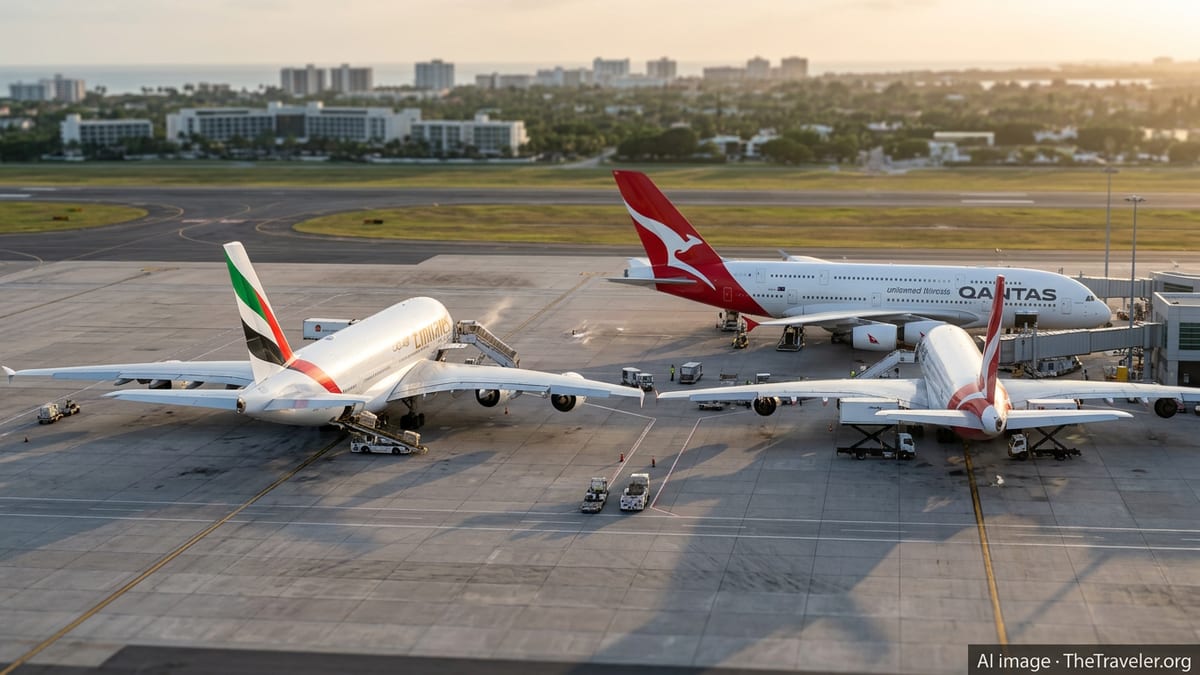
Publicly available flight data and Chinese media reports indicate that Emirates flight EK302 diverted from Shanghai Pudong to Hangzhou Xiaoshan International Airport on the night of July 22 after strong thunderstorms disrupted arrivals in Shanghai. The double deck A380, carrying 373 passengers, landed in Hangzhou at around 9 p.m. local time and was parked at a remote cargo stand away from the main terminal.
Passengers expected to disembark once the weather disruption eased, but accounts shared on Chinese social media platforms and summarized by outlets in mainland China describe a very different timeline. Travelers remained on board through the night as the aircraft waited on the ground, with doors closed and limited fresh air coming into the cabin.
As the delay stretched into the early hours, the situation reportedly worsened when the air conditioning system was unable to keep the temperature down in the tightly packed cabin. Multiple passengers described conditions as hot and airless, and videos circulating online appear to show people fanning themselves and removing extra layers of clothing as they waited for information.
Local coverage notes that emergency medical staff visited the aircraft more than once during the night after some travelers appeared to suffer heat-related discomfort, including fainting and dizziness. The incident has drawn particular attention because it involved one of the world’s largest passenger aircraft, designed for long-haul comfort but now at the center of a debate about basic protections during lengthy ground delays.
Air conditioning failure and reports of medical incidents
Reports from several Chinese news outlets state that the A380’s cabin became increasingly uncomfortable as outside temperatures remained warm and the aircraft systems cycled during the prolonged stop. Passengers have said that air conditioning was not consistently available during the delay, leaving parts of the cabin uncomfortably hot and humid for hours at a time.
According to these accounts, conditions were particularly challenging for older passengers, children and those seated away from air vents. Some travelers described feeling lightheaded and dehydrated despite efforts by crew members to distribute water and manage the cabin environment with the limited options available while parked at a remote stand.
Local media summaries of passenger testimony indicate that several people required medical attention over the course of the night. Ambulances were photographed alongside the aircraft, and reports suggest that emergency personnel boarded the plane at least twice to assist individuals suffering from apparent heat exhaustion and related symptoms.
Although there have been no reports of life threatening injuries, the combination of high cabin temperatures, limited ability to move around and uncertainty about when passengers would be allowed to disembark has raised public concern about how aircraft are managed during extended on ground delays, especially when key systems such as air conditioning are not fully functioning.
Emirates and airport responses under scrutiny
Emirates has acknowledged the disruption in public statements reported by Chinese and international media. The airline has expressed regret for the inconvenience experienced by passengers and indicated that all travelers were eventually allowed to leave the aircraft and that accommodation, meals and onward travel arrangements were provided after disembarkation.
The carrier has also been quoted as saying that online claims suggesting border control authorities refused to allow passengers off the aircraft were inaccurate. Instead, the airline and airport stakeholders have pointed to the need to coordinate immigration procedures, secure facilities and staffing before moving a large number of international passengers into a city that was not their scheduled destination.
Hangzhou Xiaoshan International Airport’s version of events, as reported in domestic Chinese coverage, emphasizes the operational complexity of handling an unscheduled arrival of a long haul superjumbo late at night. Airport-focused reports note that the aircraft was parked at a freight stand rather than a passenger gate and that accommodating hundreds of travelers would have required additional buses, ground staff and border control coordination during off peak hours.
Industry commentators in Chinese aviation media have suggested that, from the airline’s perspective, keeping passengers on board can sometimes be viewed as a faster and more economical way to resume the journey once conditions improve, especially when immigration and customs procedures at the diversion airport are not configured for a full international arrival late at night. However, this approach has now come under fire given the length of the delay and the reported failure to maintain a safe level of comfort on board.
Passenger rights and international norms on tarmac delays
The Hangzhou incident is prompting comparisons with tarmac delay rules in other major aviation markets. In the United States, for example, airlines face penalties if they keep passengers on a domestic flight on the ground for more than three hours without giving them the option to deplane, with a slightly longer limit for international services. Many consumer advocates argue that long periods confined on board are among the most stressful aspects of disrupted air travel.
China has no widely publicized time limit that mirrors the specific tarmac delay rules seen in some other jurisdictions, and airlines operating international flights into the country generally follow a mix of local practice and their own operational policies. Aviation specialists quoted in Chinese business publications note that complex regulatory and immigration considerations can slow the process of deplaning international passengers at an unscheduled airport, particularly late at night or in areas primarily configured for cargo operations.
The Emirates A380 case has sparked discussion on social media in China and abroad about whether global carriers should adopt more uniform standards for maximum on board waiting times, regardless of the airport or jurisdiction involved. Commentators have also highlighted the importance of ensuring that essential services such as air conditioning, potable water and basic medical support remain fully available whenever passengers are kept on board for extended periods.
Consumer advocates observing the incident say it underscores the gap between regulatory frameworks and traveler expectations in an era when social media can broadcast cabin conditions in real time. While the diversion was triggered by severe weather in Shanghai, much of the criticism now centers on decisions made after landing in Hangzhou and the question of how long it is reasonable to confine hundreds of passengers in a stationary aircraft when comfort systems are not operating reliably.
Broader implications for Emirates and long haul operations
Emirates is one of the world’s largest operators of the Airbus A380, using the double deck aircraft on high density routes linking Dubai with major cities across Asia, Europe and the Americas. The carrier’s business model relies heavily on connecting traffic through its Dubai hub, and its reputation has traditionally been built around premium service on long haul journeys.
The widely reported delay in Hangzhou comes at a time when large international airlines are under heightened scrutiny for how they handle disruptions, from weather diversions and airspace closures to crew shortages and technical problems. In recent months, Emirates has already faced operational challenges on some routes, and critics say the Hangzhou episode illustrates the pressure carriers face when balancing cost, complexity and customer care during irregular operations.
Aviation analysts note that incidents involving passengers being kept on aircraft for many hours are relatively rare compared with the overall volume of global flights, but they often become emblematic flashpoints in debates about airline accountability. In this case, images of passengers sitting through the night on a parked superjumbo without reliable air conditioning have resonated well beyond China and fueled calls for clearer international standards.
For travelers, the Hangzhou diversion is a reminder that even on flagship aircraft marketed for comfort, disruptions can quickly erode the passenger experience when contingency plans are not transparent and basic needs such as temperature control, hydration and timely information are not fully met. For airlines operating complex long haul networks, the incident may prompt renewed internal reviews of how diversion scenarios are managed, especially when large aircraft like the A380 are involved.