


More news on this day
Etihad Airways flight EY061 from Abu Dhabi to London Heathrow returned to its departure airport shortly after take-off following a reported technical issue, compounding disruption across the carrier’s network at a time when operations from the Emirati hub are already constrained.
Get the latest news straight to your inbox!
Midnight Departure Diverted Back to Abu Dhabi
Publicly available flight-tracking data for services between Abu Dhabi and London Heathrow indicate that an Etihad rotation operating as EY061 initiated its climb from Zayed International Airport before levelling off, entering a holding pattern and subsequently routing back to Abu Dhabi, rather than continuing on its scheduled path to the United Kingdom. Reports from aviation monitoring platforms describe the event as a precautionary return consistent with standard procedures when a potential technical concern is identified after departure.
The aircraft is understood to have landed safely back in Abu Dhabi after burning or dumping fuel to reach a suitable landing weight, a typical requirement for long-haul widebody flights that experience an interruption shortly after take-off. There are no public indications of injuries, and available information points to a controlled operational response by the flight crew and ground teams.
Eyewitness accounts shared on social platforms describe the flight’s initial climb and subsequent turn back toward the Gulf, with passengers later disembarking at the terminal. While specific technical details have not been disclosed, the sequence aligns with established safety protocols that prioritise a return to base when any onboard warning or anomaly cannot be fully resolved in the air.
The interruption adds a new layer of complexity to Etihad’s Abu Dhabi to London link, one of the airline’s highest-profile long-haul routes and a key pillar of its long-standing reliance on widebody aircraft for premium and connecting traffic.
Operational Response and Passenger Disruption
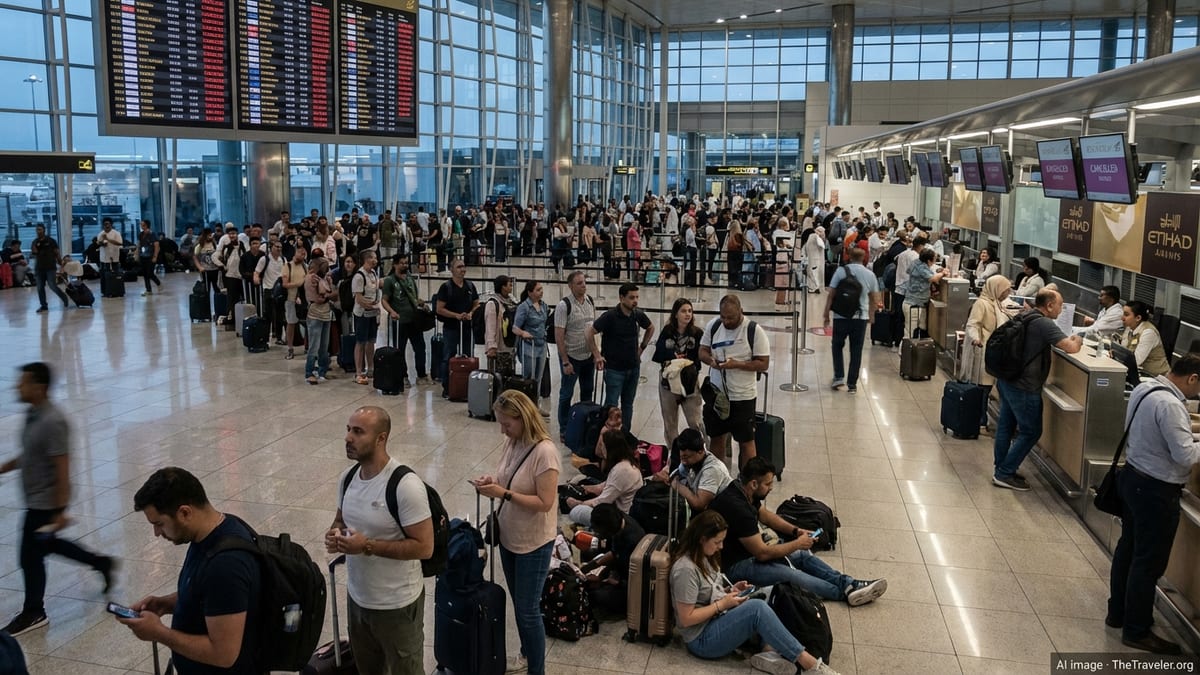
According to publicly accessible booking tools and schedule displays, the unplanned return of EY061 forced a reorganisation of seat inventory across several Etihad departures linking Abu Dhabi with London and onward European destinations. Passengers on the affected service reportedly faced lengthy waits in the terminal while new options were arranged, including rebooking onto later Etihad flights and, where possible, rerouting through alternative hubs on partner airlines.
Consumer posts summarising their experiences with Etihad’s current disruption regime describe a mix of hotel accommodation, meal vouchers and reissued tickets, but also note lengthy queues at service desks and extended call-centre hold times when multiple long-haul sectors require adjustment at short notice. For travellers with complex itineraries, particularly those using Abu Dhabi as a transit point to North America or Asia, the return of EY061 created a ripple effect of missed connections and involuntary rebookings.
Several trip-report style accounts from recent weeks already highlighted a fragile balance between limited capacity and strong demand on Etihad’s restored Abu Dhabi services. The added strain of an out-of-rotation long-haul aircraft has further tightened available seats, especially in the premium cabins typically favoured on the London route.
Travel analysts commenting in published coverage of the wider regional situation note that unplanned technical events on long-haul flights can force airlines to prioritise stranded passengers already in transit over those yet to depart, contributing to last-minute cancellations or booking removals even when subsequent flights appear to be operating normally.
Incident Comes Amid Wider Network Constraints
The timing of the EY061 return is especially significant because it coincides with a broader period of constrained operations for Etihad. Publicly available information shows that the airline is still operating a limited schedule from Abu Dhabi following regional airspace closures earlier in the year, with many departures temporarily suspended and others consolidated into fewer daily frequencies.
Officially published advisories and travel alerts describe a phased resumption strategy, under which Etihad has focused on maintaining connectivity to key cities such as London, New York, Paris, Frankfurt, Toronto and several major Asian gateways while holding back full restoration of secondary routes. In this context, the unavailability of a single widebody aircraft for even part of a day can have an outsized impact across the system.
Reports on consumer and aviation platforms indicate that London Heathrow services, in particular, have been operating close to or at capacity as demand rebounds faster than the supply of seats. Instances of overbooking, last-minute schedule reshuffles and changed flight numbers are widely documented by passengers describing their spring 2026 travel experiences via Abu Dhabi.
With EY061 forced back to base, Etihad has had to juggle a high-profile trunk route that is central to its network strategy while also protecting limited connectivity for long-haul passengers to and from markets such as North America, South Asia and Australia. That trade-off has likely influenced which passengers receive priority rebooking and how aircraft are reassigned in the short term.
Safety Protocols and Technical Events Under Scrutiny
The EY061 incident also comes at a moment when several recent technical events across the region have drawn fresh attention to how Gulf carriers manage in-flight abnormalities. Recent published coverage of an Etihad flight from Chennai to Abu Dhabi described a suspected hydraulic issue detected during ground operations, prompting a cancellation and a return of passengers to the terminal before departure. In another widely discussed case, a separate Middle Eastern carrier operating an Airbus A380 between London and Dubai carried out an emergency return to Heathrow following a landing gear problem.
Aviation specialists quoted in industry analysis emphasise that such events, while alarming for passengers, are generally handled within strict safety frameworks and tend to demonstrate the robustness of modern aircraft systems. Flight crews are trained to return to the departure airport whenever they cannot conclusively resolve a cockpit alert in the climb phase, which is broadly consistent with the pattern seen on EY061.
Historical data on long-haul operations through Abu Dhabi and other Gulf hubs shows that technical returns and rejected take-offs are relatively rare compared with the total number of flights operated, but each event can trigger significant knock-on disruption. Limitations on spare aircraft, crew duty-time regulations and curfews at destination airports all combine to complicate the recovery effort, particularly for overnight flights into slot-constrained European hubs such as Heathrow.
Publicly accessible fleet information suggests that Etihad continues to balance the deployment of widebody types such as the Airbus A380 and A350 across a compact but high-demand network. Any unplanned removal of one of these aircraft for inspections following a technical event can reverberate through schedules for days, even if the underlying issue turns out to be minor.
What Travellers Should Expect in the Coming Days
For passengers booked on upcoming Etihad flights between Abu Dhabi and London, publicly available guidance from airline advisories and travel portals consistently recommends checking flight status frequently in the 24 to 48 hours before departure. In the wake of the EY061 return, there is potential for rolling schedule tweaks as the carrier works through backlog and realigns its fleet.
Reports from recent travellers on the route suggest that, while many flights have been operating normally, last-minute departure time shifts, aircraft changes and involuntary rebookings remain possible. Some passengers describe relatively smooth journeys with spare capacity on board, while others recount abrupt cancellations and the need to accept alternative routings via different European or Middle Eastern hubs.
Industry commentators writing on consumer travel platforms advise that affected travellers should retain documentation related to delays and cancellations, including boarding passes and booking confirmations, in case of later claims under applicable consumer protection regimes. Travel insurance policies may also play an important role for those incurring additional accommodation or rebooking costs because of disrupted connections.
As Etihad continues its gradual rebuild of a global network centred on Abu Dhabi, the return of EY061 underscores how even a single technical event can magnify the challenges of operating within tight capacity constraints. Passengers planning to connect through the Emirati hub in the coming days are likely to face a mixed picture, with many flights running close to schedule but little slack in the system should further disruptions occur.