


More news on this day
Etihad Airways cancelled a scheduled morning flight between Abu Dhabi and Bahrain after a separate Abu Dhabi service was forced to turn back shortly after departure, according to live flight-tracking data and regional media reports, creating further disruption for passengers already facing an unsettled Middle East travel landscape.
Get the latest news straight to your inbox!
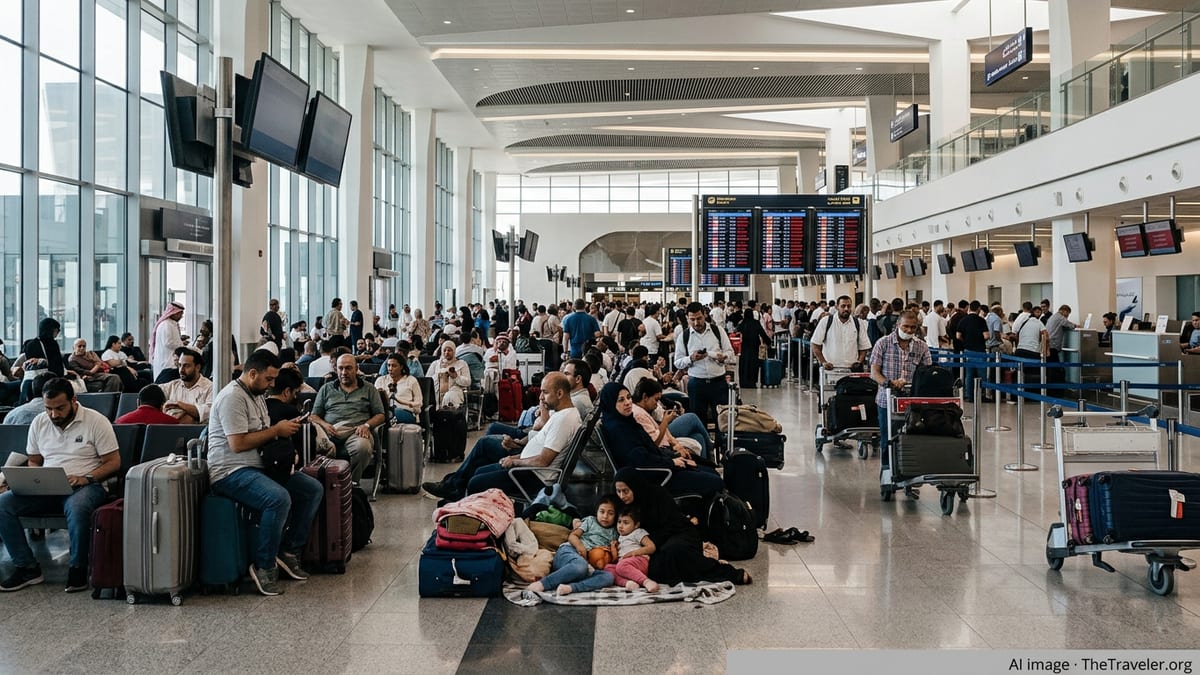
Turnback over the Gulf precedes Bahrain cancellation
Publicly available flight-tracking information shows that an Etihad service departing Abu Dhabi for a regional destination early Thursday began its climb before entering a holding pattern and returning to Zayed International Airport, instead of continuing along its planned route. The aircraft landed safely back in Abu Dhabi, where it remained on the ground for checks and schedule reassessment.
Subsequent schedule data indicates that a morning Etihad rotation on the Abu Dhabi–Bahrain route was then cancelled, removing one of the early links between the two Gulf capitals for that day. The flight had been listed as operating normally in advance, suggesting the cancellation followed the disruption to the earlier Abu Dhabi service rather than being part of a broader timetable change.
Operational details such as exact flight numbers, onboard passenger totals and the specific reason for the initial turnback had not been comprehensively disclosed across official channels at the time of publication. However, the sequence visible on tracking platforms aligns with a pattern in which an unplanned return to base can cascade into further schedule adjustments on short regional routes that rely on tight aircraft rotations.
There were no indications in open reports of any injuries or emergency declared in connection with the turnback, and available information pointed instead to a precautionary return designed to allow ground teams to inspect the aircraft and reassess crew and routing for the remainder of the operating day.
Knock-on disruption for Bahrain-bound travelers
The suspended Bahrain morning service removed an important peak-time option for business and connecting travelers commuting between the island kingdom and Abu Dhabi’s growing hub. The route typically feeds onward long-haul departures to Europe, Asia and North America, and the loss of an early segment can complicate wider itineraries for passengers who rely on same-day connections.
Booking engines and airport departure boards showed the Bahrain flight listed as cancelled rather than delayed, indicating that Etihad opted to remove the service entirely rather than operate it later with a different aircraft or crew pairing. Travelers booked on the affected flight were directed by publicly available advisories to check their reservations for automatic rebooking, or to contact the airline and travel agents for alternative arrangements.
Etihad, like other Gulf carriers, has encouraged passengers in recent months to monitor flight status closely before leaving for the airport, particularly when traveling through Abu Dhabi. The emphasis on real-time checks reflects a region where a combination of technical issues, airspace constraints and high aircraft utilization can prompt late operational changes, even on short-haul sectors traditionally seen as reliable shuttles.
In Bahrain, the cancelled arrival reduced Etihad’s presence during a busy morning window that also handles departures for regional and Saudi services, although other airlines continued to operate on Thursday and Bahrain International Airport’s public channels did not indicate any wider technical disruption.
Regional context of heightened operational sensitivity
The incident unfolded against a backdrop of lingering uncertainty in Middle East aviation following months of airspace restrictions and intermittent disruptions linked to regional tensions. Earlier this year, carriers across the Gulf, including Abu Dhabi-based airlines, temporarily suspended or rerouted multiple flights as conflict-related risks prompted closures on key air corridors and forced detours around sensitive areas.
Although core operations at major hubs such as Abu Dhabi, Dubai and Doha have largely stabilized, schedules remain more finely balanced than before. Airlines are operating complex networks with aircraft and crews still catching up from earlier dislocations, which can magnify the impact of individual events like a precautionary return to base.
According to recent regional travel advisories and analysis from aviation data platforms, short-haul Gulf routes are especially exposed to such ripple effects. Aircraft that perform several there-and-back segments in a single day leave limited room to absorb unexpected delays or technical checks, so a single disruption early in the schedule can trigger cancellations on later rotations.
In addition, heightened safety and security sensitivity in the region means operators tend to err on the side of caution when any anomaly is detected shortly after departure. That approach may increase the number of returns and subsequent cancellations in the short term, but it also underlines a focus on conservative risk management as carriers navigate a complex operating environment.
Passenger rights and practical next steps
For travelers affected by the Bahrain cancellation, standard Etihad conditions of carriage and regional consumer regulations provide for rebooking or refunds when a flight is removed from the schedule. Publicly accessible guidance from the airline notes that passengers on cancelled services are typically offered the choice of the next available flight on the same route, rerouting via alternative destinations where available, or reimbursement if travel is no longer required.
Given the highly connected nature of Abu Dhabi’s network, passengers originating in Bahrain and connecting onwards may face longer rebooking times on certain long-haul sectors, particularly at the height of the summer peak. Travel advisors in the region generally recommend retaining all booking confirmations, keeping boarding passes from unaffected legs and monitoring airline communication channels frequently while alternative options are processed.
Travel insurance policies can also play a role for some passengers, although coverage varies. Many comprehensive policies treat airline-initiated cancellations as an insured event, potentially covering additional accommodation, meals and local transport costs if travelers are stranded away from home. Policy terms differ widely, however, and insurance specialists stress the importance of checking wording carefully rather than assuming that all disruption-related expenses will be reimbursed.
For those with upcoming trips via Abu Dhabi or Bahrain, industry guidance points to a few practical steps: verify mobile contact details in the booking, confirm that the airline app or messaging preferences are enabled for schedule alerts, and revisit itineraries 24 to 48 hours before departure to confirm that all sectors are still operating as planned.
What the episode signals for Gulf aviation
While the cancellation of a single Bahrain morning flight is modest in the context of Etihad’s wider network, the episode illustrates how quickly operational plans can shift for Gulf carriers working with dense regional schedules and persistent external pressures. Short-haul sectors, once perceived as relatively predictable, are now more vulnerable to same-day disruption when even routine technical checks or airspace adjustments arise.
For Bahrain, which has positioned itself as a nimble regional hub in coordination with carriers across the Gulf, any reduction in early-morning connectivity to Abu Dhabi can briefly narrow options for business travelers and tourists alike. However, the cancellation appears to be a contained event rather than the start of a broader pullback from the route, with later flights between the two cities continuing to show as operating.
Across the Middle East, analysts following airline performance note that carriers are gradually rebuilding resilience into their timetables by adding schedule buffers, optimizing fleet deployment and diversifying connection banks throughout the day. Even so, the combination of geopolitical risk, intense summer heat, and heavy reliance on hub-and-spoke models means that occasional clusters of cancellations and returns are likely to persist.
For passengers, the main takeaway from the latest Etihad Bahrain disruption is the importance of flexibility and vigilance. In a period when regional aviation is still recalibrating, even a routine short hop can be affected by events hundreds of miles away, and staying closely engaged with flight-status information has become an essential part of traveling through the Gulf.