


More news on this day
Fresh waves of delays linked to air traffic control constraints at Sydney Airport are intensifying scrutiny of how well Australian passengers are protected when disruptions fall outside airline control, particularly around access to accommodation, meals and expense reimbursements.
Get the latest news straight to your inbox!
Fresh ATC Disruptions Underscore a Persistent Bottleneck
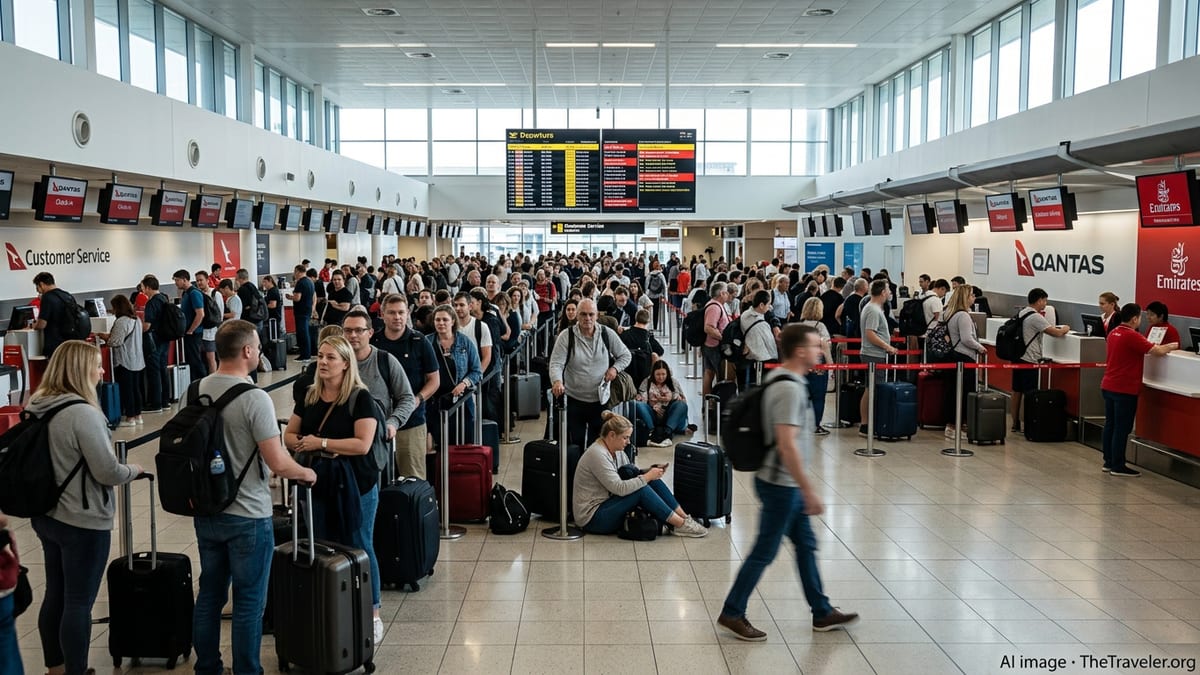
Recent school holiday travel at Sydney Airport has again been marred by operational caps triggered by air traffic control staffing issues, with published coverage describing short-notice sick leave among controllers that reduced the tower’s capacity and forced ground delay programs. These flow restrictions limited the number of arrivals and departures per hour, pushing some flights into lengthy delays and others into outright cancellation during peak demand.
Operational notices indicate that ground delay programs for flights arriving into Sydney have required airlines across Australia to seek specific off-block times before departure, reflecting broader network implications rather than a purely local problem. When Sydney’s air traffic system slows, the impact rapidly spreads across domestic routes as aircraft and crews are left out of position.
Government and industry documents released over recent years have repeatedly identified air traffic control workforce shortages as particularly acute in Sydney, warning that they can generate significant knock-on delays throughout the national network. With domestic capacity still rebuilding and demand surging on popular routes, the system has little slack to absorb these disruptions without visible effects for travelers.
The latest incidents follow multiple earlier episodes where controller absences, weather and traffic management measures converged, reinforcing community concerns that delays at Australia’s busiest airport are no longer exceptional events but recurring stresses built into the system.
When Disruptions Are “Outside Airline Control,” Support Shrinks
The renewed delays are drawing attention to a key fault line in Australian passenger protections: the distinction between disruptions within an airline’s control and those attributed to external factors such as air traffic control restrictions or severe weather. Publicly available airline policies typically offer accommodation, meal vouchers and transfers when problems are considered within the carrier’s control, for example certain maintenance or crewing issues.
However, consumer guidance and airline conditions of carriage indicate that when flight disruption is deemed outside the airline’s control, obligations often narrow to rebooking on the next available service or providing a refund or credit. In many such cases, accommodation and meals are framed as discretionary “assistance” rather than an entitlement, with policies urging passengers to check individual fare rules and travel insurance.
Australian consumer advocates have long highlighted that this framework can leave travelers exposed when they are stranded away from home by events like air traffic control constraints. While some carriers may choose to provide hotel rooms or meal vouchers on a goodwill basis, the absence of a uniform legal guarantee means outcomes can differ widely between airlines, routes and even individual disruptions.
Reports from recent disruptions at Sydney suggest a patchwork experience: some travelers receiving hotel rooms and transport while others, particularly those whose onward connections were canceled due to flow restrictions, were told that external causes limited what airlines would fund.
Global Comparisons Put Australia’s Patchwork in Focus
The situation at Sydney is also being viewed through the lens of international standards, where regulatory regimes in other regions set clearer minimums for care and assistance. In the European Union, for example, air passenger regulations require airlines to provide meals, refreshments and, where necessary, hotel accommodation and transport between the airport and hotel once delays pass certain thresholds, even when the underlying cause is considered extraordinary.
While those European rules allow airlines to avoid paying financial compensation where disruptions are outside their control, they nevertheless mandate practical assistance to stranded passengers. That contrast is sharpening calls among some consumer advocates and legal commentators for Australia to move beyond purely contractual solutions and introduce baseline statutory rights to care.
By comparison, the Australian model remains heavily reliant on individual airline policies and the fine print of fare conditions. Travelers departing or arriving through Sydney are discovering that protections can differ not only by carrier but also by whether a ticket was sold as a domestic or international itinerary, and whether a delay is framed as an operational decision or an unavoidable external constraint.
These differences are becoming more visible as social media posts and online forums circulate detailed accounts of how passengers on the same disrupted flight have received varying levels of support depending on booking channel, loyalty status or persistence in seeking reimbursement.
Government Advice Highlights Limits of Current Framework
Australian government travel advice encourages passengers to read airline conditions carefully, purchase adequate travel insurance and stay informed during disruptions, particularly during peak periods at major hubs such as Sydney. Official consumer tips outline that airlines may offer refunds, credits or rebooking when schedules change, but they stop short of promising accommodation and meals in situations beyond airline control.
Recent policy material and freedom of information releases concerning aviation oversight show continued concern at official levels about the impact of air traffic control staffing and weather on punctuality and reliability at Sydney. At the same time, there has been limited movement toward a comprehensive national passenger rights charter that would clearly spell out entitlements across all carriers.
The forthcoming launch of Western Sydney International Airport and related changes to airspace management in the Sydney Basin are also in focus. Planning documents anticipate increased communication and workload for controllers as the region’s traffic grows, prompting measures such as new visual flight corridors and traffic levelling proposals designed to distribute demand more evenly.
Stakeholders monitoring these developments argue that capacity improvements alone will not resolve questions about care for disrupted passengers, particularly if staffing and infrastructure constraints continue to generate ground delay programs and flight caps during busy periods.
Rising Demand, Tight Staffing and the Case for Clearer Rules
With domestic travel demand rebounding and airlines seeking to maximize aircraft utilization, Sydney’s recurrent air traffic control constraints create a difficult operating environment. Carriers have to balance schedule density with the risk that even minor staffing or weather issues will trigger significant restrictions on arrivals and departures.
For passengers, the results are familiar: long queues at check in and security, congested departure halls and uncertainty about whether they will reach their destinations on the intended day. When disruptions are formally categorized as outside airline control, travelers often find that the cost of last-minute hotel rooms, meals and ground transport falls largely on them.
Legal scholars and consumer organizations increasingly point to this gap as a structural problem rather than an unfortunate side effect of occasional bad luck. They argue that predictable, recurring constraints in the air traffic system should not be treated in the same way as rare, unforeseeable events, particularly when these issues have been flagged in planning and workforce documents for years.
As Sydney Airport continues to experience periodic delays linked to air traffic control management, debate is intensifying over whether Australia should introduce clearer, nationally consistent standards for care and assistance. For now, travelers navigating disruptions at the country’s busiest gateway must rely on a mix of airline goodwill, personal insurance and careful reading of terms and conditions to avoid bearing the full cost of staying put when the system grinds to a halt.