


More news on this day
Prolonged delays linked to air traffic control constraints at Sydney Airport are intensifying scrutiny of Australia’s patchwork passenger protections, as travellers report confusion and inconsistent support on airline-funded hotels, meals and incidental costs when flights are disrupted for reasons beyond an airline’s direct control.
Get the latest news straight to your inbox!
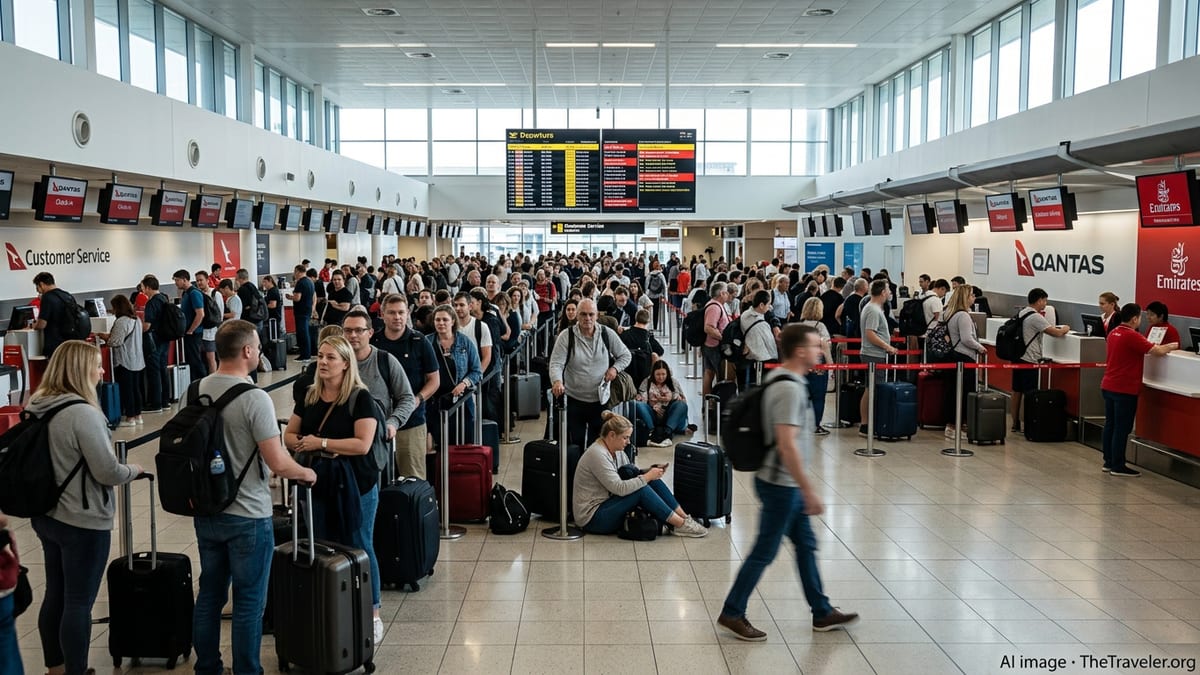
ATC Bottlenecks Collide With Sydney’s Movement Cap
Recent disruption patterns at Sydney Airport have highlighted how operational limits can magnify the impact of air traffic control constraints. Publicly available information from Sydney Airport explains that the flow of arriving and departing aircraft is managed by Airservices Australia, which adjusts movements in response to weather, runway conditions and airspace capacity. When significant delays occur, the ability to recover is further constrained by a longstanding hourly movement cap that restricts the number of take offs and landings, even after conditions improve.
Evidence presented in recent submissions to government inquiries indicates that ground delay programs and reduced arrival rates into Sydney can quickly cascade through the national network, causing missed connections and knock-on delays at other airports. Once a backlog builds, the movement cap prevents operators from substantially increasing throughput to clear stranded passengers. Industry material suggests that this structural limitation has left thousands of travellers facing extended waits and unplanned overnight stays in Sydney after air traffic control restrictions have been imposed.
These dynamics mean that even where the root cause is a temporary air traffic control or weather issue, the practical impact for passengers may be much longer than the disruption window itself. Travellers who miss last departures of the night can find themselves searching for accommodation in a city already under pressure from simultaneous flight cancellations, often without clear guidance on what assistance the airline will provide.
When Airline-Funded Care Stops at “Outside Our Control”
Australia does not yet have a comprehensive statutory framework that clearly sets out assistance and compensation rights for air passengers affected by delays and cancellations. Instead, support tends to be defined by each airline’s contract of carriage and internal policies, which usually distinguish between disruptions within an airline’s control and those attributed to outside causes such as air traffic control restrictions or severe weather.
Consumer advocacy coverage and publicly accessible airline policies indicate that carriers are more likely to offer meal vouchers, accommodation and ground transport when the cause is an internal issue like crew rostering problems or aircraft maintenance. However, where delays are linked to air traffic control decisions, flow restrictions or broader network congestion, travellers frequently report being told that hotels and substantial reimbursement are not available because the situation is beyond the airline’s control.
Online complaints and case studies compiled by consumer groups describe passengers stranded overnight after flights into or out of Sydney were delayed or diverted due to air traffic control limitations. Some travellers recount receiving modest food vouchers that did not cover a full meal in an airport environment with elevated prices, while others say they were left to arrange accommodation at their own expense despite being far from home. These experiences underline how the “outside our control” classification can sharply limit airline-funded care just as costs for passengers begin to mount.
Government Reform Plans Raise Expectations
The federal government has signalled that this status quo is likely to change. An aviation white paper process and subsequent policy announcements outlined plans for strengthened passenger protections, including clearer obligations on airlines to refund fares, provide care such as food and accommodation, and in some cases pay compensation when flights are significantly delayed or cancelled.
Budget documents released in May 2026 confirmed new funding to support the design and enforcement of an overhauled passenger rights regime. Public reporting on the proposals notes that the planned framework would be more prescriptive about when airlines must cover meals and accommodation, particularly for disruptions within their control, while also considering how to handle events that originate with airport infrastructure, security screening, baggage systems or air traffic management.
Industry submissions to parliamentary committees and consultation processes have argued that any new laws should recognise the limits of airline responsibility when air traffic control restrictions, movement caps or government-owned infrastructure trigger widespread delays. Some carriers have warned that extending liability to those situations could raise operating costs and ultimately airfares. Consumer advocates, by contrast, have pointed to international models in Europe and parts of North America where airlines are obliged to provide at least basic care and assistance regardless of whether delays are technically within their control.
Comparisons With Overseas Passenger Rights Frameworks
The debate around Sydney Airport’s recurring disruption highlights how Australia’s current approach differs from some major aviation markets. Under European air passenger regulations, for example, airlines must usually provide meals, refreshments and hotel accommodation when long delays or cancellations require passengers to wait extended periods, even when the trigger is air traffic control or other external factors. While compensation payments can be limited in cases of extraordinary circumstances, the obligation to provide care and assistance tends to remain.
Guidance issued by transport authorities in countries such as the United Kingdom and members of the European Union outlines a relatively clear minimum standard for care, including hotel stays and transfers when an overnight delay is unavoidable. In North America, separate rules focus more on transparency and commitments voluntarily published by airlines, but regulators maintain dashboards and comparison tools that pressure carriers to match or exceed rivals on meal and accommodation support during significant disruptions.
Australia’s emerging reforms appear to be drawing selectively on these models. Policy papers and advocacy submissions suggest there is strong public support for guaranteed basics such as food, water and overnight accommodation, regardless of the precise cause of a delay, particularly at major hubs like Sydney where alternative transport options are limited. However, there is less agreement on whether automatic cash compensation for lost time should be mandated in the same way it is in parts of Europe.
What Travellers Can Expect in the Interim
Until new legislation comes into force, travellers using Sydney Airport remain subject to a mix of airline-specific policies and general consumer law, rather than a dedicated statutory passenger bill of rights. Government travel guidance encourages passengers to review fare conditions and airline contracts of carriage before flying, and to keep receipts for food, accommodation and ground transport in case reimbursements are later offered after a disruption.
Travel insurance is frequently cited by consumer organisations as an important additional safeguard, particularly for itineraries that rely on tight connections through Sydney or involve the last services of the day. Many policies provide coverage for reasonable expenses, including hotel stays and meals, once delays exceed a specified threshold, whether or not the airline accepts responsibility for the underlying cause.
As the federal government moves toward implementing stronger passenger protections, the experience of recent Sydney Airport delays is likely to shape the final design. The interaction between air traffic control constraints, regulatory movement caps and airline support policies has exposed gaps that can leave passengers bearing substantial unforeseen costs. How new rules define the line between unavoidable operational limitations and obligations to provide care will determine whether future travellers are better shielded when airspace disruptions strike Australia’s busiest gateway.