


More news on this day
European aviation regulators have ordered urgent structural checks on a small group of Airbus A380 superjumbos after cracks were found in key wing components, sparking fresh concerns about potential flight delays at the height of the northern summer travel season.
Get the latest news straight to your inbox!
Emergency directive targets 16 superjumbos
Publicly available regulatory documents show that the European Union Aviation Safety Agency has issued an emergency airworthiness directive covering 16 Airbus A380 aircraft after cracks were detected in internal wing structures. The action follows the discovery of damage in a component known as the wing mid spar, a primary load-bearing element inside the wing box.
According to published coverage in European and aviation media, the directive was issued on June 22 and comes into legal effect from June 24, 2026, requiring operators to carry out detailed inspections within tight deadlines. The order applies predominantly to aircraft built during a specific production period that share the same design and manufacturing features as the jet where the initial cracks were found.
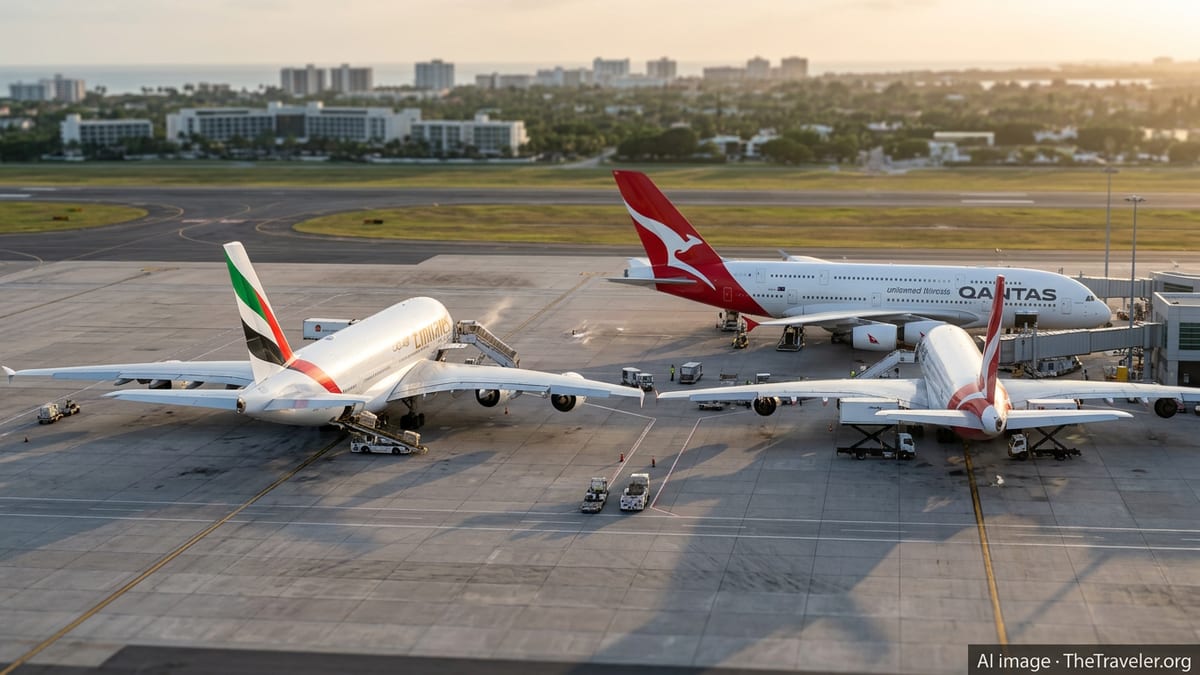
Reports indicate that 15 of the affected aircraft belong to Emirates, the Dubai-based carrier that operates the world’s largest A380 fleet, while a single aircraft is operated by Australia’s Qantas. Five of the jets are required to undergo inspections before their next commercial flight, effectively grounding them until checks are completed, while the remaining aircraft must be examined within 25 flight cycles.
The emergency directive notes that the cracks, if left unaddressed, could reduce the structural integrity of the wing and ultimately affect safe operation. Regulators have therefore instructed operators to conduct enhanced non-destructive testing of the mid-spar region and to report findings within days, regardless of whether additional cracks are discovered.
Cracks focus attention on ageing A380 fleet
The development places renewed scrutiny on the long-term durability of the Airbus A380, the world’s largest passenger jet. The double-deck aircraft entered commercial service in 2007 and remains a flagship on dense long-haul routes, even though Airbus ended production in 2021 after a decline in new orders. Many airframes in service today are now well into their second decade of operation.
Aviation specialists quoted in recent coverage describe the mid-spar as a crucial part of the A380’s wing architecture, responsible for distributing loads across the structure during take-off, cruise and landing. Cracks in this area are regarded as serious findings that demand rapid inspection and, where necessary, repair or component replacement.
The new directive follows earlier airworthiness actions on the A380 wing, including previous inspections for different types of cracking linked to manufacturing techniques. Industry analysis suggests the latest issue appears confined to a defined subset of aircraft with common production characteristics, rather than pointing to a universal design flaw across the entire global fleet.
In its public statements, Airbus has characterised the inspections as a precautionary measure arising from data obtained during heavy maintenance checks. The manufacturer is providing technical instructions to airlines on how to carry out the additional examinations and any subsequent structural work that may be needed.
Airlines juggle inspections and schedules
Emirates and Qantas rely heavily on the A380 for high-demand international routes, meaning any extended groundings require swift network adjustments. Media reports note that one affected Qantas aircraft is already in heavy maintenance in Europe, which may limit the need for extra cancellations, while Emirates is expected to use other widebody types to cover some A380 services during the inspection window.
Publicly available schedule data and airline communiques indicate that the most immediate impact will fall on the five aircraft that must be inspected before their next flight. These jets are likely to be temporarily withdrawn from passenger service, with operators substituting smaller long-haul aircraft such as Boeing 777s or Airbus A350s on certain routes.
For the remaining 11 aircraft, regulators have allowed a short grace period of up to 25 flight cycles before inspections must be completed. This flexibility gives carriers limited room to rotate aircraft through maintenance bases in a way that reduces disruption, though some retiming and equipment swaps are likely as engineers fit the extra work into already crowded hangar schedules.
Reports from aviation tracking and analysis platforms suggest that airlines have been preparing contingency plans since drafts of the directive circulated to operators. These plans typically include consolidating lower-demand flights, upgauging or downgauging aircraft types on specific routes, and prioritising capacity on key trunk services.
What travelers can expect this summer
The timing of the inspections, coinciding with peak summer travel from Europe and the Middle East, has raised concern among passengers booked on A380 flights in the coming weeks. Industry observers quoted in specialist outlets emphasise that the directive does not ground the entire A380 fleet, and most of the world’s superjumbos are not directly affected by the latest order.
Still, the need to remove a handful of high-capacity aircraft from operation, even temporarily, can create knock-on effects. When an A380 with more than 450 seats is substituted with a smaller widebody, airlines may have to rebook or reroute some passengers, particularly on already busy days. Travelers could see schedule changes, aircraft swaps and occasional delays as carriers reshuffle fleets to accommodate inspection slots.
Consumer advocates suggest that passengers flying on A380 routes operated by Emirates or Qantas in the near term should monitor booking portals and mobile apps closely for updates, and consider allowing additional connection time when planning complex itineraries. However, the limited number of affected aircraft means widespread cancellations across global networks are not currently expected.
Aviation analysts point out that safety-driven inspections of this kind are a routine part of modern air transport, even if emergency directives can appear dramatic when taken in isolation. The current situation, they argue, reflects a system designed to identify structural issues early, remove individual aircraft from service when necessary and return them only once engineers are satisfied with the repairs.
Longer-term implications for Airbus and the A380
The inspection order also comes at a sensitive time for Airbus as it contends with supply chain challenges and high demand for newer single-aisle and long-range twin-engine jets. While the A380 is no longer in production, the manufacturer remains responsible for continued airworthiness support and must coordinate closely with regulators and operators when structural issues arise.
Public reporting indicates that Airbus has already updated maintenance documentation and service bulletins to reflect the new inspection regime, and further design refinements or retrofits could follow if inspections reveal more extensive cracking than initially anticipated. Any such measures would be aimed at ensuring the affected aircraft can continue operating safely for the remainder of their service lives.
For airlines, the episode is a reminder of the costs associated with operating complex, ageing widebody fleets, particularly aircraft that are unique in size and configuration. Some carriers have already begun to phase out the A380 in favor of more flexible twin-engine models, while others, notably Emirates, have invested heavily in cabin upgrades to keep the type in front-line service into the 2030s.
Market commentators note that the latest checks are unlikely on their own to determine the long-term fate of the A380. Instead, they are seen as part of the ongoing technical stewardship required for any large commercial aircraft platform. How smoothly airlines manage the inspections and associated schedule adjustments over the summer will shape traveler perceptions in the short term, even as the superjumbo continues to occupy a high-profile niche in global aviation.