


More news on this day
Europe’s push to move travelers and freight from road and air to rail is entering a new phase, as the European Commission revises State aid rules in a bid to revive night train services and accelerate investment in the European Rail Traffic Management System (ERTMS).
Get the latest news straight to your inbox!
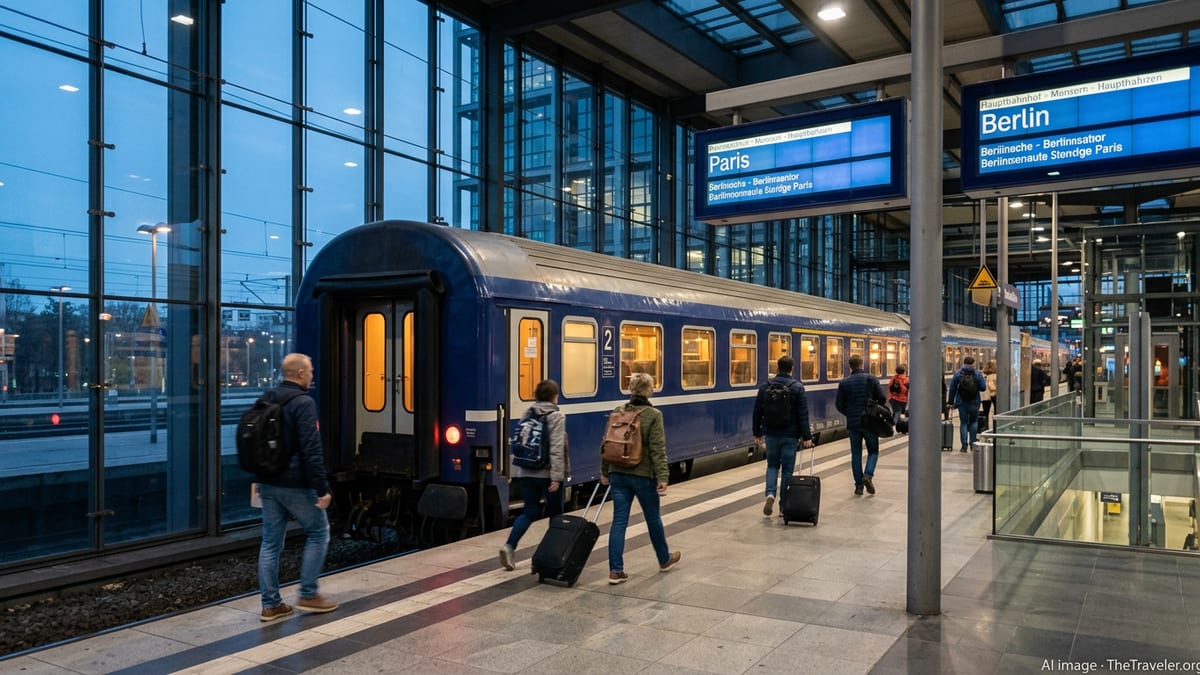
New Railway Guidelines reshape EU State aid landscape
Publicly available information shows that the European Commission has approved revised Railway Guidelines on State aid, updating a framework that had been largely unchanged since 2008. The overhaul reflects the European Green Deal’s objective to cut transport emissions and the practical experience gained from more than a decade of case-by-case decisions in the rail sector.
The new guidance clarifies when national and regional authorities can support rail operators and infrastructure managers without unduly distorting competition. It aligns more closely with general State aid concepts such as the “notion of aid” under Article 107 of the Treaty on the Functioning of the European Union and with the rules governing public service compensation for passenger transport services by rail and road.
According to published coverage, the Commission’s fitness check of earlier rules concluded that the previous approach did not sufficiently reflect market opening, the rise of open-access passenger operators and the EU’s climate ambitions. The revised framework therefore places greater emphasis on shifting traffic from more polluting modes and on supporting interoperable infrastructure, including digital signaling and cross-border capacity.
The update also interacts with broader efforts to simplify procedures for green transport projects. Earlier initiatives to extend block exemptions for certain types of rail, inland waterway and multimodal support now sit alongside the more detailed Railway Guidelines, giving governments a more flexible toolkit to back low-carbon mobility.
Clearer paths for supporting night trains as public service
Night trains have re-emerged as a symbol of Europe’s sustainable travel ambitions, but their economics remain fragile on many routes. Under the EU’s public service obligation regulation for rail and road passenger transport, authorities can compensate operators for running socially necessary but commercially unviable services if contracts are properly tendered and costs and revenues are transparent.
The revised State aid framework reinforces this logic for long-distance and cross-border services, including overnight routes. Reports indicate that the rules spell out how compensation should be structured when a night train is entrusted with a public service obligation, with the aim of preventing overcompensation while allowing operators to cover higher fixed and staffing costs associated with overnight operations.
Observers note that this clarity is particularly relevant as several member states explore or expand night train links that traverse multiple jurisdictions. National ministries and regional transport authorities have been experimenting with joint tenders, cost-sharing arrangements and the creation of rolling-stock pools for couchette and sleeping cars, all of which depend on predictable State aid parameters.
Industry analyses, including the 2024 Night Train Atlas published by the International Union of Railways, suggest that a more stable regulatory and financing environment could encourage new entrants and partnerships on key corridors such as Paris–Berlin, Vienna–Rome and services connecting central Europe with the Nordics. The revised guidance may make it easier to structure contracts that span borders while respecting competition rules.
ERTMS recognised as priority investment for aid
In parallel with support for operations, the new Railway Guidelines give a prominent role to digital signaling and control systems. ERTMS, the European standard for train protection and traffic management, is explicitly recognised as an eligible target for investment aid, alongside conventional track and electrification works.
Commission documentation on ERTMS describes it as a common standard intended to replace a patchwork of national signaling systems and to improve both safety and capacity on Europe’s railways. By harmonising train control technology, ERTMS is designed to allow seamless cross-border operations and to support faster, more frequent services without compromising safety margins.
The revised rules set out compatibility criteria for aid that covers the additional costs of equipping lines and rolling stock with ERTMS compared with maintaining legacy systems. Publicly available decisions on national support schemes, for example in Denmark and other member states, have already applied similar principles, covering on-board equipment for locomotives and infrastructure-side components needed for deployment on key corridors.
Analysts argue that enshrining ERTMS in the generic guidance provides more legal certainty for future funding programmes, including those financed from national budgets or co-financed through EU-level instruments. It is expected to ease the path for large, multi-annual schemes aimed at converting entire networks or priority freight and passenger routes.
Balancing competition, climate targets and budget constraints
The recalibrated rules come at a time when governments face pressure to reduce emissions while managing tight public finances. The Commission’s approach seeks to channel State aid toward projects that deliver clear environmental and interoperability benefits, while maintaining safeguards against unfair advantages for individual operators.
For night trains, this means demonstrating that services contribute to shifting demand away from short- and medium-haul flights or long car journeys, and that contracts are competitively awarded or otherwise justified under the public service framework. For ERTMS, authorities are expected to show that aid addresses coordination failures and the high upfront costs that have slowed deployment, especially on cross-border sections.
European Parliament reports have called for further simplification of rail aid rules, including options such as European rolling-stock pools and coordinated support for cross-border services. The latest guidelines respond in part by updating categories of compatible aid and by acknowledging the role of infrastructure managers and transport authorities as key actors in delivering the Green Deal’s modal shift objectives.
Travel industry observers note that, while the impact on passengers will materialise gradually, the combination of clearer State aid disciplines and targeted support for ERTMS and night trains could reshape long-distance rail over the coming decade. As member states translate the guidance into concrete funding schemes and tenders, travelers may see a denser network of overnight connections and more reliable, interoperable services across Europe’s borders.