


More news on this day
Europe’s latest overhaul of its external border rules is colliding with peak travel demand, as the European Union removes a key “safety valve” on checks just as airlines warn that airports are not prepared to prevent longer queues, missed flights and wider disruption.
Get the latest news straight to your inbox!
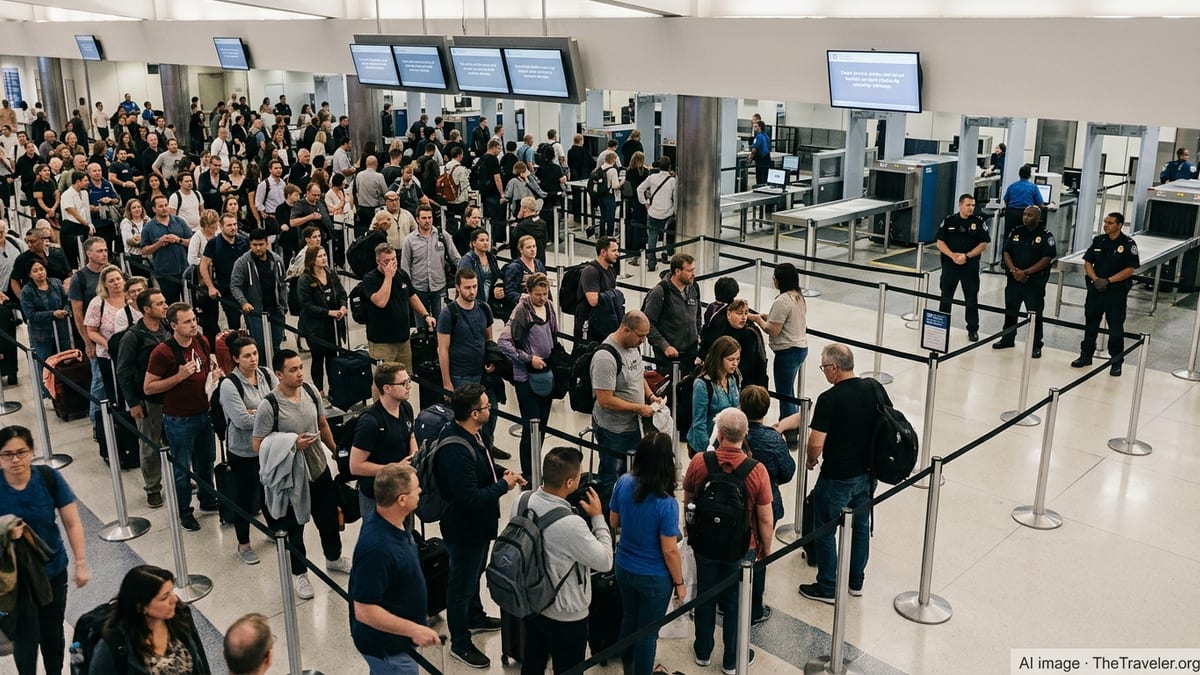
What Has Changed at Europe’s Borders
The shift comes as the European Union rolls out its new digital Entry/Exit System for non-EU short-stay visitors to the Schengen area, requiring fingerprints and facial images at border control. The system is intended to tighten security and automate the tracking of overstays, but it adds extra processing time for each traveller.
At the same time, the updated Schengen Borders Code, formally adopted by EU governments in May 2024, refines when and how member states can reintroduce internal border checks and which alternative tools can be used instead. Publicly available information shows that the reform is designed to keep internal checks as a measure of last resort while strengthening coordination at the external frontier.
Within this framework, a temporary mechanism that allowed authorities to ease pressure by relaxing full use of the new Entry/Exit System at especially congested crossing points has now been withdrawn. Industry coverage describes this phased approach as a “safety valve” that gave airports and border police added flexibility during early implementation.
The end of that flexibility means border officers are expected to apply the full suite of new checks consistently, even when queues swell. For many airports that struggled with the initial rollout, travel industry groups suggest that this marks a decisive turning point that could expose remaining weaknesses in staffing, training and technology.
Airlines Warn of Longer Queues and Missed Flights
Airlines and airports have been flagging concerns about the Entry/Exit System for months. In a joint statement in early 2026, European airline and airport associations warned that persistent understaffing at border control, technical problems with automated kiosks and patchy adoption of pre-registration tools were already causing significant delays for passengers. They cautioned that without more flexibility, queues could easily stretch to several hours at peak times.
Recent industry reporting highlights that some carriers have documented waits of two to three hours at key hubs and leisure gateways, including major airports in Poland, Portugal and Italy, during the first big waves of summer travel. Travel news coverage notes that bottlenecks tend to be most severe where high volumes of non-EU visitors meet limited numbers of trained border officers and a high proportion of manual processing.
Low-cost carriers with dense schedules and rapid turnarounds appear particularly exposed. Publicly available comments from these operators argue that the strict application of the new border regime, without the earlier pause option, could lead to more late departures, missed connections and last-minute rebookings that ripple across their networks.
Industry groups are urging European institutions to keep some form of contingency in reserve, such as the ability to temporarily simplify procedures at specific bottlenecks or to phase in extra requirements more gradually on the busiest routes. For now, however, travel trade reporting indicates that the political momentum in Brussels is focused on full enforcement of the new system rather than further postponements.
How the New Rules Fit into the Schengen Overhaul
The end of the “safety valve” on the Entry/Exit System forms part of a wider recalibration of how the Schengen area manages border pressures while preserving free movement. The updated Schengen Borders Code, agreed politically in early 2024 and subsequently adopted, seeks to clarify when internal checks can be brought back and to strengthen cooperation in response to crises at the external frontier.
According to official summaries, the reform clarifies time limits and conditions for the reintroduction of internal border control where there is a serious threat to public policy or internal security. It also introduces new options for coordinated measures, such as reinforced police checks within border regions and joint operations, intended to act as alternatives to full internal controls.
At the same time, EU legal texts describe a stronger framework for reacting to situations such as large-scale public health emergencies or deliberate instrumentalisation of migration flows. In such cases, the European Commission can propose common responses, including authorising member states to reintroduce border controls for limited periods, while encouraging the use of mitigating measures to keep traffic flowing where possible.
For travellers, these legal adjustments are largely invisible but shape the practical experience at airports, ports and land crossings. The phasing out of temporary relief mechanisms on the Entry/Exit System underscores a broader policy trend: tighter external management, more structured rules on exceptional measures, and a renewed emphasis on avoiding ad hoc internal checks within the Schengen zone.
What Travellers Can Expect at Airports
For non-EU visitors arriving in the Schengen area, the biggest change remains the biometric registration step required the first time they enter after the Entry/Exit System is active. Travel guidance from European institutions indicates that this process should be faster on subsequent trips, once data are stored, but the initial enrolment takes longer than a traditional passport stamp.
With the removal of the previous flexibility to scale back these procedures during busy periods, travellers may notice more pronounced peaks and troughs in waiting times. Industry reports suggest that congestion risk is highest at major holiday gateways, airports with large numbers of connecting passengers from outside the EU, and terminals where infrastructure for automated kiosks is still being expanded.
Some airports are responding by adding staff at border control, installing additional kiosks and adjusting queuing layouts to separate first-time entrants from repeat visitors. Airlines are updating passenger communications to encourage earlier arrival at the airport and to warn that border formalities, rather than security screening or check-in, may now be the main constraint.
For EU citizens and those already holding residence rights, the effect is more limited, but not absent. Long lines for third-country nationals can spill over into shared terminal spaces, and any knock-on delays to boarding and departure times can affect all passengers on a given flight.
Implications for Europe’s Travel Industry
The timing of the change is sensitive for Europe’s travel sector, which depends heavily on peak summer and early autumn flows from long-haul markets. Tourism bodies have repeatedly stressed that smooth border processing is critical to maintaining the continent’s appeal as a destination, particularly for visitors weighing Europe against other long-haul options.
Analysts note that, in the medium term, a fully functioning Entry/Exit System could reduce manual checks, allow more targeted risk assessments and ultimately speed up compliant travellers. However, they also caution that the short-term transition, especially without the previous relief valve, may test both infrastructure and public patience.
Airlines are already factoring potential delays into their schedules and crew planning, particularly on early morning and late evening waves when multiple long-haul arrivals coincide. Travel news outlets report that some carriers are considering longer minimum connection times at key Schengen hubs to reduce the risk of missed onward flights for non-EU passengers.
For now, much will depend on how quickly national authorities can resolve remaining technical glitches and expand staffing at critical border points. The coming months are likely to be a decisive test of whether the new system can deliver on its promise of stronger, smarter borders without undermining the seamless travel experience that has long been central to Schengen’s appeal.
Skift: EU Ends Border ‘Safety Valve’ as Airlines Warn of More Delays
Council of the EU: Schengen Borders Code update
IATA / ACI EUROPE / A4E: Call for Schengen Entry/Exit review
EUR-Lex: Regulation (EU) 2024/1717 updating Schengen Borders Code