


More news on this day
European airports and border crossings are increasingly switching off or scaling back new Entry/Exit System checks during peak surges, blunting the worst queues for travelers while testing the limits of the European Union’s landmark digital border overhaul.
Get the latest news straight to your inbox!
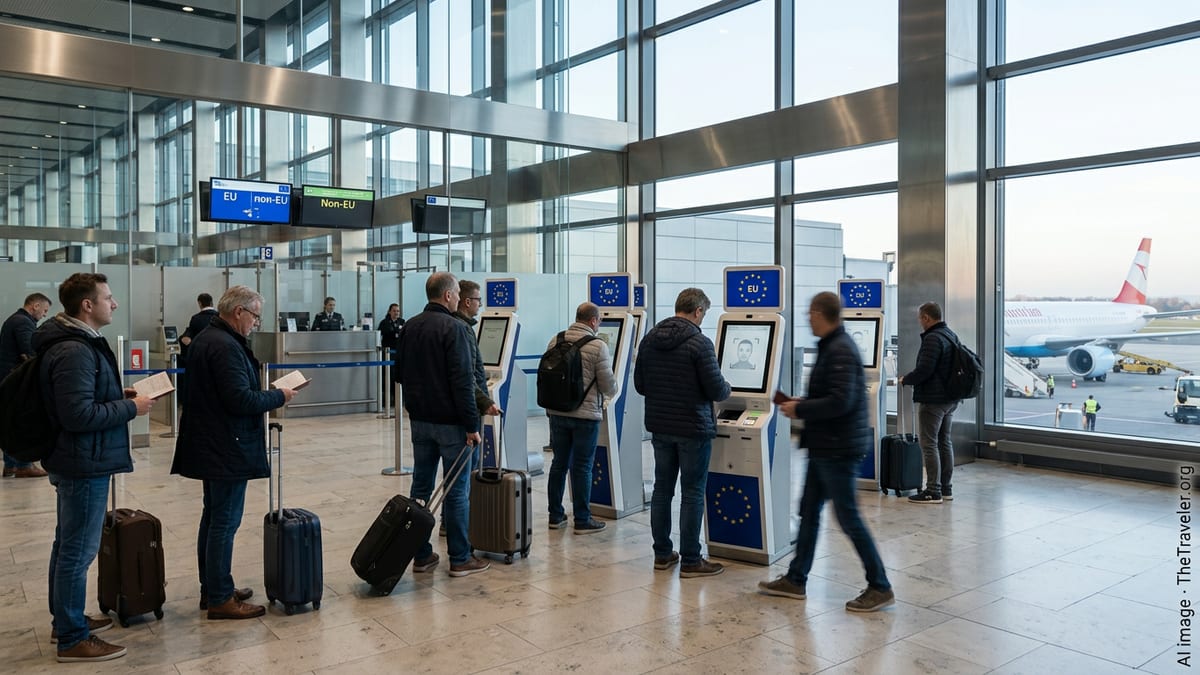
Digital border project meets real-world bottlenecks
The Entry/Exit System, or EES, is the European Union’s new biometric database for non-EU nationals crossing the external borders of the Schengen area. It became fully operational across participating states in April 2026 after a phased rollout that began in October 2025, replacing manual passport stamping with electronic registration of fingerprints, facial images and travel movements.
Publicly available information shows that EES was designed to tighten security, curb overstays and speed up border checks over time by automating processes that were previously manual. However, early months of live operation have exposed a sharp gap between the system’s technological ambitions and the realities of crowded terminals, staffing limits and uneven infrastructure at airports, ports and land crossings.
Airline and airport associations have repeatedly warned that the combination of biometric capture, unfamiliar procedures for first-time users and legacy staffing levels risks creating multi-hour queues, particularly at popular holiday gateways. Industry statements in early 2026 pointed to wait times already reaching two hours at some border posts for third-country nationals, raising alarm about the approaching peak summer season.
In response, national authorities have quietly turned to the flexibility built into the EU’s progressive launch framework, which allows EES use to be scaled up in stages and, under certain conditions, partially or temporarily suspended when it threatens to overwhelm border operations.
Targeted pauses keep holiday traffic moving
Across Europe’s main travel hubs, reports indicate that border agencies are increasingly resorting to short-term pauses or partial deactivation of EES checks to prevent queues from spiralling into what airport operators describe as a safety and crowd-control risk. These measures do not amount to scrapping the system; instead they are tactical time-outs deployed when the flow of passengers exceeds the capacity of biometric kiosks and staffed booths.
Accounts from passengers at major hubs in France and Italy describe scenes where self-service EES kiosks were shut down or bypassed after repeated technical glitches, with travelers redirected into conventional passport-control lines. At some regional airports, terminals dedicated to third-country nationals were reportedly turned off during busy arrival banks, with officers reverting to visual checks and manual processing to clear backlogs.
Similar patterns have been reported at land and sea borders. In ferry ports linking the United Kingdom and the Schengen area, where post-Brexit checks have already lengthened processing times, border officials have been observed intermittently relaxing the requirement to put every eligible traveler through full EES registration when traffic tails stretch toward several hours. Public discussion in these gateways has focused on the practical need to keep coaches, cars and foot passengers moving to avoid gridlock around terminals.
Available industry communications suggest that these pauses tend to be short, often limited to a few hours around peak arrival and departure waves. Once crowds ease and kiosks are functioning normally, EES registration typically resumes to maintain the overall integrity of the system and avoid creating large gaps in travel histories.
Patchwork implementation across Schengen
While EES is an EU-wide project, its rollout has quickly taken on a patchwork character. The regulation underpinning the system envisages a common technical backbone operated at European level, but leaves day-to-day implementation and staffing decisions to individual member states. As a result, traveler experiences vary significantly from one gateway to another.
Some large hub airports in countries such as Germany and the Netherlands have invested heavily in extra staff, additional biometric kiosks and extensive passenger information campaigns. Reports from these locations describe manageable queues in the 30 to 45 minute range for non-EU arrivals, even at busy times, helped by pre-enrolment apps and dedicated lanes for travelers who have already completed their first registration.
Elsewhere, particularly at medium-size and regional airports, infrastructure has struggled to keep pace. Accounts from travelers landing in southern Europe highlight terminals with only a handful of functioning kiosks, inconsistent signage separating EU, already-registered and first-time EES users, and frequent switching between automated and manual processing when systems stall. In some cases, passengers report undergoing multiple registrations on different trips because their earlier data did not appear to be recognized at the border crossing point.
This unevenness has fueled criticism from tourism groups and local business associations in some destinations, who argue that the lack of a predictable, harmonized experience risks deterring visitors. However, supporters of EES counter that early turbulence is inevitable with such a wide-ranging technological shift and that performance should improve as staff gain experience and technical glitches are resolved.
Regulatory leeway keeps suspension option open
The current ability of states to pause or limit EES checks is rooted in a set of transitional rules agreed at EU level before the system went live. A progressive launch was endorsed by European institutions after concerns that a hard start on a single date could overburden both national IT systems and front-line border posts, particularly at the height of the travel season.
Under this framework, member states were permitted initially to apply EES only at selected border crossing points, and to cover only a share of eligible travelers while systems and staffing scaled up. Subsequent legal adjustments, described in Council and Parliament documentation, clarified that countries can temporarily suspend or partially deactivate EES functions at specific checkpoints for limited periods when technical disruptions or extraordinary crowding make normal operations impractical.
Airport and airline groups have pressed for these flexibilities to remain in place at least through the end of the 2026 summer season, arguing in open letters that removing the suspension option too early could lead to severe congestion. Publicly available statements from these groups warn that, without the ability to step back from full EES use during acute peaks, queues could extend to four hours or more at some hubs.
EU-level reports, however, underline that any relaxation of checks must remain exceptional and strictly time-bound, stressing the importance of moving toward full, uniform application of the system as quickly as conditions allow. Officials in Brussels are promoting a greater use of automation, pre-registration tools and better queue management as the long-term answer, rather than repeated resort to manual workarounds.
What travelers should expect in the months ahead
For visitors planning trips to Europe in late summer and into the autumn shoulder season, the practical outcome of these policy choices is a mixed picture. On one hand, the willingness of some states to pause EES checks during the worst bottlenecks is helping to avert the most extreme delays and missed connections that passenger groups had feared when the system went live.
On the other hand, this flexible approach also means travelers can face very different processing times depending on when and where they cross the external Schengen border. Early-morning and late-evening banked arrivals at leisure destinations remain particularly vulnerable to surges, especially when multiple wide-body flights land within a short window or ferries arrive at the same time as long-distance trains and coaches.
Travel advice circulating among airlines, airports and consumer groups now commonly urges non-EU passengers to arrive earlier than before for outbound flights from Europe, to allow extra time for potential EES procedures at exit as well as entry. Passengers are also being encouraged to follow airport guidance on which lanes to use, to have travel documents ready, and to be prepared for a mix of automated and manual processing depending on how local authorities are handling the system at that moment.
As the first full year of EES operation continues, the balance between security, data-driven border management and passenger convenience is still being negotiated in real time. The selective pausing of checks at pressure points has become a central tool for keeping borders flowing, even as the European Union insists that its digital entry/exit regime is here to stay.