


More news on this day
Air travel across Europe faced fresh disruption today as operational data showed 62 flight cancellations and 1,391 delays affecting key hubs in the Netherlands, Spain, Italy, Denmark and Sweden, with services operated by British Airways, SAS, Norwegian, Austrian Airlines, Icelandair and other carriers experiencing knock-on impacts at airports including Amsterdam, Barcelona, Rome, Copenhagen and Oslo.
Get the latest news straight to your inbox!
Widespread Disruptions Across Major European Hubs
Operational snapshots from flight-tracking and airport information platforms indicate that Europe’s busiest hubs are again under pressure, with a relatively small number of outright cancellations masking a far larger wave of delays. The latest aggregated figures highlight 62 cancelled services alongside 1,391 delayed departures and arrivals, affecting traffic flows across northwestern and southern Europe.
The Netherlands, Spain and Italy are among the most affected, with Amsterdam Schiphol, Barcelona El Prat and Rome Fiumicino all reporting a build-up of delayed movements. Northern Europe has not been spared, as Copenhagen, Oslo and major Swedish airports report extended turnaround times, tighter slot management and revised departure boards.
While individual airports continue to handle the majority of their scheduled operations, the volume of delayed flights is creating ripple effects on aircraft rotations and crew planning across the continent. Even modest timetable changes at one hub are feeding into rolling disruptions for connecting passengers and later departures elsewhere in the network.
Data available from independent tracking services suggests that, although cancellations remain relatively contained compared with past major disruption events, the sheer scale of delays is enough to strain airport infrastructure, baggage handling and customer service operations at multiple airports simultaneously.
Key Airlines and Routes Feeling the Strain
The knock-on impact of today’s disruption is being felt across a broad mix of network and low-cost carriers. British Airways services linking the United Kingdom with hubs such as Amsterdam and Rome feature among the affected flights, with delays on both outbound and inbound rotations spilling into later departures as aircraft and crews fall out of their planned patterns.
Scandinavian flag carrier SAS faces a particularly complex operational picture, given its dense schedule across Denmark, Sweden and Norway and its reliance on hubs at Copenhagen, Stockholm Arlanda and Oslo Gardermoen. Publicly available information shows SAS adjusting departure times on routes into and out of Amsterdam and other European cities, adding to the overall delay statistics and requiring passengers to recheck schedules throughout the day.
Norwegian-operated services, including links from Spain and Italy into the Nordic region, are also exposed to congestion and slot restrictions. Flight-tracking data from recent days illustrates how schedules on routes such as Barcelona to Oslo and Rome to Copenhagen can quickly slide when earlier flights in the rotation encounter delays, even when individual sectors still manage to depart and arrive on the same calendar day.
Austrian Airlines and Icelandair, which depend heavily on smooth hub operations at Vienna and Reykjavik while feeding traffic into major European nodes, are likewise caught in the broader congestion pattern. Aircraft arriving behind schedule into Amsterdam, Barcelona or Copenhagen can compress turnaround times or require schedule reshuffles, with even minor adjustments potentially triggering further delays later in the day.
Airports Balancing Capacity, Weather and Air Traffic Control Limits
Operational reports and recent airport performance data suggest that today’s disruption is part of a broader pattern in which European hubs are operating close to capacity while managing changeable weather and tight air traffic control constraints. Amsterdam Schiphol, for example, has a history of running high volumes of movements within narrow operating windows, leaving little slack when visibility, wind conditions or runway availability temporarily reduce capacity.
Barcelona and Rome, key gateways for Mediterranean and long-haul traffic, can also be vulnerable when adverse weather or local ground handling constraints intersect with peak travel periods. As aircraft queue for take-off or landing and ground operations slow, even short tactical delays can cascade into missed slots, diversions or the need to reshuffle aircraft across multiple routes.
In northern Europe, Copenhagen and Stockholm have both faced recent periods of weather-related constraints and traffic management measures, according to publicly accessible regulatory and passenger-rights discussions. When such restrictions are combined with dense schedules operated by SAS, Norwegian and other carriers, extended delays often arise even without large-scale cancellations.
Oslo and other Nordic airports act as critical transfer points for both regional and transcontinental services, meaning that any reduction in their operational flexibility quickly affects connecting itineraries. Airlines are then forced to prioritise certain flights for on-time departure, while others absorb delays to maintain overall network stability.
Impact on Travellers and Passenger Rights Under EU Rules
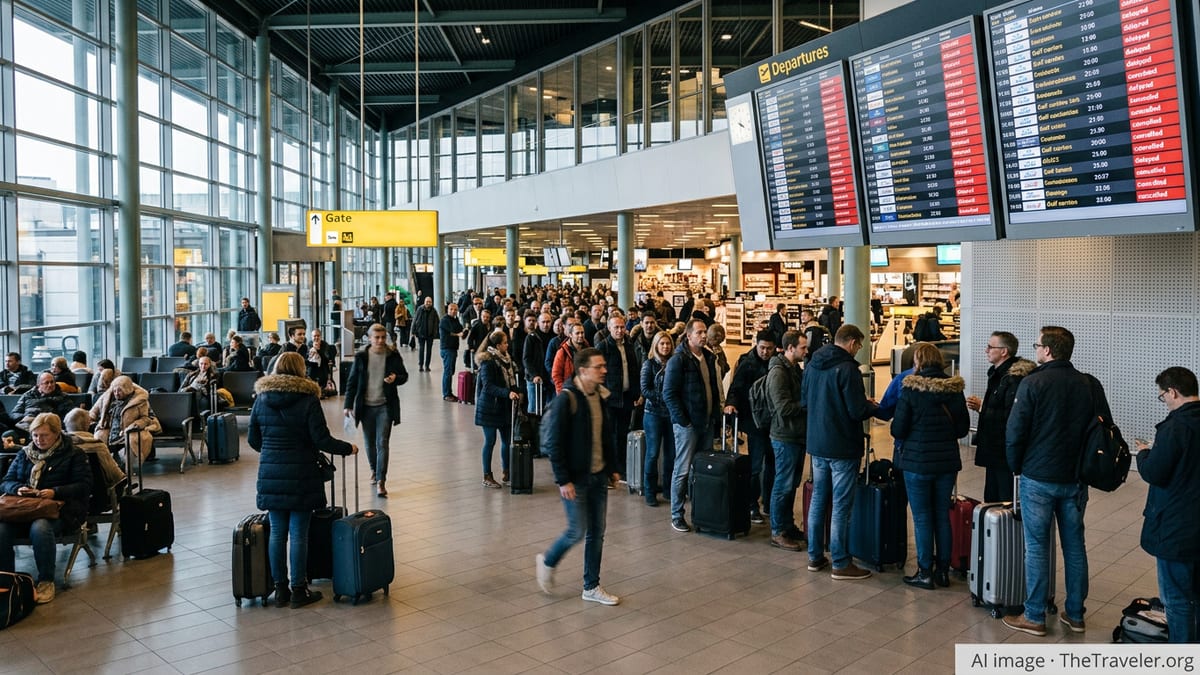
For passengers, the immediate effect of 62 cancellations and more than a thousand delayed flights is felt in missed connections, disrupted holiday plans and extended airport waits. Crowded terminals at Amsterdam, Barcelona, Rome and Copenhagen can heighten the sense of uncertainty, particularly when departure boards update frequently and estimated times shift throughout the day.
Consumer advocacy organisations and passenger-rights platforms continue to highlight the protections available under EU and UK regulations. Under the EU261 framework, travellers on eligible itineraries may be entitled to assistance, rerouting or financial compensation depending on the length of delay, the distance flown and the reasons behind the disruption. Those flying with British, SAS, Norwegian, Austrian Airlines, Icelandair and other affected carriers are being urged through public guidance to retain boarding passes, note actual arrival times and keep records of any additional expenses.
However, the extent to which compensation applies can depend heavily on whether airlines classify today’s disruptions as the result of extraordinary circumstances such as severe weather or air traffic control restrictions. Recent public cases involving delayed departures from Nordic and Benelux hubs illustrate that the interpretation of these rules can be contested, with some passengers seeking redress through national enforcement bodies when claims are rejected.
Travel experts quoted in open guidance materials recommend that affected passengers first make use of official airline apps and airport information screens for real-time updates, then consult passenger-rights resources once the immediate travel problem has been resolved. This approach can help travellers understand whether they may claim reimbursement for meals, accommodation or alternative transport after they have secured a new itinerary.
What Travellers Should Do Now
With delays and limited cancellations still evolving across multiple European hubs, travellers scheduled to fly through Amsterdam, Barcelona, Rome, Copenhagen, Oslo or major Swedish airports are being advised in public guidance to build extra time into their itineraries. Those with tight connections, particularly on separate tickets, face a higher risk of missed onward flights when initial sectors depart late.
Airline and airport tools that provide live status updates can be critical in these conditions. Passengers are encouraged by widely available travel advice to monitor their flight numbers closely on the day of departure, sign up for notifications where possible, and check for any gate or timing changes before proceeding through security or to remote boarding areas.
At the airport, keeping receipts for meals, refreshments and any emergency purchases is important for potential later claims. Where overnight stays become necessary because of missed connections or long delays, public guidance suggests asking airlines at the service desk or via digital channels what assistance may be offered, while also documenting any self-funded accommodation if prompt support is not available.
For upcoming trips, some travel-planning resources now suggest choosing longer layovers when connecting through Europe’s most congested hubs, particularly during peak holiday periods or when weather forecasts indicate potential disruption. While such precautions cannot eliminate the risk of delay, they can provide a useful buffer when widespread congestion, like that seen today, sweeps across the continent.