


More news on this day
Thousands of passengers have been stranded across Europe after a new wave of flight disruption brought 4,769 delays and at least 278 cancellations to airports in Italy, Spain, the Netherlands and other countries, heavily impacting British Airways, Lufthansa, KLM and several other major carriers at hubs including London and Munich.
Get the latest news straight to your inbox!
Wide Disruption Across Europe’s Summer Network
The latest data from flight-tracking and passenger-rights platforms shows Europe’s already fragile summer schedule coming under renewed pressure, with disruption concentrated over a single 24-hour period. Delays and cancellations have rippled across multiple national airspaces, from Italy and Spain in the south to the Netherlands and Germany further north.
Operational statistics indicate that, in aggregate, 4,769 flights were delayed and 278 were cancelled in Europe over the period, affecting both short-haul and long-haul services. The pattern is consistent with earlier spikes in June, when several days saw more than 2,000 delayed flights and around 200 cancellations across the region, particularly at large connecting hubs.
As flights fell out of their planned rotations, aircraft and crews were left out of position, amplifying disruption well beyond the airports where problems first appeared. Travellers reported missed connections, involuntary overnight stays and last-minute reroutings as airlines struggled to realign schedules during one of the busiest travel windows of the year.
While no single cause has been identified, a combination of air-traffic control constraints, weather, infrastructure bottlenecks and airline staffing and fleet pressures has been cited in recent days in connection with similar episodes. The complexity of Europe’s interlinked hub-and-spoke networks means that localised problems can quickly cascade into a continent-wide issue.
Major Hubs From London To Munich Under Strain
Large hub airports once again bore the brunt of the turmoil. London’s main gateways, particularly Heathrow, saw extensive knock-on delays that affected British Airways and partner airlines across both European and intercontinental routes. Publicly available flight-status data for individual services shows multiple departures from London to European cities operating significantly behind schedule or being withdrawn entirely on the day of departure.
In Germany, Munich and Frankfurt felt the strain on Lufthansa’s network. Earlier in June, Lufthansa had already contended with a major operational setback that led to more than a hundred cancellations and several hundred severe delays in a single day across its Munich and Frankfurt hubs. The latest spike adds further congestion to already stretched schedules, complicating connections for travellers heading between Europe, North America, Asia and the Middle East via German hubs.
The Netherlands also featured prominently, with Amsterdam Schiphol once more appearing among the hardest-hit airports. Published disruption summaries for June show Schiphol repeatedly logging hundreds of delays and dozens of cancellations in a day, particularly affecting KLM, which relies on the airport as its primary connecting hub. Any fresh wave of disruption quickly affects passengers travelling onward to the United States, Canada, Africa and Asia via Amsterdam.
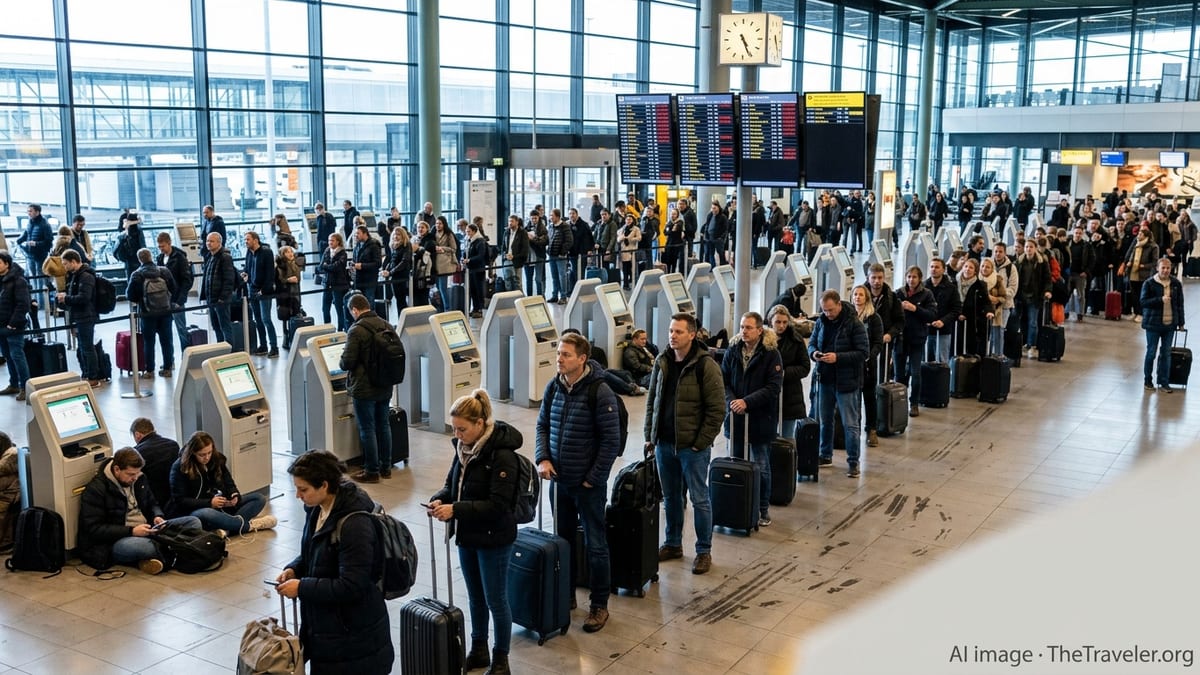
Southern European gateways in Italy and Spain have likewise seen congestion grow as delays accumulate. Reports of crowded terminals at airports serving cities such as Madrid, Rome and Milan mirror scenes previously documented during earlier disruption events this spring, where passengers were left queueing for rebooking desks, baggage assistance and accommodation vouchers late into the evening.
British Airways, Lufthansa And KLM Among Most Affected
Among individual airlines, British Airways, Lufthansa and KLM stand out as some of the most heavily exposed carriers in the latest disruption, reflecting their reliance on complex hub operations. Data compiled by traveller-rights services during recent June events shows these three airlines frequently appearing near the top of daily rankings for delays and cancellations across Europe.
On particularly difficult days this month, British Airways and Virgin Atlantic together have logged dozens of cancellations and several hundred delays from London Heathrow alone, while KLM has led disruption metrics on some dates with more than 150 delayed flights and several dozen cancellations centred on Amsterdam. Lufthansa, meanwhile, has faced multiple days with elevated disruption numbers at Frankfurt and Munich, including one episode with more than 150 cancellations in a single day.
Other carriers, including low-cost and regional operators, have also been drawn into the latest wave as shared airspace constraints and aircraft rotations link their operations to those of the large network airlines. Services run by partner or codeshare airlines frequently bear the impact when a major hub carrier adjusts its schedule, with passengers sometimes discovering changes first through mobile apps or departure boards rather than direct notifications.
For travellers, the result has been long queues at customer-service points, difficulty securing same-day alternatives and growing concern about onward connections, especially for those travelling from secondary cities to intercontinental departures in London, Munich or Amsterdam.
Thousands Of Travellers Stranded Or Re-Routed
The high volume of disrupted flights means the number of affected passengers runs into the tens of thousands. Even assuming conservative average load factors, the combination of 4,769 delayed flights and 278 cancellations would be sufficient to leave many travellers stranded overnight or arriving significantly later than planned.
Accounts shared on public forums over the past few days describe travellers facing multi-hour delays that ultimately turned into cancellations, as well as rebookings that failed to materialise. Some passengers returning from long-haul routes reported arriving at European hubs only to learn that their onward connections to cities such as London, Paris or Munich had been cancelled while they were in the air.
Others describe being rerouted through unfamiliar airports or being moved to competing airlines at short notice when original carriers were unable to accommodate them on their own metal. While such rebookings can sometimes reduce delays, they can also add complexity when baggage handling, seat allocations and through-ticketing are involved.
Family groups and travellers with time-sensitive commitments, such as cruises, tours or business meetings, appear particularly vulnerable to the rolling disruption, as missed connections may render entire itineraries impossible to complete as planned.
What Passengers Can Expect Under European Rules
The disruption has renewed attention on European and United Kingdom air-passenger protection frameworks. Under Regulation EC 261/2004 and its UK equivalent, travellers departing from airports in Italy, Spain, the Netherlands, Germany and other European countries, or flying into Europe on an EU or UK carrier such as British Airways, Lufthansa or KLM, may be entitled to assistance and, in some cases, financial compensation.
Public guidance from consumer advocates notes that, depending on the distance of the flight and the length of the delay on arrival, eligible passengers can claim fixed-sum compensation if the disruption is attributable to the airline and not to extraordinary circumstances such as severe weather or widespread air-traffic control shutdowns. In addition, airlines are generally required to provide so-called duty of care, including meals, refreshments and accommodation where necessary, when significant delays or cancellations occur.
Specialist claim services that track day-by-day disruption across Europe report that recent June events, with thousands of delayed flights and dozens or hundreds of cancellations on single days, fall squarely within the scope of these regulations for many passengers. However, the burden remains on travellers to document their cases with boarding passes, written notices of delay or cancellation, and receipts for out-of-pocket expenses.
With the peak summer travel season only just beginning, analysts caution that similar disruption may recur if underlying capacity and staffing constraints are not addressed. Travellers scheduled to fly through London, Munich, Amsterdam or major airports in Italy and Spain in the coming weeks are being advised by consumer groups and travel agents to monitor flight status closely, allow generous connection times and familiarise themselves with their rights in case of further large-scale delays or cancellations.