


Turkish Airlines quietly entered the U.S. credit card market with the Miles&Smiles Premier Visa Signature card, promising easy status miles, Turkish Airlines lounge access and boosted rewards on everyday spending. On paper, it looks like a powerful tool for anyone who flies regularly between the United States, Turkey and beyond. In practice, the value is much more nuanced. After digging through the fine print, current terms and plenty of real traveler reports, here is a grounded look at whether this card actually earns a place in a serious traveler’s wallet.
Get the latest updates straight to your inbox!
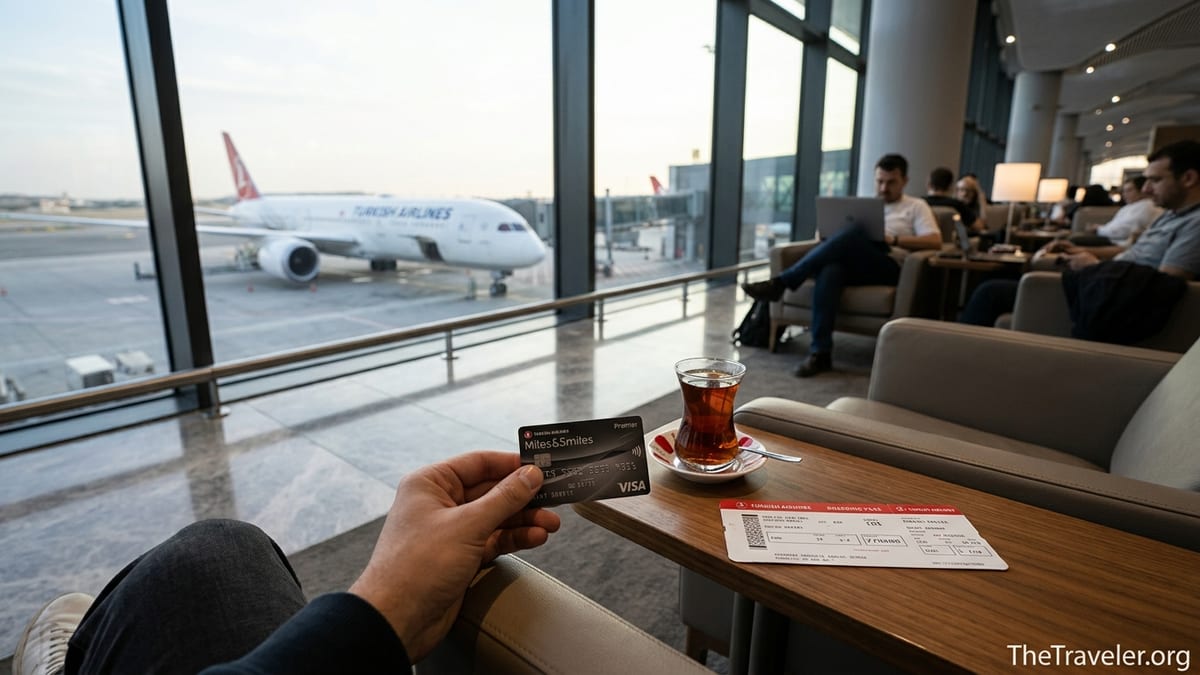
What the Turkish Airlines Miles&Smiles Premier Visa Actually Is
The Turkish Airlines Miles&Smiles Premier Visa Signature Credit Card is a co-branded travel rewards card for U.S. residents, issued by First Electronic Bank and powered by fintech company Imprint under the Visa Signature network. It launched for the U.S. market in mid-2024 and is currently the only Turkish Airlines co-branded card available to American travelers. That alone makes it interesting if you are loyal to Turkish Airlines or often rely on Star Alliance partners such as United, Lufthansa or Swiss.
The card carries a 99 dollar annual fee that posts on your first statement, along with a standard revolving credit structure and interest charges based on the average daily balance method. There are no foreign transaction fees, which matters if you routinely spend in Turkish lira in Istanbul, euros in Germany or other currencies across Turkish Airlines’ extensive network. From a cost perspective, the 99 dollar fee puts it in the same ballpark as many entry-level airline cards from U.S. carriers, but without the checked-bag perks that American travelers may be used to.
On the rewards side, recent program details show that the card can earn up to 40,000 bonus miles for new cardholders who meet spending thresholds: 25,000 bonus miles after 2,000 dollars spent in the first 90 days, and an additional 15,000 miles after a further 6,000 dollars in spending within the first year. Day-to-day earning is structured at 3 miles per dollar on Turkish Airlines purchases and other selected categories, 2 miles per dollar on common travel lifestyle categories such as dining, groceries, entertainment and lodging, and 1 mile per dollar on all other purchases. These rates are competitive with other co-branded airline cards, but the true value depends on how easily you can redeem Turkish miles.
Crucially, the card is deeply tied to the Miles&Smiles loyalty program. Everything you earn funnels into Turkish Airlines’ own miles currency instead of a flexible bank points system. That works well if you are actively booking Turkish or Star Alliance award flights, but it can be an obstacle if you want simple cash back or easy redemptions like with a general travel card from Capital One or Chase.
Headline Benefits: Status Miles, Lounge Access and Priority Treatment
The most distinctive features of the Miles&Smiles Premier Visa are not the earning rates but the airline-style benefits attached to the plastic itself. According to Turkish Airlines’ latest benefit guide, cardholders earn 125 status miles for every 500 dollars in net purchases posted in a statement cycle, up to a cap of 5,000 status miles per calendar year. These status miles count toward elite tiers in the Miles&Smiles program but cannot be spent on flights or upgrades. In practical terms, if you put 20,000 dollars of eligible spending on the card in a year, you would max out that 5,000 status mile boost, which might help bridge the gap to Classic Plus, Elite or Elite Plus status if you are already flying Turkish several times per year.
Lounge access is another major selling point. Cardholders receive complimentary access to a defined list of Turkish Airlines-branded lounges when flying on a Turkish Airlines ticket. The current list includes key international locations such as New York JFK, Miami, Washington Dulles, Bangkok Suvarnabhumi, Nairobi and Narita in Tokyo, plus domestic lounges in Istanbul Airport, Istanbul Sabiha Gokcen, Antalya, Ankara, Izmir, Bodrum and several other Turkish regional airports. Access is tied to both your boarding pass and the Premier Visa, and the name on the card must match the passenger name record.
Unlike many U.S. cards that offer only the primary cardholder access, Turkish’s terms explicitly allow qualifying family members or one companion traveling on the same reservation to use the lounge benefit with you. For example, if you are flying from New York JFK to Istanbul in economy with your spouse and two teenage children on the same booking, you could all relax in the Turkish Airlines lounge at JFK before your overnight flight without paying per-person lounge entry fees. If you value lounge entry at roughly 40 to 50 dollars per visit, a family of four using the lounge twice a year could easily outweigh the 99 dollar annual fee in lounge value alone.
The card also grants priority check in and priority boarding on Turkish Airlines flights arriving to or departing from the United States. In practice, that can mean using the business or priority lanes at check in counters at airports like Los Angeles, Chicago or Houston, and boarding ahead of the main economy cabin. For long-haul departures, this can reduce time spent in lines and increase your chances of finding overhead bin space. Importantly, the priority benefit also extends to a spouse, children under 25, or one non-family companion on the same booking.
Real-World Earning: How Many Miles Can You Actually Get?
On paper, the earning structure looks straightforward, but it helps to work through real examples. Suppose you are a U.S.-based traveler who flies Turkish roundtrip from Chicago to Istanbul once a year for about 1,200 dollars in economy, spends 8,000 dollars annually on dining and groceries, 2,000 dollars on hotels and entertainment, and another 10,000 dollars on everything else. If you put all of that on the Premier Visa, your annual earnings might look like this: 1,200 dollars in Turkish tickets at 3x yields around 3,600 miles, 10,000 dollars in bonus categories at 2x yields 20,000 miles, and 10,000 dollars in other spending at 1x yields 10,000 miles. Add the 40,000-mile welcome bonus if you meet the first-year thresholds, and you are looking at roughly 73,600 miles in year one.
Turkish’s award chart is known for sweet spots, especially on Star Alliance partners. For instance, economy flights within the United States on United can sometimes be booked for about 7,500 Turkish miles each way on domestic routes, and economy to Europe from the U.S. has historically been priced attractively as well. In practice, travelers have used around 15,000 Turkish miles for roundtrip domestic U.S. itineraries on United and roughly 45,000 to 60,000 miles for one way business class awards between North America and Europe, depending on routing and current rules. While exact pricing and availability fluctuate, the point is that 70,000 Turkish miles can comfortably cover at least one long-haul one way premium cabin ticket or multiple shorter trips within the U.S. on United when booked through Miles&Smiles.
However, everyday earning on this card competes with flexible points credit cards that also transfer to Turkish. Capital One Venture, Venture X, Bilt Rewards and some Citi and American Express cards allow 1:1 transfers into Miles&Smiles, and many of those products earn 2x on all purchases or offer richer travel credits and protections. Some current cardholders of the Turkish co-branded card report that after securing the sign-up bonus and testing the benefits, they now primarily use general travel cards for daily spend and move points into Turkish only when they are ready to book a specific award.
The status miles earning feature is useful, but capped. A heavy spender putting 40,000 dollars a year onto the card still only gets 5,000 status miles from the spending component. To reach or maintain Turkish Elite status, you will still need a significant amount of butt-in-seat flying. If your main objective is elite status with lounge access and extra baggage, it might be more efficient to concentrate on actual Turkish or Star Alliance flights instead of relying on status miles from the card.
Traveler Experiences: The Good, the Frustrating and the Unexpected
Since the card’s 2024 launch, traveler feedback has ranged from pleasantly surprised to deeply frustrated. On the positive side, some frequent Turkey flyers report that the card does what it promises: accelerated miles on Turkish tickets, easy lounge access at Istanbul and U.S. gateway airports, and a welcome bonus that quickly covered an award ticket back to Istanbul or a domestic trip on United. One U.S.-based passenger who flies to Turkey frequently described meeting the 5,000 dollar spend needed for the initial 25,000-mile bonus quickly and then using those miles to shave a big chunk off a future trip’s cost.
Others emphasize that the card’s value is tightly linked to how often you use the Turkish ecosystem. Several cardholders share that, once they unlocked their initial bonus miles and realized how dependent redemptions are on Turkish’s sometimes opaque IT systems and customer service, they stopped using the card for general spending. They now reserve it strictly for Turkish ticket purchases from the U.S. and lean on other cards that also transfer to Miles&Smiles when they need more miles for a specific booking.
There are also reports of real headaches. Some early adopters noted that linking an existing Miles&Smiles loyalty account to the new U.S. credit card took weeks of back-and-forth with support, meaning miles earned on the card did not immediately appear in their airline account. Others have been surprised by the program’s strict rules, such as the limited flexibility around transferring or using miles for friends or family without additional verification, or difficulty resolving issues when miles transfers from partners like Bilt or bank points lag or get stuck.
Finally, some travelers have been disappointed by expectations versus reality around benefits like priority boarding. At least one traveler recounts assuming that simply holding the Premier Visa automatically granted high boarding priority on every U.S.–Turkey flight, only to learn that check in agents sometimes misunderstand or apply the rules inconsistently. The lesson: even when a benefit exists on paper, you may occasionally need to politely advocate for it at the airport counter.
How It Compares to Other Options for Turkish Flyers
To decide if the Miles&Smiles Premier Visa is worth it, you have to compare it to realistic alternatives. For many U.S. travelers, the main competitors are general travel cards with 2x earning on everything and the ability to transfer points into Miles&Smiles. Cards like Capital One Venture and Venture X, as well as Bilt for renters, allow you to build a balance of flexible points and then move what you need into Turkish when you find a good award seat. These products often include wider lounge networks, travel credits, stronger trip protections and the option to redeem points at fixed values for any travel purchase.
Imagine you spend 20,000 dollars a year on travel and everyday expenses. With a 2x-everywhere card that transfers to Turkish, you would bank 40,000 transferable points, which could become 40,000 Turkish miles if you choose. With the Turkish Premier Visa, that same spending might net you roughly 30,000 to 35,000 Turkish miles, depending on how much falls into bonus categories and whether you are buying Turkish tickets. The Premier card gives you status miles and branded lounge access, but you sacrifice some flexibility and potentially raw points earning compared with a strong general travel card.
On the airline card side, the Turkish card’s 99 dollar fee is similar to mainstream U.S. co-branded cards like the United Explorer, Delta Gold or American Airlines AAdvantage Platinum Select, but its feature mix is different. Those U.S. carriers tend to offer first checked bag free on their own flights, priority boarding, and in some cases companion certificates. The Turkish card focuses instead on Turkish-specific lounge access, status miles and limited priority services. If your primary flying is within the U.S. on domestic carriers and you only occasionally connect onward to Turkish, a U.S. airline card may provide more day-to-day value.
Another angle is how you value customer support and digital tools. Turkish’s Miles&Smiles platform and website can feel clunky compared with the polished apps from major U.S. banks and airlines. Finding award availability online, ticketing Star Alliance partner itineraries, or fixing errors can require phone calls, emails or even visits to airport ticket offices in some cases. Travelers who prefer seamless self-service booking may find the combined friction of the Turkish program and a locked-in co-branded card unappealing, especially when flexible bank points cards give them multiple airline options.
Who This Card Is Great For, and Who Should Skip It
When you lay out the details, a clear profile emerges of who should seriously consider the Turkish Airlines Miles&Smiles Premier Visa. The card shines for U.S.-based travelers who fly Turkish Airlines at least once a year, value relaxing in a Turkish lounge at Istanbul or key U.S. airports before long overnight flights, and are willing to invest the time to understand and exploit Turkish’s award sweet spots. If you frequently shuttle between cities like New York, Chicago, Houston or Los Angeles and Istanbul, and often continue onward to Europe, the Middle East, or Africa on Turkish metal, the combination of 3x earning on Turkish tickets, bonus miles, status mile boosts and lounge access can offer outsized value for a modest 99 dollar fee.
It can also be a good fit for travelers who already use a flexible points ecosystem to feed Turkish redemptions but want guaranteed Turkish-branded lounge access even when they are not flying in business class. A classic case would be a family from Boston that connects via New York or Washington to Istanbul in economy each summer. Paying 99 dollars a year for a card that gets them and their kids into comfortable lounges at JFK and Istanbul, plus fills in status miles to maintain elite benefits, might easily be worth it alongside a general travel card.
On the other hand, the card is a poor match for casual or infrequent Turkish flyers. If you only fly Turkish once every few years, you are unlikely to fully exploit lounge access, status miles and priority services. In that situation, a no-annual-fee card or a flexible travel rewards product will usually offer more everyday value. Similarly, travelers who dislike dealing with complicated frequent flyer programs or who prioritize frictionless customer service may want to avoid centering their strategy on Miles&Smiles at all.
Finally, if your travel is heavily domestic within the United States and you rarely touch Star Alliance partners, a co-branded card tied to United, Delta or American might give you more concrete perks on the flights you actually take. Free checked bags, companion certificates and easier upgrades often matter more for those routes than Turkish-specific lounge access that you might never use.
The Takeaway
Weighing real benefits, current terms and traveler experiences, the Turkish Airlines Miles&Smiles Premier Visa is a niche but potentially powerful tool. It is not a must-have general travel card, nor is it the simplest way to accumulate airline miles. Instead, it is best viewed as a specialized accessory for travelers who are already committed to flying Turkish and squeezing value from the Miles&Smiles program.
If you fly Turkish Airlines between the United States and Istanbul at least annually, care about airport comfort, and are willing to learn how to book Turkish and Star Alliance awards, the 99 dollar annual fee can be easily justified through lounge visits, a strong welcome bonus and ongoing miles. If you rarely see a Turkish boarding pass in your hand or prefer straightforward, flexible points, though, you will likely be better off with a mainstream travel card that happens to include Turkish as one of many transfer partners.
In short: for dedicated Turkish flyers, the Miles&Smiles Premier Visa can absolutely be worth it. For everyone else, treat it as an interesting curiosity rather than a cornerstone of your travel rewards strategy.
FAQ
Q1. Does the Turkish Airlines Miles&Smiles Premier Visa have foreign transaction fees?
The current version of the card for U.S. residents does not charge foreign transaction fees, which makes it practical for spending in Turkey and other countries on Turkish’s network.
Q2. How much is the annual fee and can it be waived?
The annual fee is 99 dollars and is typically charged on your first statement. As of the latest information, there is no routine waiver, although promotional offers can always change in the future.
Q3. Do I get free checked bags on Turkish Airlines with this card?
No, the card’s main benefits center on lounge access, earning miles and status miles, and priority services. It does not currently advertise a free checked bag benefit on Turkish flights.
Q4. Can I access Turkish Airlines lounges even if I am flying economy?
Yes. As long as you are flying on a Turkish Airlines-operated flight and meet the card’s lounge conditions, you can use eligible Turkish-branded lounges in economy, often along with your immediate family or one companion on the same booking.
Q5. How quickly do miles earned on the card post to my Miles&Smiles account?
In general, miles post after each statement cycle once your loyalty number is correctly linked. Some travelers have reported delays or initial setup issues, so it is wise to verify that your Miles&Smiles number is properly attached soon after approval.
Q6. Is the welcome bonus enough for a free flight?
The welcome bonus can often cover at least one simple roundtrip within certain regions or significantly reduce the cost of a long-haul trip. Exact value depends on the route, cabin, and award pricing at the time you book.
Q7. Are the status miles I earn from spending the same as regular miles?
No. Status miles earned from spending help you reach or maintain Miles&Smiles elite tiers but cannot be redeemed for tickets or upgrades. Redeemable miles and status miles are tracked separately in your account.
Q8. Can I get this card if I am new to the Miles&Smiles program?
Yes. You can typically enroll in Miles&Smiles during the card application process or link an existing account. Just ensure that your name and details match exactly to avoid linking problems.
Q9. How does this card compare to just using a general travel card that transfers to Turkish?
General travel cards can earn more versatile points and often have broader benefits. The Turkish card trades that flexibility for Turkish-specific perks like lounge access and status miles, which are most valuable if you travel on Turkish frequently.
Q10. Is this card worth keeping after the first year?
It is worth keeping if you realistically use lounge access several times per year, continue to fly Turkish regularly and value the status mile boost. If not, many travelers downgrade their Turkish strategy to flexible bank points and close or sideline the card after earning the initial bonus.