


More news on this day
Major European airports are once again struggling to keep flights moving as fresh disruption ripples across the continent, with publicly available trackers showing 1,603 services delayed and 49 cancelled in a single day, affecting routes operated by Lufthansa, Ryanair, easyJet and several other carriers and causing long waits for passengers in hubs such as Amsterdam and Copenhagen.
Get the latest news straight to your inbox!
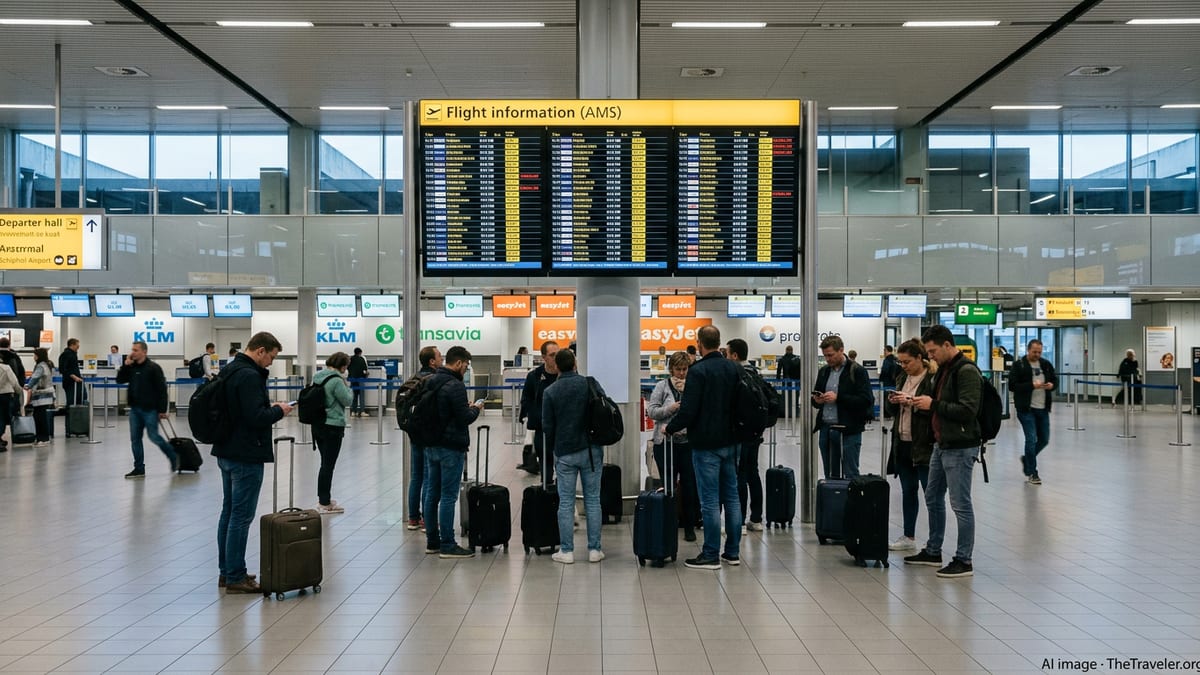
Wide Disruption Across Northern and Western Europe
The latest wave of disruption has put particular pressure on airports in the Netherlands, France, Sweden and Denmark, alongside a string of other European countries. Data compiled from flight tracking platforms and industry reports points to an intense day of operational strain, where traffic bottlenecks translated into late departures, missed connections and overcrowded terminals.
Amsterdam Schiphol, Copenhagen, and other major hubs in northern Europe have been repeatedly highlighted in recent travel disruption summaries as among the hardest hit. Amsterdam, already familiar with operational pressure from weather and capacity constraints earlier in the summer, again reported a high volume of delayed movements, while Copenhagen has seen processing times lengthen as passenger queues build during peak departure banks.
The combined impact across the region reflects a pattern that has been emerging since late June. A mix of unstable summer weather, heavy demand, and complex airspace management has repeatedly pushed schedules beyond their limits, leaving airlines and airports with little margin to absorb knock-on delays once the day’s first flights slip behind.
Reports from aviation analysts and consumer-focused travel outlets describe the present disruption as part of a broader period of fragile operations rather than a single one-off event. On several recent days, delay totals across Europe have run into the thousands, with cancellations clustering at a handful of major hubs.
Lufthansa, Ryanair, easyJet and Others Face Mounting Schedule Pressure
The day’s tally of 1,603 delayed flights and 49 cancellations spans a wide range of airlines, but publicly available information indicates that large network carriers and low-cost operators have been especially exposed. Lufthansa and its group partners remain particularly vulnerable where they dominate at key German hubs, while Ryanair and easyJet, with dense short-haul networks, are frequently visible in delay statistics whenever European airspace becomes congested.
Recent disruption reports for Germany and the wider region have shown Lufthansa, Eurowings and other group airlines regularly appearing in the highest delay and cancellation counts. When traffic at Frankfurt or Munich is disrupted, the effect can quickly spill into neighboring countries as connecting passengers and aircraft rotations are pushed out of position, feeding into delays on services touching Amsterdam, Copenhagen and other northern gateways.
Ryanair and easyJet, meanwhile, operate extensive point-to-point networks serving a wide range of secondary and primary airports across Europe. Industry coverage notes that when air traffic control restrictions or local weather events slow the system, their multi-sector daily rotations leave little spare time to recover. A single lengthy delay or cancellation early in the day can cascade across several routes, including those linking to the Netherlands, France, Sweden and Denmark.
Other carriers, including Air France, KLM, SAS and British Airways, have also featured prominently in recent delay figures. Their roles as national or hub carriers mean that any disturbance on home turf has a disproportionate effect on travelers attempting to make connections across Europe or to long-haul destinations.
Amsterdam, Copenhagen and Other Key Hubs Under Strain
Amsterdam Schiphol and Copenhagen have emerged as focal points in the current episode of travel chaos, although they are far from alone. Amsterdam continues to juggle high summer demand with operational constraints that leave limited flexibility when storms, crosswinds or airspace bottlenecks reduce runway capacity. Earlier in the season, heat and storms already led to substantial delay and cancellation totals at Schiphol, and observers note that the airport has remained sensitive to further disruption.
Copenhagen, a crucial hub for Scandinavia and the Baltic region, has been under particular scrutiny as passenger volumes surge into the peak holiday period. Travel writers describe longer processing times at security and border checkpoints, while the broader European Entry/Exit System rollout has added extra steps for some non-EU travelers. Any slowdown on the ground has the potential to ripple into the flight schedule, particularly during morning and evening peaks.
Other hubs have also played a part in the day’s disruption totals. Airports in France, including Paris Charles de Gaulle and Orly, as well as major gateways in Sweden such as Stockholm Arlanda, have been affected both by local weather and by air traffic control constraints in surrounding airspace. Reported figures in recent days show that capacity limits and temporary route restrictions can quickly translate into holding patterns, slot delays and missed departure windows.
Secondary airports have not been spared. Facilities serving popular leisure destinations and regional business centers have seen departures pushed back as incoming aircraft arrive late from congested hubs. In some cases, night curfew rules at noise-sensitive airports have forced airlines to cancel late-evening departures altogether when delays accumulate beyond a certain threshold.
Underlying Causes: Weather, Airspace Congestion and Systemic Fragility
Analysts point to a combination of factors behind the latest disruption. Weather continues to play a central role, with summer thunderstorms, crosswinds and episodes of heat affecting performance across northwestern Europe. In recent weeks, a prolonged heatwave and storm systems over parts of the continent have contributed to thousands of delays and more than a hundred cancellations as runways and airspace sectors operated at reduced capacity.
Airspace congestion is another key driver. Performance reports from European network managers for the first half of 2026 highlight steadily rising average delay per flight, with traffic levels approaching or surpassing pre-pandemic volumes. Capacity constraints in busy corridors, particularly over France and Germany, can have far-reaching consequences for flights connecting the United Kingdom, the Netherlands, the Nordic countries and southern Europe.
Operational fragility within airlines and airports adds a further layer of risk. Industry coverage has repeatedly raised concerns about staffing levels in ground handling, security and air traffic control. When demand surges on peak days or unplanned absences occur, the margin for recovering from a disruption narrows. Turnaround times lengthen, baggage systems come under stress, and aircraft can quickly fall behind their planned rotations.
Technical and regulatory changes have also shaped the operating environment. The gradual implementation of new border control systems, changes to night curfew enforcement at certain airports, and evolving safety procedures all add complexity to daily planning. While these measures are intended to improve security and reliability in the long term, their short-term effect can be to slow processes and expose pre-existing bottlenecks.
What Passengers Are Experiencing and How They Can Respond
For travelers passing through Amsterdam, Copenhagen and other affected hubs, the immediate impact of 1,603 delayed flights and 49 cancellations is being felt in hours-long waits, missed connections and last-minute changes to holiday and business itineraries. Social media posts and travel forum discussions describe crowded departure halls, long queues at service desks and difficulty securing alternative routings at short notice on peak summer days.
Consumer advocates and travel information services are urging passengers to monitor their flight status closely, use airline apps where possible, and allow more time at the airport, especially for early morning and late-evening departures that are more vulnerable to knock-on delays. Travelers with flexible plans are often encouraged to rebook to less busy days or off-peak times when airlines waive change fees during major disruption spikes.
Under EU and UK passenger rights regulations, many travelers affected by delays and cancellations may be entitled to assistance and, in some cases, financial compensation. Guidance from legal and consumer organizations explains that eligibility depends on factors such as the length of delay, the distance of the flight and whether the disruption stemmed from extraordinary circumstances such as severe weather or air traffic control strikes. Even where compensation is not due, airlines are generally expected to provide meals, refreshments and, in the case of overnight disruption, hotel accommodation and transport to and from the airport.
Industry observers note that the pattern of repeated, large-scale disruption across Europe this summer is likely to keep pressure on airlines, airports and regulators to strengthen resilience. For now, however, passengers flying across the Netherlands, France, Sweden and neighboring countries remain at the mercy of tight schedules and crowded skies, with each new day’s figures on delays and cancellations watched closely by both the industry and the traveling public.