


By midmorning in Guayama’s historic center, the heat has already settled over the south coast, but Plaza de Recreo Cristóbal Colón still feels surprisingly welcoming. Shade from the plaza’s famously mushroom-shaped laurel trees falls in rounded patches over benches and the central fountain, and the pastel facades around the square look freshly washed in the Caribbean light. I set out from here on a slow, two-hour walk through the compact centro histórico, taking in churches, old municipal buildings, theaters and museums, and discovering that Guayama’s reputation as one of Puerto Rico’s best-preserved town centers is very well earned.
Get the latest updates straight to your inbox!
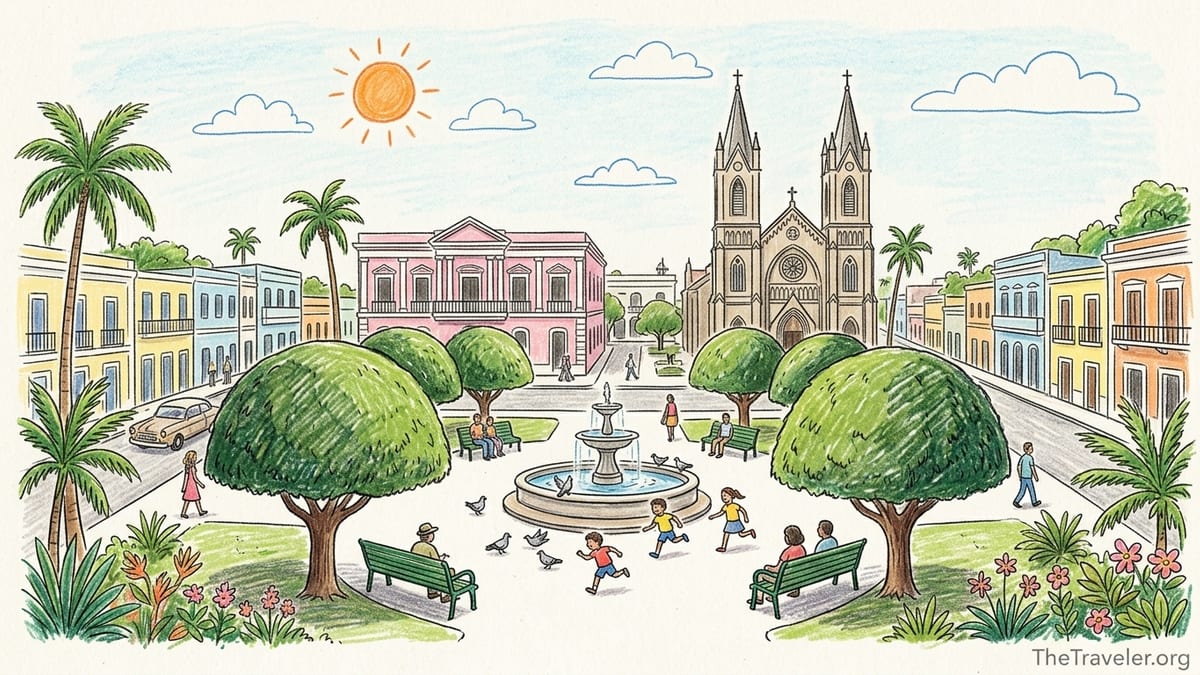
Starting at Plaza de Recreo Cristóbal Colón
I began my walk just after 10:00 a.m. on a weekday, when the sun was already strong but the plaza still had a gentle, unhurried rhythm. Plaza de Recreo Cristóbal Colón sits at the heart of Guayama’s barrio-pueblo and concentrates much of the town’s history into a few city blocks. Local guides and cultural organizations point out that Guayama is one of Puerto Rico’s clearest examples of the classic Spanish colonial grid, with the main streets crossing in a perfect cross around the central square and the largest lots reserved for civic and religious buildings. The result, when you stand in the middle of the plaza and slowly turn in a circle, is a textbook view of nineteenth-century urban life on the island.
What first caught my eye that morning was the fountain and the rows of laurels trimmed into dense, rounded canopies. Cultural groups in Guayama like to describe these trees as looking like green mushrooms, and it is accurate; each trunk flares into a solid cap that throws real, usable shade. Underneath, older neighbors chatted on benches, teenagers scrolled their phones, and a couple of kids chased pigeons around the fountain. Cars moved steadily along the perimeter streets, but the interior of the square felt buffered from traffic, thanks in part to the thick greenery and the relatively narrow lanes.
Arriving by car, parking was easier than I expected for a historic district. On the north side of the plaza, I found several free street spots mid-morning, and additional spaces opened up as office workers moved on. The streets are one-way in places and quite narrow, so drivers should take it slow and watch for pedestrians crossing between blocks. For anyone nervous about squeezing into small spaces, it is worth circling once or twice rather than rushing a tight parallel park.
From the center of the plaza, I took a few minutes just to orient myself. Facing one way, you see the neoclassical lines of the former city hall; turn slightly and you have the main parish church, San Antonio de Padua; look across again and Casa Cautiño anchors another edge. Without crossing a street, you can already read centuries of Guayama’s history in stone, stucco and wrought iron. That density of heritage is what makes this a particularly satisfying place to explore on foot.
Iglesia San Antonio de Padua: Stone, Light and Quiet
My first stop was the parish church, Iglesia San Antonio de Padua, on the east side of the plaza. Local and official tourism information note that the present church dates from the late nineteenth and early twentieth centuries, replacing an earlier hermitage and surviving major hurricanes and later reconstructions. From the plaza, the facade immediately feels grander than you would expect from a town of Guayama’s size. The twin towers, pointed arches and rose window show the clear influence of European Gothic forms, and Discover Puerto Rico highlights that the design was inspired in part by Notre Dame in Paris, adapted to local needs and materials.
Crossing the street from the plaza to the church was straightforward, with light traffic and good visibility, although there are few marked crosswalks. Stepping inside, I found the doors open and the interior quiet, with maybe a handful of worshippers scattered among the pews. There was no entrance fee that morning, and no staff at a front desk, which is common for parish churches in smaller towns. If you visit, dress modestly and keep voices low; this is primarily a place of worship, not a tourist attraction.
What surprised me most inside was how cool it felt despite the rising heat outside. Thick walls and high ceilings channeled light from stained glass windows, leaving most of the nave in a soft, filtered glow. The polished tile floor and dark wooden pews contrasted with white plaster walls, and side altars displayed statues of saints familiar across Puerto Rico. There were a few framed panels on the back walls mentioning the parish history and reconstruction after early twentieth-century storms, but interpretation in English was limited. Travelers who read Spanish will get more from the signage; others will still appreciate the space visually and acoustically, as it offers a quiet counterpoint to the activity of the plaza.
After ten or fifteen minutes, I stepped back into the square, blinking in the strong light. From this angle, the relationship between church and plaza is clear; the church anchors one side of civic life, the former city hall anchors another, and the everyday comings and goings of residents play out between. It is a pattern repeated in many Puerto Rican towns, but in Guayama it feels particularly intact.
Old Municipal Architecture and a Walk Along the Grid
From the church steps I turned left, walking clockwise around the plaza to focus on Guayama’s civic architecture. The former Casa Alcaldía, or city hall, faces the square with the kind of quiet confidence you see in buildings that have seen revolutions, hurricanes and countless patron saint festivals. Its facade shows the neoclassical vocabulary common to public architecture in Puerto Rico during the nineteenth century: symmetrical windows, a central balcony, pilasters framing the entrance, and a carefully proportioned cornice. Local heritage studies cite Guayama’s city hall and surrounding blocks as key examples of well-preserved civic architecture in the island’s south.
Late morning traffic around the plaza was moderate, with a steady flow of cars but very little honking or aggressive driving. The sidewalks are generally wide and shaded in sections by the overhanging laurel trees and the balconies of two-story buildings. Some corners have curb cuts and ramps, though not all, so visitors with limited mobility may need to plan a route that follows the most accessible crossings. I walked slowly, stopping to examine tilework and wrought-iron balconies along the side streets radiating from the square.
Continuing west along one of these side streets, you start to feel how the historic grid extends beyond the plaza. Blocks remain short and regular, buildings rarely exceed two stories, and the architectural language stays consistent: pastel stucco, tall wooden doors, louvered shutters. A cultural resource survey of Guayama’s historic zone notes that this pattern dates back to the early colonial planning of the town, reflecting the Laws of the Indies guidelines that called for an orderly grid with the main plaza at its center. Walking it today, you sense how that planning still shapes everyday life, from where people park to how they move between home, church, market and office.
Some facades are immaculate, recently painted in bright yellows and blues. Others show peeling layers, where older colors emerge beneath newer coats. A few ground floors now host modern businesses: a cellphone shop, a bakery offering pan sobao and café con leche, a small clothing boutique. Even when commercial signs appear, though, they are constrained by the scale of the buildings; nothing towers over the plaza or breaks the low roofline. That restraint keeps the historic center feeling cohesive rather than overtaken by contemporary branding.
Theaters Old and New: Teatro Guayama and Antiguo Teatro Campoamor
Looping back toward the plaza, I aimed for Guayama’s historic theaters, which Discover Puerto Rico lists among the town’s cultural highlights. The art deco Teatro Guayama stands out immediately once you reach its block, with a streamlined facade, geometric ornamentation and the name “Guayama” rising vertically above the entrance. A planning document prepared for local authorities notes that the theater originally opened in the late 1930s, built in masonry with a seating capacity of over 1,000, and served for decades as both cinema and live performance venue. Restoration efforts in recent years have focused on preserving that art deco character while updating the interior for modern cultural events.
On the morning of my visit, the main doors were closed and a notice indicated current restoration and programming details in Spanish, with upcoming cultural events listed but no daytime visiting hours for walk-in tourists. From the outside, though, the building rewards close inspection. The facade’s vertical fluting and stylized sunburst motifs are good examples of how global architectural trends reached even small Caribbean towns in the interwar period. I lingered across the narrow street, where a modest awning provided a sliver of shade, and watched a few residents pause to read the same notice board before moving on with grocery bags.
Not far from Teatro Guayama, local tourism materials also mention the Antiguo Teatro Campoamor, a historic movie theater from the 1920s. In practice, finding clear visitor information on Campoamor was more challenging. Signage in the immediate area referenced the building’s historic role in Guayama’s cultural life, but I did not find posted public hours or an obvious visitor entrance that morning. It appeared to be either under ongoing restoration or used for community functions without a set museum-style schedule. In this case, the building is best appreciated from the sidewalk as part of a larger ensemble of early twentieth-century culture in the town center.
Between these two theaters and smaller venues like the local fine arts center, you begin to understand why Guayama is often described as having a strong cultural backbone. Even when interiors are not accessible, the mere presence of multiple historic theaters within a few blocks of the main square speaks to a long-standing investment in performance, cinema and community life. Travelers who are keen on catching a show should check municipal and cultural calendars for evening events, as daytime walk-in access remains limited.
Café Stop and Reading the Street Life
By late morning, the combination of Caribbean sun and reflective pavements made shade essential. I headed back toward the plaza’s north side in search of coffee and a chance to watch the town’s rhythm. Around the square you will find several small cafés and panaderías that serve espresso drinks, pastries and light lunches. I chose a corner café facing the laurel trees, where a simple cortado and a chilled bottle of water cost under ten US dollars in total, a price in line with other small-town cafés elsewhere on the island.
Sitting by the window, I had a clear view of how Guayama’s historic center functions in everyday life. A municipal worker watered plants in the plaza; a group of high school students cut across the square in uniform; a delivery truck carefully navigated a narrow side street to drop boxes at a pharmacy. The center felt active but not touristy, with most people clearly going about regular business rather than sightseeing. For visitors, that balance means you can observe local routines up close without feeling like you are in a staged heritage district.
Noise levels were surprisingly low compared to larger cities. Occasional car radios and snippets of reggaeton passed by, but conversations at nearby tables remained audible without shouting. The laurel canopy created a microclimate a few degrees cooler than the streets just one block away, and intermittent breezes cut through the heat. If you are sensitive to high temperatures, plan your walk so that you spend the hottest midday hours either under the plaza’s trees, in a café, or inside one of the museums around the square.
Before leaving the café, I asked staff about recent changes in the area. They mentioned ongoing restoration work on several historic buildings, including theater spaces and civic facades, funded in part by post-hurricane recovery programs. That confirmed what I had sensed on the walk: Guayama’s center is not frozen in time, but actively maintained, with scaffolding here and fresh paint there. The core layout and most key buildings remain intact, yet new layers are continually added.
Casa Cautiño: A Deep Dive into Nineteenth-Century Urban Life
From the café, it was a short walk of less than two minutes across the plaza to Casa Cautiño, the stop that left the strongest impression on me. Tourism bodies and heritage organizations consistently describe Casa Cautiño as one of the finest examples of late nineteenth-century urban architecture in Puerto Rico, and it sits directly on the plaza’s edge as if overseeing the town’s civic life. Built in the 1880s for the Cautiño family, the house combines imported neoclassical elements with local materials and construction techniques, illustrating how wealthy urban elites expressed status in that period.
On the day of my visit, Casa Cautiño was open as a historic house museum, with a small staff presence near the entrance. Admission information is subject to change and was not posted in a way I felt comfortable quoting precisely for future readers, but access functioned more like a community museum than a high-cost attraction. Visitors are strongly advised to confirm current opening hours and any entrance fees directly with municipal cultural offices or up-to-date tourism sources before planning a dedicated trip, because small museums on the island sometimes adjust schedules due to staffing or maintenance.
Inside, the house unfolds around a central courtyard, with high-ceilinged rooms radiating outward. Furnishings, photographs and decorative arts pieces offer a glimpse into upper-class life in a provincial city at the end of Spanish rule and the beginning of US influence. I walked through a formal salon with carved wood furniture, a dining room set for guests, and smaller bedrooms with iron beds and embroidered linens. Informational panels, primarily in Spanish but with some English support, explain how Casa Cautiño served as headquarters for American forces during the Spanish American War and how its architecture reflects both European ideals and local adaptations to climate.
What makes Casa Cautiño especially valuable for travelers interested in architecture is the chance to see construction details up close: timber beams, brick and masonry walls, patterned hydraulic tiles underfoot. Standing on the balcony and looking back toward the plaza, you can appreciate the intended dialogue between house and public square. Unlike other facades that you may only photograph from the street, Casa Cautiño invites you behind the scenes to understand how these grand exteriors were supported by carefully planned interiors, ventilated corridors and sheltered courtyards that mitigated the tropical heat.
Signage, Wayfinding and Practical Considerations
Throughout my walk, I paid attention to how easy it would be for a first-time visitor to navigate the historic center without a guide. Around Plaza de Recreo Cristóbal Colón and at certain key buildings like Casa Cautiño and the parish church, I found a mix of municipal plaques and interpretive panels that provided dates, architectural styles and historical context in Spanish. English information appeared less consistently, often limited to shorter summaries. For visitors comfortable reading Spanish, the walk becomes richer; for others, carrying a short printed guide or using a translation app can help fill in gaps.
Street signs with names are present on most corners, affixed to building walls or on simple posts, making it relatively easy to follow a paper map or offline digital map. The grid layout itself is forgiving. Because the historic zone is small and centered on the plaza, you are rarely more than a few minutes from a recognizable landmark. I never felt at risk of getting lost, even when I intentionally detoured down side streets to photograph balconies or doors.
In terms of safety, the center felt relaxed and lived-in, with a steady presence of families, students and office workers. As with any urban area, it makes sense to be attentive with bags and cameras, but this is a daytime environment where most people are more focused on their errands than on visitors. Evening atmospheres can differ, especially during festivals or events, so travelers may wish to ask at their accommodation or a local café about current patterns.
Including my time sipping coffee and exploring Casa Cautiño’s interior, the complete circuit from plaza to church to theaters and back took roughly two hours at a leisurely pace. Without entering any museums, a basic outlines walk could be done in under an hour, but the real value lies in pausing: sitting on a bench to watch the plaza breathe, stepping into the quiet of the church, reading a panel in a side gallery. Guayama rewards curiosity more than speed.
The Takeaway
Walking Guayama’s historic center from Plaza de Recreo Cristóbal Colón offers a compact but surprisingly layered introduction to Puerto Rico’s urban and architectural history. Within a few tightly knit blocks, you encounter a textbook colonial grid, a plaza shaded by distinctive laurel trees, a parish church that bridges European inspirations and Caribbean realities, civic buildings that speak of nineteenth-century prosperity, and theaters that remind you how vital performance and cinema once were to community life.
Casa Cautiño stands out among all these as the deepest window into the past. More than a picturesque facade, it allows you to trace the social and architectural ambitions of a prominent family and to see how imported styles were adapted to local climate and culture. Visiting the interior transforms Guayama from a pretty square with nice buildings into a living case study of class, power and domesticity at a turning point in Puerto Rican history.
Practically, the center is manageable on foot, with accessible parking options around the plaza and enough cafés and bakeries to keep you hydrated and caffeinated. Heat and limited English signage are the main challenges; planning for a morning or late afternoon visit and using translation tools can address both. The reward is a walk that feels authentic and unhurried, where most of the people you pass are residents going about their own routines.
If you are mapping out a route along Puerto Rico’s south coast, carving out a half day for Guayama’s centro histórico is well worth the effort. Begin at the plaza, step into the church, circle the municipal buildings and theaters, and then settle into Casa Cautiño for an hour. By the time you step back into the sun and look again at the laurel trees and fountain, you will see not just a pretty square, but the layered story of a town that has carefully guarded its heart.
FAQ
Q1. How long does it take to walk Guayama’s historic center from the plaza?
Most visitors can complete a relaxed loop from Plaza de Recreo Cristóbal Colón past the church, theaters and Casa Cautiño in about one and a half to two hours, including brief stops for photos and a coffee break.
Q2. Is Casa Cautiño currently open to the public and what are the hours?
Casa Cautiño operates as a house museum, but specific hours and days open can change due to staffing or maintenance. Travelers should confirm current opening times and any admission details directly with local cultural or tourism offices shortly before visiting.
Q3. Are there entrance fees for Iglesia San Antonio de Padua or other churches in the center?
Parish churches like Iglesia San Antonio de Padua generally do not charge an entrance fee for visitors, though small donations are appreciated. As they remain active places of worship, access can be limited during services or special ceremonies.
Q4. Is parking available near Plaza de Recreo Cristóbal Colón?
There is on-street parking around the plaza and on nearby blocks, typically without meters in the immediate historic area. Spaces are easier to find mid-morning or early afternoon on weekdays, but drivers should be prepared for narrow streets and one-way traffic patterns.
Q5. How walkable and accessible is Guayama’s historic center?
The historic zone is compact and generally flat, making it quite walkable. Sidewalks are present on most streets, though some corners lack ramps and paving can be uneven, so visitors with mobility concerns may want to plan routes that follow the widest, most recently improved sidewalks.
Q6. Can visitors tour the interiors of Teatro Guayama or Antiguo Teatro Campoamor?
Teatro Guayama has been undergoing restoration and is primarily used for scheduled cultural events rather than regular daytime tours. Antiguo Teatro Campoamor has limited public information posted on-site. Travelers interested in interiors should check local event calendars or inquire with the municipality about any upcoming performances or guided visits.
Q7. Is there useful signage in English around the plaza and museums?
Most historical plaques and interpretive panels are in Spanish, with occasional brief English summaries. Visitors who do not read Spanish may find a translation app or bilingual companion helpful for understanding architectural and historical details.
Q8. What is the best time of day to explore the historic center on foot?
Morning hours between about 9:00 a.m. and noon, or late afternoon after the peak midday heat, are the most comfortable for walking. The plaza’s laurel trees offer shade, but side streets can feel very hot under direct sun around midday.
Q9. Are there good options for coffee or a light meal near the plaza?
Yes, several small cafés and bakeries ring the plaza and nearby streets, serving espresso drinks, pastries and simple sandwiches at prices similar to other small towns in Puerto Rico. These make convenient stops for cooling off and watching daily life around the square.
Q10. Is Guayama’s historic center suitable for travelers who are new to driving in Puerto Rico?
Drivers new to Puerto Rico may find the streets narrower than they are used to, but traffic around the plaza is generally calm. Taking your time, following one-way signs, and looking for parking just a block or two off the main square can make the experience manageable even for less confident drivers.