


I went to Jayuya looking for traces of Puerto Rico’s Indigenous past and came home thinking about a mid‑20th‑century revolt. In a single morning, visiting Museo El Cemí and Casa Canales, I moved from Taíno sacred objects to bullet holes and prison sentences. The two museums sit within the same cultural complex in the mountain barrio of Coabey, but they interpret very different moments in Jayuya’s story: the pre‑Columbian world of the Taínos and the 1950 Nationalist uprising that briefly declared the “Republic of Puerto Rico.”
Get the latest updates straight to your inbox!
Planning A Morning In Jayuya’s Cultural Heart
I started my visit at the Centro de Arte y Cultura Elpidio Collazo “Maboití,” which the municipality uses as its tourism and cultural hub. Staff there coordinate routes that bundle Museo El Cemí and Casa Canales with other experiences, from coffee haciendas to Taíno sites. On the day I visited, they confirmed that both Museo El Cemí and Casa Canales were open from 9:30 a.m. to 4:00 p.m. on weekdays and from 10:00 a.m. to 4:00 p.m. on weekends and most holidays, and that admission to the museums was included when booking one of their cultural routes. Walk‑in visitors without a route are received as staffing allows, so it is worth calling ahead to confirm hours for the specific date of your trip.
The center’s staff explained that their “Ruta Cacique Jayuya” and “Ruta Cultural” both include the two museums, a stop at the artisan shop, and visits to places like La Piedra Escrita and local cultural institutions, generally priced around 25 US dollars per person, including lunch. While I chose to visit on my own by car, the detailed route descriptions posted inside the center made it clear that group tours are still an active part of Jayuya’s tourism strategy. For independent travelers who prefer flexibility, it is possible to pay the museum admissions on site; in my case, a small combined fee was charged in cash at the entrance desk shared by both museums.
Signage at the Centro de Arte y Cultura Maboití was primarily in Spanish, but the receptionist switched to clear English when I asked about the logistics of visiting. She also called ahead to confirm that a guide would be available when I reached the museums. That phone call turned out to be important, because the depth of my experience once inside Museo El Cemí and Casa Canales depended heavily on having a staff member walk with me, interpret the objects, and answer questions that the labels did not fully address.
From the center, it took about ten minutes by car along the winding mountain road to reach the complex where the two museums stand. The drive itself hints at why Jayuya brands itself as Puerto Rico’s “capital indígena”: banners and road signs reference Taíno heritage long before the first museum display case comes into view.
First Impressions Of Museo El Cemí’s Three‑Pointed Temple
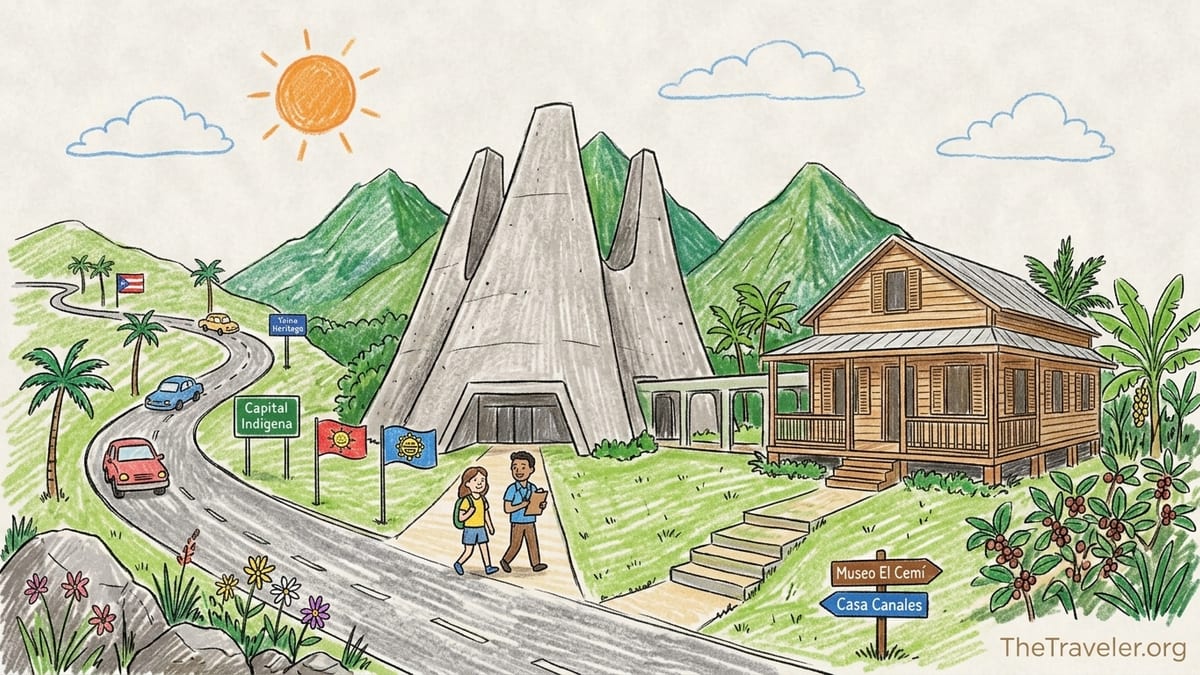
No photograph prepared me for seeing Museo El Cemí up close. The building is shaped like an enormous three‑pointed stone, echoing the small cemí figures that Taínos carved and buried in their fields as representations of deities or ancestral spirits. Approaching from the parking area, the museum’s concrete surfaces rise in three triangular peaks against the backdrop of the Tres Picachos mountains, an intentional dialogue between Taíno cosmology and Jayuya’s landscape. The entrance is low and central, so that you effectively walk into the body of a cemí.
Inside, the space is intimate, more like an oversized shrine than a conventional gallery. I spent about 55 minutes in Museo El Cemí, guided by a staff member from the cultural center. Admission here was covered by my combined ticket. The guide began by pointing out which objects in the first section were original Taíno artifacts and which were modern reproductions used to illustrate daily life. Original pieces were consistently placed in locked glass vitrines with typed labels that included provenance details such as the barrio where they were found, while reproductions and educational models sat on open platforms or hung from the walls with simpler captions.
The original artifacts included grinding stones used for processing cassava, stone axes, fragments of pottery with incised geometric designs, and small cemí figures carved from stone and bone. One particularly striking object was a weathered three‑pointed stone that, according to the label, came from a nearby agricultural field and was dated to the pre‑contact period based on stylistic comparison. The guide emphasized that these original pieces came from different parts of Jayuya, including Coabey and neighboring barrios associated with the historical cacique Hayuya, underlining that the municipality itself is a living archaeological landscape.
To help visitors visualize how these objects functioned, the museum supplemented the originals with reproductions: a reconstructed bohío interior, a model conuco field with mounded rows for yuca, and a life‑size wooden figure of a behique or shaman. The guide clearly distinguished these as interpretive aids, explaining that most were based on archaeological and ethnographic studies rather than direct finds from Jayuya. This explicit separation between artifact and reconstruction was crucial for understanding what the physical evidence can prove and where the museum relies on scholarly inference.
Understanding Taíno Spirituality, Agriculture And Ceremony
Museo El Cemí’s interpretive panels, mostly in Spanish with some bilingual headings, trace how Taíno spirituality permeated everyday practices. The central cemí figure represented more than a god in the abstract; it was connected to rainfall, soil fertility and community well‑being. One panel explained the belief that cemí figures “ate” offerings of cassava bread and tobacco smoke, which in turn kept the cycles of agriculture in balance. While the text was not especially dense, my guide elaborated in both Spanish and English, describing how farmers might bury cemís at the corners of their fields and perform simple rites before planting.
The agriculture section included both original stone tools and reproductions of wooden planting sticks and woven baskets. The label style made it easy to distinguish between them: original tools were behind glass with inventory codes, while the replicas were clearly marked as “copia” or “recreación” and could sometimes be handled under supervision. Standing in front of a recreated conuco, my guide pointed toward the window where banana plants and mountain ridges were visible and invited me to imagine the pre‑Columbian landscape layered under the current one. That concrete gesture made the history feel less remote.
Ceremonial life received its own corner, with a small model of a batey, the plaza where ball games and rituals took place. Here the museum leaned more heavily on interpretive models and drawings, since original carved stones from bateyes are mostly preserved outdoors at archaeological sites or in larger collections. My guide was careful to note that the alignment of the model’s stone rows and the figures dancing in the illustration were based on excavated sites in Puerto Rico and the Dominican Republic, not on a specific Jayuya structure. She used this section to introduce the figure of Cacique Hayuya and to explain how caciques were both political leaders and spiritual mediators.
For a visitor without a guide, the core messages about Taíno spirituality, agriculture and social hierarchy would still come through, especially for Spanish speakers, but some nuance would likely be lost. English‑language text existed as headings or short summaries, not full translations of every panel. Complex ideas, such as how cemí worship changed after European contact, were mostly conveyed orally. On my own, I might have spent 30 minutes here; with the guide and time for questions, I stayed just under an hour.
Crossing The Courtyard To Casa Canales And The 1950 Uprising
From Museo El Cemí, it is a short walk, less than two minutes, across a small courtyard and lawn to Casa Canales. The contrast is immediate. Where Museo El Cemí is sculptural and symbolic, Casa Canales is a preserved family home, with a wide porch, wooden shutters and period furniture. The same staff coordinated my entry and guided visit here, with no additional admission fee beyond what I had already paid. I spent roughly 70 minutes inside Casa Canales, slightly longer than in Museo El Cemí, because the layered political history required more explanation.
The house originally belonged to the Canales family, an educated and politically active clan whose members included the writer and legislator Nemesio Canales and, crucially for the museum narrative, his niece Blanca Canales Torresola. The first rooms interpret the family’s early 20th‑century life with original objects, including furniture, photographs, books and personal items. These are clearly labeled as originals, and the guide emphasized which pieces had belonged directly to Blanca, such as a writing desk and some domestic utensils preserved by relatives and later donated.
As the visit progresses, the storyline shifts toward Blanca’s role in the Puerto Rican Nationalist Party and the events of October 30, 1950, known as the Jayuya Uprising. Here, Casa Canales moves from family museum to historical site. The guide explained that from this house, Blanca and her comrades left to seize control of the town, attack the police station and post office, cut telephone lines and raise the Puerto Rican flag in the plaza, declaring the “Republic of Puerto Rico.” Archival photos, facsimiles of newspapers, and reproductions of Nationalist pamphlets line the walls. Original documents are mostly preserved elsewhere, so what visitors see are high‑quality reproductions identified as such on discreet captions.
Casa Canales handles the 1950 events by combining documented facts with the different perspectives held by the actors involved. Timelines on the wall summarize key points: the Nationalist Party’s opposition to colonial rule, earlier confrontations in Ponce and elsewhere, and the coordinated uprisings in various towns in 1950. My guide underlined that historians broadly agree on the sequence of events in Jayuya on that day, supported by police reports, press accounts and participant testimony. Where interpretations diverge is in assessing whether the uprising was a heroic anti‑colonial act, a tragic miscalculation, or both.
Fact, Interpretation And Memory In Casa Canales
One of Casa Canales’s strengths is how openly it acknowledges that the 1950 uprising is still politically charged. In one room, objects and texts present the Nationalists’ own narrative. A reproduction of the flag raised that day, period photographs of Blanca in Nationalist meetings, and excerpts from speeches emphasize a struggle for Puerto Rican self‑determination against US control. The guide, speaking carefully, framed this as the perspective of Blanca and her comrades, and highlighted that they saw themselves in continuity with earlier anti‑colonial movements across Latin America.
Another section presents the state’s response: images of bomb‑damaged buildings in Jayuya after US military aircraft were used against the town, reproductions of arrest records, and a panel discussing the long prison sentences meted out to participants, including Blanca’s eventual commuted sentence and release. Here, the interpretive text is slightly more neutral in tone, summarizing judicial outcomes and legislative changes without editorializing. The guide explained that while these panels are grounded in documentary archives, survivors and historians debate specific details such as the degree of US federal versus local Puerto Rican decision‑making in the crackdown.
Casa Canales tries to help visitors navigate these layers by clearly indicating when a panel is presenting “documented facts,” such as dates, official charges and laws, and when it is quoting or paraphrasing participants’ political arguments. Panel backgrounds and headings use different colors to distinguish these categories. The guide reinforced the distinction, explicitly saying when she was sharing scholarly interpretation versus eyewitness testimony. As a visitor, I felt that this approach prevented the house from turning into a simple shrine or a polemic. Instead, it became a place where you can see how competing narratives about colonialism, violence and resistance are built.
For visitors without a guide, however, the complexity might be harder to untangle. While key dates and events are clearly labeled in Spanish and, to a lesser degree, in English, some of the nuance about political context relies on the guide’s explanations. The museum would benefit from fuller English translations and perhaps a concise handout that walks visitors through the main phases of the uprising and its aftermath. As of my visit, there was mention of an external audio guide project, but on‑site audio devices were not yet in regular use.
Linking Taíno Heritage, Modern Nationalism And Jayuya’s Center
Leaving Casa Canales, I realized how deliberate the juxtaposition with Museo El Cemí is. In less than three hours, I had walked through a pre‑Columbian cosmology where cemí figures governed rain and crops, and then through a domestic space where a mid‑century family confronted another imperial power. The Centro de Arte y Cultura Maboití, which oversees both museums and organizes thematic routes, explicitly uses this pairing to market Jayuya as a place where Indigenous roots and modern political history intersect. Route descriptions posted at the center list the museums alongside stops at Taíno sites and cultural landmarks, underscoring that Jayuya’s identity is built on more than a single era.
To see how these narratives play out in the town’s public space, I drove back to central Jayuya and parked near the main plaza. Official tourism materials describe the plaza as a hub where the bust of Cacique Hayuya, the first monument in Puerto Rico erected specifically to honor a Taíno leader, shares space with civic buildings and a church. Climbing the colorful mosaic steps known as “Las Escalintas,” decorated with the names of Indigenous place‑names and caciques from across the island, I reached the overlook where the bust of Hayuya and the Tumba del Indio, a symbolic tomb honoring Taíno ancestors, are located.
The monument’s plaque identifies Hayuya as “Señor de Jauca, Zama y Coabey,” linking him directly to the barrios that still contain important Indigenous archaeological sites. This is not just decorative; it is a physical reminder that the landscapes I had driven through to reach Museo El Cemí and Casa Canales are part of a deeper network of bateyes and petroglyphs. Standing there, with views down to the plaza and out to the surrounding mountains, it was easy to understand why Jayuya embraces the title “capital indígena.”
Information at the monument is limited, mostly in Spanish, and there were no guides present during my brief visit. Still, my time inside Museo El Cemí helped me decode the imagery: the solar medallion on Hayuya’s chest, the prominence given to specific Taíno place‑names, and the decision to connect the monument to the town center via mosaic steps that themselves become a kind of open‑air gallery. In this way, the museums and the plaza form a continuous interpretive route, even for independent travelers exploring without a formal tour.
Guides, Languages And Practical Details For Visitors
Across Museo El Cemí and Casa Canales, the human guides were as important as the objects. At both sites, my guide was arranged via the Centro de Arte y Cultura Maboití and did not require an extra payment beyond the admission and route cost, though I chose to offer a voluntary tip afterward. Guided visits are subject to staff availability, especially on weekdays outside peak school group season, so travelers who care about context should call the cultural center or municipal tourism office ahead of time to schedule a specific hour.
In terms of language, I found that Spanish speakers can navigate both museums largely through written labels and panels, while English speakers benefit more from having a bilingual guide. Museo El Cemí’s headings and some summaries are bilingual, but deeper content is often only in Spanish. Casa Canales has fewer English texts, particularly when it comes to detailed legal and political explanations of the 1950 uprising. My guide alternated fluidly between Spanish and English, checking my understanding and occasionally simplifying legal terms, which made the complex material feel accessible without being watered down.
Accessibility and pacing are straightforward. The combined time I spent inside both museums was roughly two hours and five minutes: just under an hour in Museo El Cemí, about seventy minutes in Casa Canales, plus a few minutes walking and talking in the courtyard between them. With travel time from the Centro de Arte y Cultura Maboití and a short stroll in central Jayuya, the entire experience occupied a solid morning from around 9:30 a.m. to 1:00 p.m. I could easily imagine spending longer if joining a full cultural route that includes lunch and more stops, but for independent travelers, half a day feels like a realistic commitment.
One practical limitation is that both museums operate with relatively small staffs and are occasionally used for school groups and special activities. On busy days, independent visitors may need to wait for a guide to become available or share a tour with other guests. When I visited, my guide suggested arriving earlier in the day, ideally soon after opening, to increase the chances of a more personalized experience and to leave enough buffer time in case of brief closures for maintenance or group reservations.
The Exhibit That Stayed With Me And What Could Be Improved
The single exhibit that left the deepest mark on me was a modest corner in Casa Canales dedicated to the personal consequences of the 1950 uprising. On one wall, a sequence of photographs showed Blanca Canales being taken into custody, standing in court and later serving her sentence. Next to them, a panel summarized the charges, including the use of US federal laws to prosecute Nationalists. On the opposite wall, a small table held copies of letters and memoirs from participants and relatives reflecting on the years of imprisonment. Most of the texts here were in Spanish, and my guide translated sections into English as needed.
What struck me was not only the heroism often associated with Blanca in pro‑independence circles, but the quieter notes of doubt and grief in some of the testimonies. One relative described the pain of family separation; another questioned whether the uprising had been tactically wise given the odds. The museum did not resolve these tensions, and the guide did not try to. Instead, she pointed out that historical actors can be both courageous and flawed, and that visitors should leave with questions rather than ready‑made answers.
At Museo El Cemí, the most powerful moment came when my guide dimmed the lights slightly and asked me to stand in the center of the three‑pointed structure. Surrounded by depictions of cemís and the sounds of the mountain wind outside, she explained how many Taíno descendants and contemporary cultural practitioners still see these figures not as relics, but as living symbols. That reframing shifted my understanding of Taíno heritage from something locked in pre‑Columbian time to something that continues to inform identity in places like Jayuya today.
If there is an area where interpretation could improve, it lies in the depth and consistency of English‑language materials. While guides do an excellent job filling gaps, independent travelers who do not speak Spanish could miss important subtleties about both Taíno cosmology and the legal and political frameworks surrounding the 1950 uprising. Expanded bilingual labels, a concise printed chronology, and perhaps a simple audio guide accessible on personal phones would help. Even with these limitations, however, the museums already offer a rich experience for visitors willing to engage thoughtfully.
The Takeaway
By the time I left Jayuya, I understood why the municipality invests in the Centro de Arte y Cultura Maboití and its network of routes. In a single morning that linked Museo El Cemí, Casa Canales and the monument to Cacique Hayuya, I traced a line from pre‑Columbian spirituality through colonial disruption to 20th‑century political resistance. The visit changed how I think about Puerto Rican history, not as separate chapters filed under “Indigenous,” “Spanish colonial,” “US territory” and “Nationalist movement,” but as overlapping stories that continue to shape daily life in mountain towns like this one.
From a traveler’s perspective, the two museums absolutely merit a full morning. Allow at least two hours inside Museo El Cemí and Casa Canales combined, plus time to reach the sites, chat with guides and walk through central Jayuya to the bust of Cacique Hayuya. If you can coordinate with the Centro de Arte y Cultura Maboití, consider joining one of their cultural routes, which knit together the museums, Taíno sites and local food into a coherent narrative. Whether you arrive as a casual visitor or a devoted history enthusiast, you are likely to leave with your sense of Puerto Rico’s past and present permanently reshaped.
FAQ
Q1. Where are Museo El Cemí and Casa Canales located in Jayuya?
Museo El Cemí and Casa Canales sit together in the rural barrio of Coabey, a short drive from Jayuya’s urban center and reachable via the mountain road that also serves the Centro de Arte y Cultura Maboití.
Q2. What are the current opening hours for the two museums?
According to the municipal cultural center, Museo El Cemí and Casa Canales are generally open Monday to Friday from 9:30 a.m. to 4:00 p.m. and on Saturdays, Sundays and holidays from 10:00 a.m. to 4:00 p.m., though visitors should confirm by phone before traveling.
Q3. How much time should I plan to spend inside each museum?
On my visit I spent just under one hour in Museo El Cemí and about seventy minutes in Casa Canales, which allowed enough time for a guided walkthrough, questions and quiet observation of the exhibits.
Q4. Is it necessary to book a guide in advance?
Guides are not strictly required, but they add significant value, especially at Casa Canales; contacting the Centro de Arte y Cultura Maboití in advance increases the chances that a bilingual guide will be available when you arrive.
Q5. Are the exhibits presented in both Spanish and English?
Most detailed exhibit text is in Spanish, while English appears in headings and some summaries; English speakers can follow the main storyline but benefit greatly from a bilingual guide for nuance and context.
Q6. What is distinctive about Museo El Cemí’s architecture?
Museo El Cemí is built in the form of a giant three‑pointed cemí figure, with its three peaks echoing Taíno ritual stones and visually aligning with nearby mountains, turning the entire building into a symbolic artifact.
Q7. How does Casa Canales interpret the 1950 Jayuya Uprising?
Casa Canales presents the 1950 events through a mix of family history, reproduced documents, timelines and guided explanation that separate documented facts, such as dates and legal charges, from the differing political interpretations of Nationalists and authorities.
Q8. Can I understand the museums without speaking Spanish?
English‑only visitors can grasp the broad themes through images and partial translations, but some of the more complex historical and spiritual concepts are easier to follow with a bilingual guide or companion who can translate.
Q9. Is the Centro de Arte y Cultura Elpidio Collazo “Maboití” still active?
Yes, the Centro de Arte y Cultura Maboití remains active as Jayuya’s cultural hub, offering museum access, local artisan sales and organized cultural routes that include Museo El Cemí and Casa Canales among their main stops.
Q10. Do Museo El Cemí and Casa Canales justify dedicating a full morning?
Based on my firsthand visit, the two museums, combined with the short walk to the Cacique Hayuya monument and the drive from town, comfortably fill a morning and reward visitors with a nuanced understanding of Taíno heritage and the 1950 uprising.