


More news on this day
Chicago O’Hare International Airport will remain under federal flight caps for at least another year, after the Federal Aviation Administration issued an order extending operating limits designed to ease congestion and improve on time performance at one of the nation’s busiest hubs.
Get the latest news straight to your inbox!
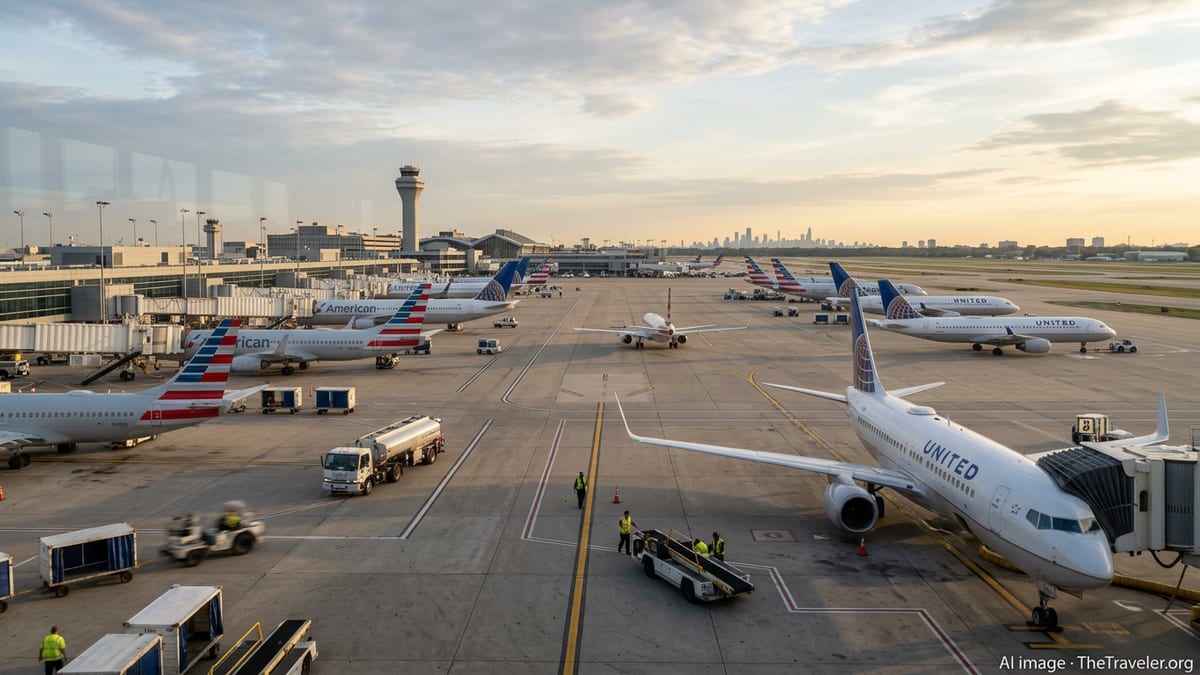
One Year Extension Keeps Summer Flight Caps in Place
Publicly available federal regulatory documents show that the FAA has extended its order establishing scheduling limits at Chicago O’Hare, effectively continuing caps on the number of daily flight operations for an additional year-long period that spans upcoming peak travel seasons. The move follows an earlier decision to impose temporary limits on O’Hare’s schedule after planners concluded that airlines’ proposed flying for 2026 exceeded what the airfield and surrounding airspace could reliably handle.
The current order keeps a ceiling of roughly 2,700 scheduled operations per day during the busiest months, holding daily activity close to levels seen in the previous summer rather than allowing the substantial growth airlines had planned. Through this extension, the agency aims to maintain tighter control over departures and arrivals while additional infrastructure and staffing improvements progress.
According to published regulatory summaries, the extended limits apply primarily to commercial passenger and cargo operations, with carve outs for certain general aviation and irregular operations. However, the practical effect for travelers is that large airlines must continue to trim or reshuffle their schedules at O’Hare instead of adding as many new flights as they hoped for the coming seasons.
Industry analyses indicate that the extension mirrors earlier steps the FAA has taken at other large, delay prone airports, where temporary caps have been used as a tool to stabilize operations while longer term capacity investments are underway.
Congestion, Delays and Safety at the Heart of the Decision
Official notices describe the extension as an effort to protect safety and efficiency at O’Hare, which regularly ranks among the top airports in the United States by aircraft movements. In recent summers, the airport has experienced heavy congestion, with long taxi times, airborne holding and a high rate of delayed departures and arrivals during peak hours.
Regulatory text associated with the order points to concerns that airlines’ planned schedules would again push the airfield beyond its practical capacity, even after years of runway reconfiguration and modernization. Planners cited a risk that overscheduling could strain air traffic control, ramp operations and gate availability, creating cascading delays that would affect flights across the national network.
Publicly available data on past performance at O’Hare shows that on time arrival and departure rates have lagged other major hubs during busy periods. By capping the number of flights per hour and per day, the FAA expects to reduce gridlock and allow more buffer in the system when storms or other disruptions occur.
Analysts note that the decision reflects a broader shift in federal strategy that favors operational reliability over unconstrained growth at already crowded hubs. The extension at O’Hare aligns with recent actions at Newark Liberty International Airport and other slot controlled fields, where temporary limits and usage waivers have been used to manage congestion while hiring and infrastructure catch up with demand.
Impact on Airlines, Schedules and Travelers
The year long extension means that airlines operating at O’Hare must continue working within a fixed pool of daily slots, revising schedules to stay under the cap. Industry reporting shows that major carriers had already begun scaling back their 2026 plans in anticipation of the order, cutting some short haul frequencies and deferring certain route launches to free up capacity for higher demand services.
Network planning experts indicate that carriers are likely to prioritize long haul and high yield domestic routes, while consolidating some regional flights into fewer daily frequencies operated with larger aircraft. This strategy allows airlines to preserve overall seat capacity as much as possible even when the number of takeoffs and landings is constrained.
For travelers, the most immediate effect of the extension is that O’Hare is unlikely to see a surge of additional flights during peak seasons, which could mean fewer scheduling options on certain routes but potentially more reliable operations overall. Travel analysts note that improved on time performance, shorter taxi queues and reduced risk of missed connections could offset the inconvenience of slightly reduced frequency on some city pairs.
Some demand may also shift to alternative airports in the region, including Chicago Midway and several designated reliever airports, as carriers and passengers look for ways to avoid the tightest constraints at O’Hare. However, the city’s primary international gateway is expected to remain the dominant hub for most long haul and connecting traffic in the Midwest.
Coordination With Broader National Airspace Measures
The extension of flight caps at O’Hare fits into a wider package of measures that federal planners are using to manage pressure on the National Airspace System. In parallel with local scheduling limits, the FAA has been adjusting slot rules, issuing temporary waivers and modifying operating orders at several other congested airports to reflect ongoing staffing and capacity challenges.
According to regulatory archives, the agency has recently extended certain slot usage relief at key East Coast airports and renewed limits at Newark, while also setting specific deadlines for airlines to submit schedule information for upcoming seasons at O’Hare, John F. Kennedy International and LaGuardia. These steps are intended to give planners earlier visibility into airline intentions and more leverage to address overscheduling before it translates into operational gridlock.
Experts in air traffic management point out that congestion at one major hub can quickly ripple across the network. By holding schedules at O’Hare to a more sustainable level, the FAA is seeking to reduce the likelihood that disruptions in Chicago will propagate into widespread delays elsewhere. The extension therefore has implications not only for local travelers but also for national on time performance statistics.
Observers also note that the order underscores the limits of physical expansion alone as a solution to congestion. Even after runway projects and terminal upgrades, gate configurations, taxiway layouts and staffing levels can still constrain how many flights an airport can handle reliably. Scheduling limits, while sometimes controversial with airlines and local stakeholders, remain one of the few tools available to quickly rebalance demand and capacity at the busiest hubs.
What Comes Next for O’Hare Capacity Planning
The one year extension is widely viewed as a bridge while longer term plans for O’Hare’s growth take shape. The airport is in the midst of a multi year terminal modernization and concourse expansion program intended to add gates, improve international connectivity and streamline passenger flows, but many of those projects will not be fully complete within the current order’s timeframe.
Public planning documents suggest that federal and local aviation authorities will continue monitoring performance metrics at O’Hare, including delay minutes, on time rates and runway utilization patterns, to determine whether additional extensions or modifications to the limits are warranted in future seasons. If reliability improves and new capacity comes online, some of the caps could eventually be relaxed.
In the meantime, airlines, airport managers and travel stakeholders are expected to use the relative predictability of a year long extension to refine operational plans, invest in technology that optimizes gate and runway use, and adjust passenger communications around schedule changes. The extension provides a clear framework for the next scheduling cycles, even as debates continue over how aggressively O’Hare should grow in the years ahead.
For passengers planning trips through Chicago, the message from current policy is that O’Hare will remain busy but more tightly managed. While the extension may limit the pace of new route introductions, it is intended to deliver a more reliable experience at a crucial connecting point for domestic and international air travel.