


More news on this day
A new artificial intelligence system designed to flag air-traffic bottlenecks before they ripple across the country is now being tested in the Washington, D.C., area, positioning the nation’s capital as the first proving ground for a wider Federal Aviation Administration effort to reduce flight delays and cancellations.
Get the latest news straight to your inbox!
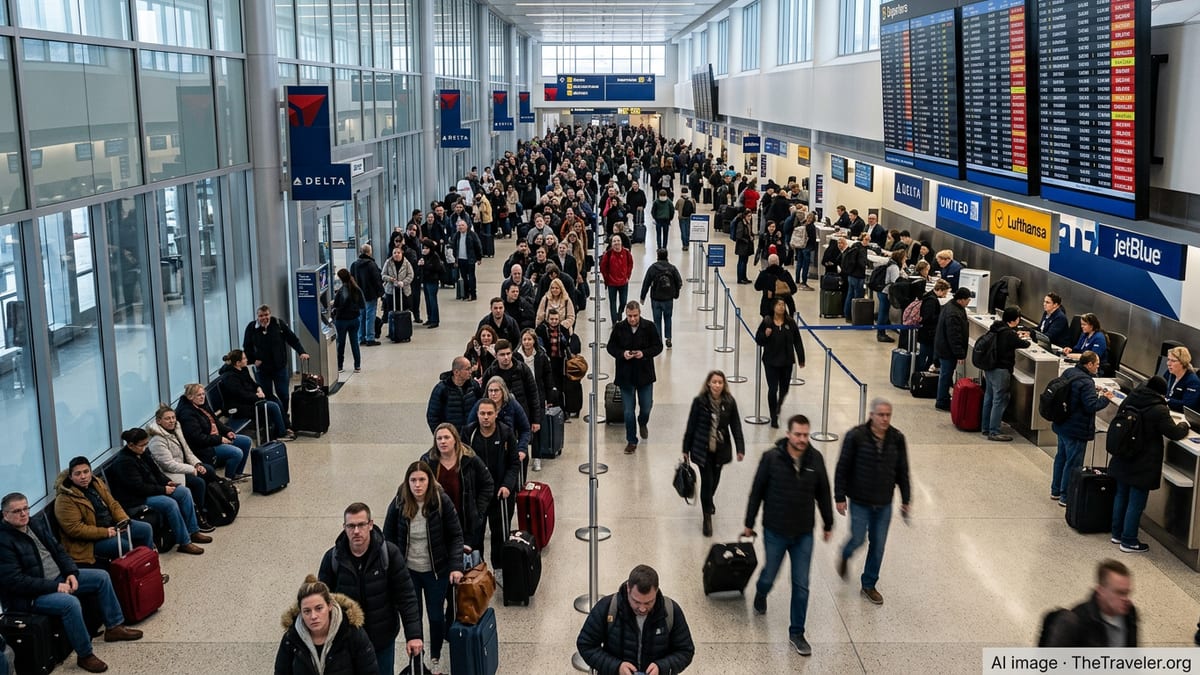
SMART system begins live trials over Washington region
Publicly available information shows that the FAA has begun operational testing of a tool known as Strategic Management of Airspace, Routes and Trajectories, or SMART, in the airspace serving Ronald Reagan Washington National Airport, Washington Dulles International Airport and Baltimore/Washington International Thurgood Marshall Airport. The limited rollout began on Monday, September 21, 2026, following several years of research and simulation work on AI-supported traffic management.
The system forms part of an $875 million modernization effort to address chronic congestion in the National Airspace System. According to government fact sheets and recent coverage from national and local outlets, SMART ingests hundreds of real-time and scheduled data streams, including airline timetables, filed flight plans, airport arrival and departure rates, weather forecasts and known airspace constraints around the capital region.
Initial use in Washington is described as an operational test rather than a full nationwide deployment. The FAA has indicated in public materials that the Washington region was selected because it concentrates three busy commercial airports within tightly constrained and security-sensitive airspace, offering a demanding early assessment of how the tool performs under complex conditions.
Reports indicate that regulators expect to expand the system gradually to other parts of the country after the Washington trials, with a broader rollout targeted by 2028 if safety and performance criteria are met.
How AI is being used to predict and prevent delays
SMART is described in official summaries as a cloud-based platform that sits alongside existing traffic management tools. Rather than issuing instructions directly to pilots or assuming separation duties, the system uses AI-supported modeling to help planners and traffic managers anticipate where schedules, weather and airspace restrictions are likely to collide later in the day.
By continuously comparing planned schedules with evolving conditions, SMART is intended to flag specific flights, routes or time periods where capacity is likely to be exceeded. When a conflict appears, the system can suggest options such as adjusting departure times, rebalancing flows between airports, or using alternative routes that keep traffic within agreed capacity limits while maintaining safety margins.
The goal is to make delay-management decisions earlier and with a wider system view. Research plans published in FAA documents describe an emphasis on system-wide performance, including aggregate delay minutes and how disruptions at one hub can propagate through aircraft rotations and crew schedules. In a hub structure like Washington’s, a late-morning ground stop or weather slowdown can reverberate through afternoon and evening departures across multiple regions.
Officials have previously outlined how AI and machine learning are being evaluated within the agency’s traffic-flow management portfolio, including tools that can test alternative flow strategies in simulated environments before they are introduced into live operations. SMART is one of the first of these research concepts to reach an operational test phase.
What travelers at D.C. airports can expect this fall
For passengers using Reagan National, Dulles or BWI, the early stages of the SMART trial are expected to be largely invisible. Airlines will continue to publish schedules and manage rebooking, while air traffic controllers and traffic managers retain responsibility for safety-critical decisions.
However, travelers may notice changes in how delays are handled when weather or congestion builds. Rather than a series of short-notice ground stops and rolling delays, the new system is intended to encourage more predictable, pre-planned programs. That could include earlier decisions to slow arrival rates ahead of storms, adjust departure banks to smooth demand, or reroute flows around constrained sectors before bottlenecks form.
Public guidance from aviation agencies indicates that the test phase will focus first on operational metrics, such as how often the system’s forecasts match actual conditions and whether recommended strategies reduce workload for traffic managers. Quantified improvements in passenger-facing statistics, such as average delay minutes per flight in the Washington region, are expected to be evaluated over a longer period once sufficient data has been collected.
Travelers passing through Washington this fall are therefore unlikely to see an immediate and dramatic shift in on-time performance. Instead, the first sign that the system is working as intended may be fewer cascading disruptions on busy travel days, particularly when severe weather affects the Northeast corridor.
Safety oversight and controller roles remain central
Publicly available statements from aviation labor groups and the agency emphasize that SMART is designed as a decision-support tool, not a replacement for air traffic controllers. Controllers at facilities such as the Potomac TRACON and the Air Traffic Control System Command Center remain responsible for separation, clearances and real-time tactical decisions.
Coverage in regional and national outlets notes that the FAA has linked the rollout of AI-based traffic tools to its existing safety management framework. That framework calls for staged testing, extensive simulation, shadow-mode trials where new software runs in parallel without affecting live traffic, and continuous monitoring before wider deployment.
External advisory groups that review FAA research have also highlighted the need for clear certification approaches for AI and machine-learning applications. Recent agency responses to those recommendations reference metrics such as system-wide delay, equity of delays across airspace users and demonstrated reliability as factors in determining how robust the testing and approval process must be for traffic management tools.
In Washington, federal briefings and union statements referenced in local news coverage point to a shared expectation that any new technology should complement, rather than dilute, the training and judgment of certified controllers. Observers will be watching how well SMART’s recommendations integrate into daily operations without adding complexity or distraction in already busy control rooms.
From D.C. test bed to nationwide rollout
The Washington trials mark the first operational step in a broader modernization roadmap for the National Airspace System. Planning documents and recent public coverage describe a multi-year schedule in which SMART and related tools are refined in one region before being extended to additional hubs and, eventually, to en route airspace across the continental United States.
The capital region’s three-airport configuration offers a distinctive test case, combining short-haul business routes at Reagan National, long-haul international traffic at Dulles and a mix of domestic operations at BWI. Data gathered here over the coming months is expected to inform how the system is tuned for very different environments, from single-airport metro areas to dense multi-hub corridors.
Industry analysts cited in recent reports suggest that any measurable reduction in average delay minutes across Washington’s airports would represent a significant gain, given the scale of traffic and the constraints of the region’s airspace. Even modest efficiency improvements could help airlines make better use of aircraft and crews, and give passengers more predictable travel days.
At the same time, published commentary also underscores ongoing questions about transparency, data quality and cyber security in large-scale AI systems. As the SMART program moves from Washington to other parts of the country, how those concerns are addressed is likely to shape public confidence in the use of AI to manage one of the world’s busiest and most complex airspace networks.