


More news on this day
A construction crew working along a New Jersey rail corridor accidentally sliced through key telecommunications cables on September 21, triggering an air traffic control outage that halted departures and snarled schedules at major Northeast airports from New York to Boston and Philadelphia.
Get the latest news straight to your inbox!
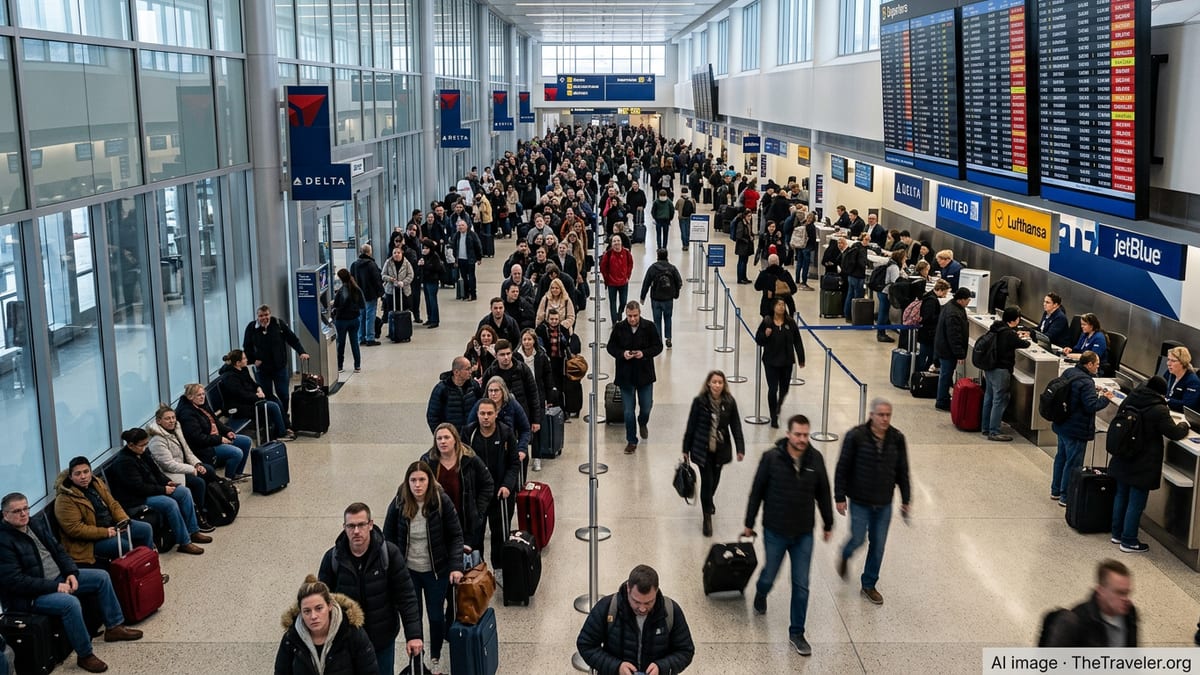
How a construction mistake rippled through the Northeast sky
Publicly available information indicates that the disruption began late Monday morning near New Brunswick, New Jersey, where contractors working on rail infrastructure cut into a Verizon fiber-optic cable running beside the tracks. The damaged line fed communications systems used by an air traffic control facility that manages a large portion of the Northeast airspace, including approaches to Newark Liberty International and Philadelphia International airports.
The outage affected both primary and backup circuits, according to multiple news reports, leaving controllers without a critical data feed and forcing the Federal Aviation Administration to slow or halt traffic at several of the country’s busiest hubs. Ground stops and severe flow restrictions were put in place at Newark, Philadelphia, New York’s LaGuardia and John F. Kennedy airports, and at Boston Logan, as the agency worked to reroute flights and restore service.
Coverage from national and local outlets shows that the incident quickly evolved from a technical glitch into a systemwide choke point. With a large swath of East Coast airspace constrained, knock-on effects spread to airports as far away as Las Vegas and San Francisco as aircraft and crews fell out of position and airlines struggled to reassemble their schedules.
By Monday evening, transportation officials reported that the cut fiber had been repaired and that air traffic systems were back online. Even so, publicly available flight-tracking data showed the disruptions cascading into Tuesday as airlines worked through congested departure banks and stranded aircraft.
Airports hit hardest and what travelers experienced
Reports from flight-status services and regional newsrooms indicate that Newark Liberty International was among the worst affected, with a near-standstill in commercial arrivals for much of Monday afternoon. Hundreds of departures and arrivals there were delayed or canceled, with aircraft stacked on taxiways waiting for takeoff slots once the ground stop lifted.
Philadelphia International Airport experienced similar turmoil. Published coverage from local broadcasters describes long lines at ticket counters and security lanes, as departures were paused and then resumed in fits and starts when capacity limits eased. Some passengers reported sitting on aircraft for hours before being brought back to gates, while others faced overnight delays as crews and planes timed out.
Boston Logan and New York’s LaGuardia and JFK airports also reported sizable knock-on delays. Local outlets in Boston highlighted fully packed taxiways and continued residual disruptions into Tuesday, even after the underlying telecommunications fault was corrected. New York media described widespread cancellations across the region’s three major airports, with travelers rebooked via alternate hubs or routed through Washington and other cities.
According to data cited in national business coverage, more than a thousand flights in the United States were canceled on Monday and well over six thousand were delayed, with the majority of the impact concentrated in the Northeast corridor. That scale placed the event among the most severe single-day disruptions for U.S. air travel so far in 2026.
Why a single fiber line matters so much to air travel
The incident underscores how dependent modern air traffic control has become on robust, redundant communications networks. Radar, flight-planning systems and controller-to-controller coordination rely on high-capacity data links that shuttle information between regional centers and radar approach control facilities. When a key node in that network fails, capacity in the surrounding airspace can be sharply reduced even if local weather and runway conditions are ideal.
In this case, published technical descriptions indicate that a backup fiber-optic cable was also affected when the construction crew cut through the line, taking the alternative route offline. With both primary and backup paths compromised, the affected facility reportedly had to fall back on more limited contingency procedures, which translated into far fewer aircraft allowed in the airspace at any one time.
Recent federal documentation already highlighted the vulnerability of the Northeast to disruption, citing the tightly interdependent airspace around the New York City area and Newark in particular. Even modest slowdowns there can quickly propagate across airline networks. A sudden capacity shock, such as the loss of a major communications feed, magnifies those effects and can create exactly the kind of widespread delays seen at the start of the week.
The event comes amid an ongoing modernization push aimed at upgrading both physical and digital infrastructure for U.S. air travel. Public remarks from transportation leaders following the outage framed the fiber cut as a reminder that investment in hardened, diversified communications paths is as critical as new runways or terminal expansions.
Continuing ripple effects and what travelers should expect
By Tuesday evening, publicly available flight-status boards at Newark, Philadelphia and Boston showed a gradual return toward normal operations, though with a lingering tail of delays and scattered cancellations as airlines repositioned aircraft and crews. Industry practice suggests that recovery from such a large-scale disruption can take at least a full day, sometimes longer, particularly when aircraft end up overnight in cities that are not part of their usual rotation.
Travelers with flights through the affected airports over the next 24 to 48 hours are being advised through airline channels to monitor their reservations closely. Even once ground stops lift, crews can reach duty-time limits and aircraft can require maintenance checks after extended ground holds, leading to last-minute schedule changes that do not appear until the day of travel.
Some carriers have issued flexible travel waivers for flights touching key Northeast airports around the dates of the outage, allowing passengers to change to alternate dates or routings without standard change fees. The specific terms vary by airline and fare type, so travelers are being directed to airline customer-service channels and mobile apps for the latest policy details.
Passengers connecting through the region may find that flights into the Northeast are operating more smoothly than departures out, as airlines prioritize moving aircraft and crews back into position. For travelers with time-sensitive plans, routing through alternate hubs outside the affected airspace, when available, could offer a more reliable path until schedules fully stabilize.
Infrastructure lessons for a heavily traveled corridor
The mishap has quickly become a case study in how seemingly local construction work can have national consequences when it intersects with critical infrastructure in a region as busy as the Northeast. The fiber cable cut occurred along a rail project corridor, but its disruption extended to aviation networks, train operations and communications providers that share common rights-of-way and duct banks.
Regulatory analyses published in recent years have already pointed to chronic congestion in the New York and New Jersey airspace, driven by a dense concentration of flights and limited options for rerouting when incidents arise. The latest outage adds a new dimension to that discussion, highlighting the importance of mapping and protecting telecommunications assets that underpin multiple modes of transport.
Industry observers note that more detailed coordination between rail operators, telecom companies and aviation authorities around planned construction could reduce the risk of repeat incidents. Measures could include more granular utility locates, additional physical separation for redundant lines, and real-time communication channels between construction managers and network control centers when anomalies are detected.
For travelers, the episode is a reminder that not all delays stem from weather or airline staffing. As U.S. transportation infrastructure continues to modernize, safeguarding the unseen digital backbone that supports air traffic may prove just as important to keeping planes moving on time as paving new taxiways or building larger terminals.