


Choosing between Finland and Norway can feel like trying to pick a favorite among northern lights, fjords, and midnight sun. Both countries deliver big on wilderness, design-conscious cities, and a high standard of living, yet they offer very different moods and experiences. The right choice depends less on which destination is "better" and more on which one fits your personal travel style, budget, and priorities.
Get the latest updates straight to your inbox!
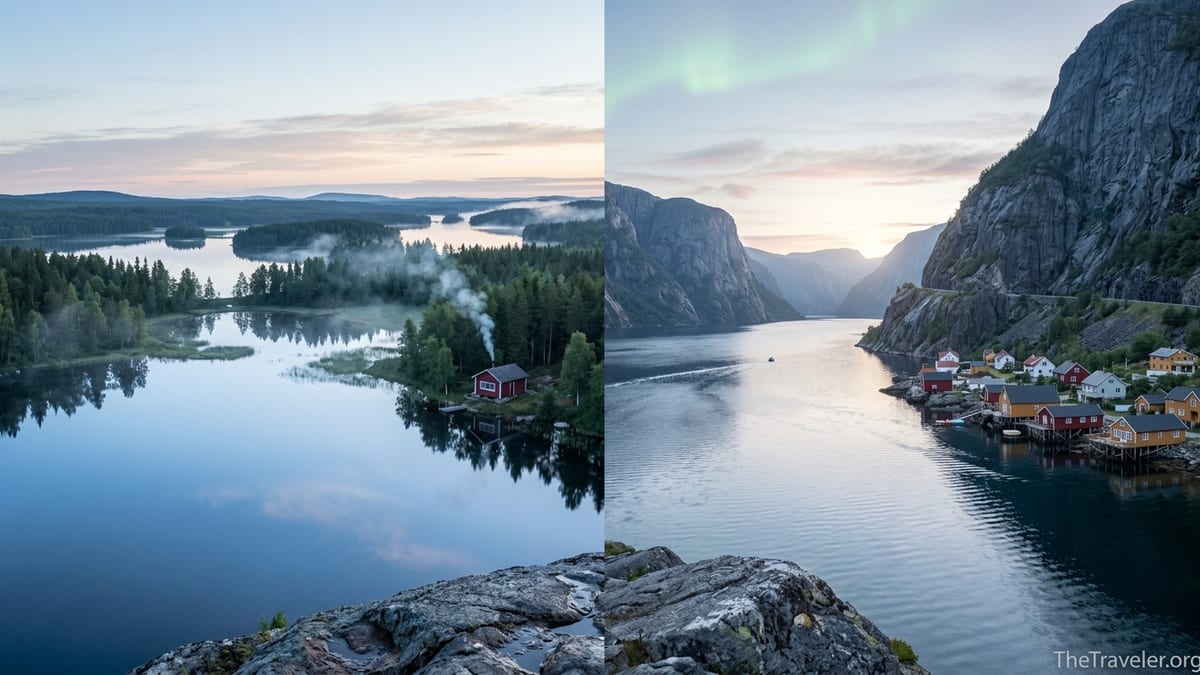
Overall Vibe: Calm Forests or Dramatic Fjords?
If you imagine your Nordic trip as quiet lakes, minimalist cabins, and long afternoons in a sauna, Finland is likely your match. Much of the country is flat or gently rolling, covered in dense spruce and pine forests and dotted with thousands of lakes. A classic Finnish holiday might mean staying in a timber cottage on a lake in Lakeland, paddling out in a rowboat at midnight in June when it never really gets dark, then slipping into a wood-fired sauna before a cold plunge.
Norway, by contrast, is about vertical drama. Its west coast is carved by deep fjords such as Sognefjord and Hardangerfjord, where sheer rock walls plunge into dark blue water and tiny farms cling to ledges high above. Even arrival in Bergen or Ålesund feels theatrical, with mountains rising straight from the sea. A typical Norwegian day might include taking the Fløibanen funicular in Bergen for a panorama of fjord and islands, then cruising along the Nærøyfjord between cliffs that rise more than a thousand meters above your boat.
Think of Finland as the place for introspective, slow-travel nature: berry-picking in Pallas–Yllästunturi National Park in autumn, cross-country skiing through the fells of Pyhä-Luosto National Park, or cycling gentle paths outside Helsinki. Norway is better suited to travelers who crave visual wow-moments every hour, whether driving the hairpin turns of the Trollstigen road, hiking to famous viewpoints such as Trolltunga or Reinebringen, or scanning for orcas in the fjords near Tromsø.
If you are planning a once-in-a-lifetime trip and want your phone gallery full of towering peaks and mirror-like fjords, Norway edges ahead. If your ideal escape is deep quiet, forests, and the ritual of sauna and swim, Finland will feel more in tune with you.
Best Seasons: When To Go for Your Travel Style
Both countries are genuinely year-round destinations, but the best choice shifts with your preferred season. For a winter wonderland, Finland’s Lapland is famous for its reliable snow and built-for-tourists infrastructure. From December to March, Rovaniemi, Inari, Levi, and Saariselkä become hubs for husky safaris, reindeer farm visits, and snowshoeing under polar night skies. Resorts like Levi and Ylläs offer downhill skiing alongside cross-country trails and snowmobile routes, so you can base yourself in one village and try multiple activities over three or four days.
Winter in Northern Norway, especially around Tromsø and the Lofoten Islands, is more rugged and maritime. Snow lines the mountains, but temperatures can be milder due to the Gulf Stream, and you might see sudden shifts from clear to stormy weather. Travelers often pair a couple of nights in Tromsø with a guided aurora chase into the surrounding valleys, where operators monitor cloud cover and drive you to clearer skies. If you like the idea of mixing urban nightlife and seafood dinners with northern lights hunting, Norway has an advantage.
Summer highlights differ too. Norway’s fjord region peaks from late May to early September. This is the time to ride the famous Oslo–Bergen railway and branch line to Flåm, then take a fjord cruise on Sognefjord, or to drive the Atlantic Road and coastal routes in Western Norway. Hiking season in Lofoten and the Lyngen Alps also runs through these months, with long days allowing late-evening summit views over aquamarine bays and white-sand beaches.
Finland’s summer is gentler and ideal for slow, outdoorsy holidays. The Lakeland region, a few hours from Helsinki, fills with kayakers and cottage-goers enjoying warm-water lakes, while Helsinki itself comes alive with terrace bars, open-air saunas such as Löyly or Allas Sea Pool, and design events. July in Finland can feel almost Mediterranean in spirit but with cooler temperatures and a more reserved atmosphere. If you like long, quiet days of swimming, grilling by a lake, and cycling through forest, Finland’s summer is hard to beat.
Northern Lights, Snow Adventures, and Arctic Magic
If your main goal is the aurora borealis, both countries offer strong chances, but in slightly different styles. In Finland, Lapland towns such as Rovaniemi, Inari, and Saariselkä are well-equipped with glass igloo hotels, aurora cabins, and dedicated northern lights excursions using reindeer sleds or snowmobiles. It is common for a three-night Lapland trip in February to combine two guided aurora hunts with one night simply watching the sky from your cabin terrace, perhaps in a village on the edge of a national park like Pyhä-Luosto.
Northern Norway, especially Tromsø and the islands and fjords around it, is frequently cited by aurora tour specialists as one of the world’s premium locations for northern lights. The region sits directly beneath the auroral oval, and the combination of steep mountains, open sea, and dark inland valleys creates dramatic backdrops if the sky clears. A typical independent trip might be four nights in Tromsø in January or February, with one or two minibus aurora chases into the countryside and one evening on a small-boat cruise where you watch possible auroras reflected on the fjord water.
For snow activities, Finland is more turnkey for families and first-time Arctic visitors. Resorts like Levi and Ruka bundle husky rides, snowshoe hikes, kid-friendly reindeer visits, and short snowmobile safaris into packages that you can book directly through your hotel or a local safari company. Distances between activities are short and public transport from Helsinki to Lapland is straightforward via domestic flights or overnight trains. Norway can certainly deliver similar activities around Tromsø and in smaller Arctic towns, but offerings are more spread out, and travelers often rely on rental cars or guided tours.
If your dream is to spend your days in an organized winter-safari bubble and your nights peering at the sky from a warm glass dome, Finland is an easier fit. If you are comfortable with more weather variability and want your northern lights photos framed by jagged peaks and fjords, Northern Norway may feel more rewarding.
Costs, Logistics, and Ease of Travel
For most visitors, Norway is notably more expensive than Finland, particularly when it comes to dining out and certain activities. In Oslo, a simple main course at a mid-range restaurant commonly costs the equivalent of around 25 to 40 US dollars per person, and a casual dinner for two without alcohol can easily reach 70 to 80 US dollars. Coffee in central Oslo often runs to the equivalent of 4 to 6 US dollars for a cappuccino, and a single city public transport ticket costs roughly the same as a short rideshare in many North American cities.
Finland is hardly a budget destination, but Helsinki’s restaurant and grocery prices are generally somewhat lower. Travelers who self-cater from mainstream supermarket chains and limit restaurant dinners to every second or third night will feel the difference more clearly in Norway, where even a takeaway burger in a touristy waterfront area can approach the cost of a sit-down meal in Helsinki. Accommodation in both capitals spans from hostels to high-end design hotels, but Norway’s fjord villages and Lofoten cabins command especially high summer prices, so booking months in advance is wise if you are cost-conscious.
On logistics, both countries are well organized and safe, with excellent transport infrastructure by global standards. Finland tends to be a bit simpler for point-to-point travel: trains connect Helsinki to Tampere, Turku, and all the way north to Lapland, and domestic flights link the capital with Rovaniemi, Kittilä and Ivalo in around 1.5 hours. Renting a car to explore Lakeland or Lapland is straightforward, and roads are generally less winding and less exposed to steep drops than in Norway.
Norway’s infrastructure is high quality, but the landscape makes journeys slower and more complex. The Oslo–Bergen railway and Hurtigruten or Havila coastal voyages are spectacular, yet driving in fjord country means navigating ferries, tunnels, and mountain passes. A two-hour distance on the map can easily become three or four hours once ferry timetables and photo stops are factored in. If you enjoy the journey as much as the destination and have time to spare, this meandering travel style is a plus. If you prefer straightforward point-to-point itineraries, Finland may feel more relaxed.
Culture, Food, and Everyday Experiences
Finland’s cultural highlights revolve around design, literature, music, and the subtle rituals of daily life. In Helsinki you might spend a day browsing the Design District, visiting the Oodi Central Library and the Amos Rex art museum, then finish with an evening in a harborfront sauna. Smaller cities like Tampere and Turku offer a glimpse of everyday Finnish life with fewer tourists, from neighborhood public saunas to lakeside cafés serving cinnamon buns and coffee on outdoor terraces.
Norwegian cities feel more shaped by the sea. Oslo has transformed its waterfront with contemporary architecture such as the Oslo Opera House and the MUNCH museum, and Bergen’s historic Bryggen wharf still shows wooden Hanseatic houses fronting the harbor. Everyday cultural experiences might include grabbing a shrimp sandwich from a harbor stall, joining locals for a hike in the city’s surrounding hills, or taking part in the Norwegian concept of friluftsliv, the love of open-air life.
In terms of food, both destinations have moved well beyond stereotypes of bland northern fare. Finland’s cuisine leans into rye bread, salmon soups, Karelian pies, and seasonal wild ingredients like mushrooms and berries, which appear in everything from mains to desserts. Trendy Helsinki restaurants will often offer set tasting menus built around local produce at price points similar to other Western European capitals. Norway focuses heavily on seafood and lamb, with dishes like stockfish in Lofoten, creamy fish soups in Bergen, and fresh prawns eaten straight from the shell along the Oslofjord in summer.
Language is unlikely to be a deciding factor. English proficiency is very high in both countries, and you can navigate transport, restaurants, museums, and outdoor activities without learning more than a handful of local phrases. The bigger difference is social: Finns are sometimes stereotyped as reserved, with quiet trams and small talk kept to a minimum, while Norwegians are often seen as slightly more outgoing, particularly in outdoorsy contexts. In practice, both cultures tend toward politeness and personal space, and friendliness tends to emerge once initial shyness fades.
Who Should Choose Finland vs Norway?
Finland suits travelers who prefer introspective nature, stable winter conditions, and a slower pace. If your ideal holiday involves settling into one cabin or a single city and using it as a base for day trips, Finland makes that easy. A one-week itinerary might look like three nights in Helsinki to explore design, museums, and modern Nordic cuisine, followed by four nights in a lakeside or Lapland cabin, with simple structured activities such as sauna evenings, local hikes, and maybe a reindeer or husky visit in winter.
Norway is better for those who like road trips, big mountain scenery, and varied landscapes in a single journey. A first-time summer visitor might spend two nights in Oslo, three nights in Bergen with a day trip on a fjord cruise, then rent a car or join a small-group tour through fjord country before flying north to Lofoten for hiking and beach walks. The same two-week trip in Finland would feel calmer: perhaps Helsinki, Lakeland, and a Lapland leg, with fewer dramatic elevation changes but more chances to experience everyday local life.
Families with young children often find Finland particularly user-friendly. Resorts in Lapland are explicitly set up for family holidays, with children’s pricing on activities, short-duration winter excursions, and stroller-friendly paths in many areas. Norway is still a great family destination, but long drives, ferry timings, and steeper hikes require more planning. Solo travelers comfortable with higher daily costs and more complex logistics may find Norway’s wildness and variety very rewarding.
Budget is perhaps the most practical filter. If your daily budget is tight and you plan to eat out frequently, Finland will usually let you stretch your money a bit further, especially outside peak holiday weeks. If you are able to allocate a higher daily spend and are willing to self-cater and book early, Norway’s landscapes might justify the extra cost for you.
The Takeaway
There is no wrong choice between Finland and Norway, but there is a choice that will align more naturally with your personality and travel style. Finland tends to favor calm, reflective travelers who love forests, lakes, and the ritual of sauna, and who appreciate a more affordable yet still high-quality Nordic experience. It works beautifully for families, couples, and solo travelers wanting a mix of cultural city time and peaceful nature without complicated logistics.
Norway, on the other hand, is for travelers who thrill at big views and do not mind paying more or planning more to chase them. Its fjords, coastal mountains, and island archipelagos serve up almost continuous scenery, from the streets of Bergen to the cliffs of the Lofoten Islands. For northern lights, dramatic summer road trips, and serious hiking-based holidays, Norway often feels like the ultimate stage.
If you still cannot decide, consider splitting your travels across two trips instead of trying to squeeze both countries into one short itinerary. Start with the country that best fits your current priorities, whether that is a cozy winter-safari week in Finnish Lapland or a summer of long drives and mountain hikes in Western Norway. The other Nordic neighbor will still be waiting with its own version of wilderness, light, and quiet when you are ready.
FAQ
Q1. Which country is better for a first-time winter trip to the Arctic?
For most first-time winter visitors, Finland is slightly easier. Lapland has compact resorts like Levi and Rovaniemi where you can base yourself for several days and easily add husky rides, reindeer visits, and aurora excursions without renting a car or changing accommodation frequently.
Q2. Is Norway really that much more expensive than Finland?
Norway is typically more expensive, especially for dining out and certain activities. A casual sit-down dinner for two in Oslo can often cost what would be a mid-range restaurant meal in Helsinki. Travelers on moderate budgets usually find they need to self-cater more and plan carefully in Norway, while similar money stretches a bit further in Finland.
Q3. Where are my chances higher to see the northern lights?
Both can deliver excellent aurora sightings. Northern Norway has particularly strong conditions thanks to its position under the auroral oval and dramatic landscapes, while Finnish Lapland offers stable winter weather and many glass-roof cabins designed for aurora watching. A three or four night stay in either region in mid-winter gives a reasonable chance, as long as you stay flexible about clouds.
Q4. Which destination is better for hiking and mountain scenery?
If you prioritize mountains and steep trails, Norway is the clear winner. Fjord regions, the Lofoten Islands, and the Lyngen Alps all offer famous hikes with big elevation gains and sweeping views. Finland has beautiful fell areas and forests, but its terrain is generally gentler and less alpine.
Q5. Is Finland or Norway better for families with young kids?
Finland often works better for families, especially in winter. Lapland resorts concentrate services in one place, with kid-friendly winter activities, short excursions, and many accommodation options that suit families. Norway is also family-friendly but can involve longer travel days, ferries, and more challenging hikes.
Q6. Which country should I pick if I have a tight budget?
With a tighter budget, Finland is usually the more forgiving choice. Accommodation and food are still not cheap by global standards, but overall costs tend to be a bit lower than in Norway, and you can rely more on trains and buses instead of rental cars. Visiting in shoulder seasons and self-catering some meals helps in both countries.
Q7. Do I need to rent a car in either destination?
You can travel both countries without a car, but the benefits differ. In Finland, trains and buses connect major regions and many Lapland resorts offer transfers, so car rental is optional. In Norway, especially in fjord and coastal regions, a car gives you much more flexibility with viewpoints, trailheads, and smaller villages that can be awkward to reach on public transport.
Q8. Which country offers a better mix of city culture and nature?
Both offer a strong city-and-nature mix, but in different balances. Helsinki combines design, food, and harborside saunas with quick access to islands and forests, while Oslo and Bergen mix waterfront culture and museums with steep hills and nearby fjords. If you want more time in forests and lakes, Finland might edge ahead; for dramatic water-and-mountain scenery right next to cities, Norway has the advantage.
Q9. What is the best time of year to visit if I do not like extreme cold?
If you want to avoid deep winter temperatures, aim for late May to early September in both countries. In this period you can enjoy long days, vibrant city life, and easy access to nature. June and July bring the brightest nights, while late August and early September can be a little quieter and cooler, with the first hints of autumn colors.
Q10. If I only have one week, should I try to see both Finland and Norway?
With just one week, it is usually better to focus on one country. Distances and flight changes between Finland and Norway can consume precious time, and you will enjoy a richer, less rushed experience by choosing either a compact Finland itinerary or a focused Norway route rather than trying to sample both superficially.