


More news on this day
A dramatic rescue at a Minnesota rail crossing was captured on video as firefighters and bystanders pulled a pickup truck driver from his vehicle just seconds before a freight train slammed into the stranded truck and hurled it down the tracks.
Get the latest news straight to your inbox!
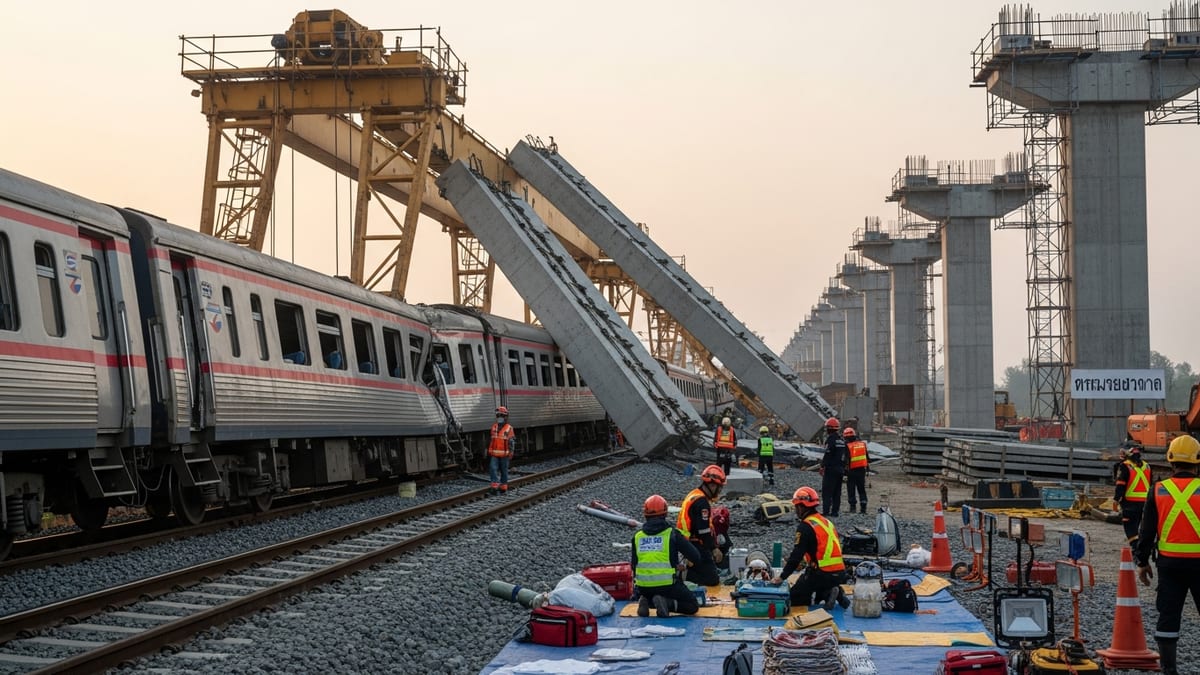
Video Shows Seconds to Spare at Minnesota Rail Crossing
Publicly available video from Mounds View, Minnesota, shows a pickup truck stopped on railroad tracks with crossing arms down and warning lights flashing as a freight train approaches from behind. A fire department vehicle is positioned close to the scene, and several firefighters and civilians can be seen running toward the stranded truck as the train’s horn sounds repeatedly in the background.
Reports indicate the truck had become stuck on or near the tracks at a grade crossing, leaving the driver unable to clear the rail line in time. As the train closes in, the video shows rescuers working urgently at the driver’s side door, which appears jammed, while others attempt to assist from the passenger side.
In the final seconds before impact, rescuers succeed in pulling the driver through a window opening and dragging the person away from the truck. Only moments later, the oncoming freight train strikes the empty pickup, sending it spinning away from the crossing in a shower of debris.
Coverage of the incident describes the driver as conscious and able to move with assistance in the aftermath of the collision. Information released so far indicates that no injuries were reported among train crew, firefighters, or bystanders at the scene.
Firefighters, Bystanders Act in Rapid Coordination
Accounts of the incident highlight how quickly both firefighters and nearby civilians converged on the truck once it became clear a collision was imminent. The video shows uniformed personnel from the fire vehicle arriving nearly simultaneously with several members of the public who had stopped or were already at the crossing.
Firefighters appear to take the lead at the driver’s door while bystanders help stabilize the driver and assist with pulling the person free. The group then moves together away from the tracks, with one firefighter supporting the driver and another signaling others to back away from the immediate impact zone.
Observers point to the coordination between trained responders and ordinary bystanders as a central factor in the successful rescue. Publicly available information suggests the entire extrication unfolded in less than half a minute from the time rescuers reached the truck to the moment the train struck it.
Emergency response specialists often emphasize that scenes at active rail crossings present particular challenges because of limited escape routes, the confined geometry of the tracks, and the difficulty in judging a train’s true speed. In this case, visual evidence shows rescuers repeatedly glancing toward the oncoming locomotive as they work, continually gauging how much time remained for a final attempt to free the driver.
Rail Safety Concerns Highlighted by Near-Fatal Collision
The Mounds View rescue adds to a series of recent incidents that have drawn renewed attention to safety at highway rail crossings. Transportation safety data regularly show that collisions between trains and road vehicles, while relatively infrequent compared with other types of crashes, often result in severe damage or loss of life.
Analyses of past train-vehicle collisions suggest that drivers can misjudge both the distance and the speed of approaching trains, especially at crossings where sightlines are limited or where vehicle drivers are unfamiliar with the area. Once a vehicle becomes stuck on the tracks, options narrow quickly, particularly if the driver attempts to move the vehicle instead of exiting immediately.
Public information campaigns in the United States and abroad have long emphasized a simple message at crossings: if a vehicle stalls or is trapped on the tracks and a train is approaching, occupants should exit immediately and move away from the tracks at an angle in the direction of the train’s approach to avoid debris. The Mounds View video underscores how little time can remain once a train rounds a curve or comes into view.
In the Minnesota case, the rapid arrival of fire personnel and the presence of willing bystanders created an opportunity to attempt a rescue that might not exist in more remote locations or under different conditions. Transportation safety specialists note that many similar incidents do not allow for such intervention, reinforcing the importance of preventive measures and cautious behavior at crossings.
Officials Review Rail-Crossing Design and Driver Behavior
Following prominent train-vehicle collisions in recent years, transportation agencies and rail operators have increasingly scrutinized crossing design, warning systems, and driver behavior. Reviews of grade crossings sometimes lead to upgraded warning lights, extended gate timing, improved roadway markings, or, in some cases, closure or grade separation.
Publicly available information on the Minnesota collision indicates that standard crossing protections, including gates and lights, were functioning at the time of the incident. In many comparable cases, investigators focus on how and why a vehicle entered or remained within a crossing after warnings activated, as well as whether road geometry or surface conditions contributed to a vehicle becoming stuck.
Educational efforts by rail safety organizations commonly stress that trains require long distances to stop and that locomotive crews may be unable to do more than sound the horn and activate emergency braking once a vehicle is observed on the tracks. Video of the Mounds View rescue shows the train sounding its horn as it approaches, but the short distance remaining leaves little opportunity to reduce impact speed significantly.
Reports on the Minnesota event suggest that local agencies will review the circumstances to determine whether any adjustments are warranted at the crossing and to incorporate lessons learned into future public outreach about grade-crossing safety.
Heroism, Training and Community Response
Public discussion following release of the rescue footage has focused on the actions of the firefighters and bystanders who chose to approach a clearly dangerous situation. Commentators have described the group’s response as a powerful example of community members and trained professionals working in concert under extreme time pressure.
Fire-service training typically addresses vehicle extrication, scene size-up, and personal safety, stressing that responders must balance the imperative to save lives with the risk to themselves and others. In the Mounds View rescue, the timing of the train’s arrival left only a narrow window where intervention was possible at all, and visual evidence shows rescuers retreating as soon as the driver was clear.
The incident has also renewed attention on the value of basic emergency awareness for the general public. While most bystanders will never face a scenario involving a train collision, safety educators note that understanding how to call emergency services, how to assist without obstructing trained responders, and when to move away from danger can all influence outcomes.
For many viewers, the Minnesota video serves as both a cautionary illustration of the risks at highway rail crossings and a rare glimpse of a close call that ended with the trapped driver pulled to safety seconds before disaster.