


Many visitors landing at Leonardo da Vinci–Fiumicino Airport face the same question: should you base yourself near Fiumicino or head straight into central Rome? The right choice can save you precious hours, ease jet lag and even cut your costs, but it depends heavily on how long you are in town, what you plan to see and when your flights depart. This guide breaks down who is genuinely better off staying in Fiumicino and who should absolutely prioritize a hotel in the heart of Rome.
Get the latest updates straight to your inbox!
Understanding the Geography and Transport Times
Leonardo da Vinci–Fiumicino Airport sits on the coast, roughly 30 kilometers from central Rome. By rail, the dedicated Leonardo Express train usually takes about 30 to 32 minutes from the airport station to Roma Termini, Rome’s main rail hub, with tickets around 14 euros per person one way. Regional trains and airport buses are cheaper, typically 7 to 8 euros, but take longer and may involve extra changes. Official taxis between Fiumicino Airport and central Rome have a fixed city-regulated fare in the 50 to 55 euro range for rides within the central area, which can be a good deal for two to four travelers with luggage.
Once you reach central Rome, distances shrink. From a hotel a few minutes’ walk from Termini, you can be at the Colosseum in around 10 minutes by metro, or reach the Trevi Fountain or Spanish Steps in a short metro ride or 20- to 25-minute walk. In contrast, the town of Fiumicino itself, while closer to the airport, is a small seaside community with limited direct public transport into the historic center. You are essentially trading rapid access to Rome’s major sights for quick access to the airport.
For a traveler on a three-night stay packed with sightseeing, every extra hour spent on trains or buses adds up. Over two days of touring, commuting from Fiumicino into Rome and back could easily mean 3 to 4 hours in transit, versus staying in a central neighborhood where you can step out of your hotel and almost immediately be in front of major landmarks. Understanding this basic geography is the foundation for deciding where you ought to sleep.
Who Should Seriously Consider Staying in Fiumicino
Fiumicino makes sense for a narrow but important group of travelers: those who care more about airport convenience than constant sightseeing in central Rome. If you land late at night, for example after 22:00, and your onward flight is early the next morning, staying in Fiumicino can spare you the stress of racing across the city in the dark. Many airport hotels offer free or paid shuttles and are within a 5- to 10-minute drive of the terminals, so you can be in your room with a shower and a bed while others are still queuing at the taxi stand to get into Rome.
Business travelers with meetings in the airport area or at nearby conference venues also benefit from staying in Fiumicino. If you are in Rome only to attend a one-day meeting and fly back out the following morning, a hotel in the town or near the terminals saves time and simplifies logistics. In these cases, you might pop into central Rome for a single dinner or a quick afternoon stroll, then return early to be rested and close to your departure gate.
Another profile that fits Fiumicino is the exhausted long-haul passenger arriving from North America or Asia early in the morning after an overnight flight. Booking a nearby hotel for a “recovery day” can be more realistic than trying to dive straight into the city’s chaos. You can nap, walk along the waterfront promenade in Fiumicino, enjoy a quiet seafood lunch, and then move into central Rome refreshed the next day for a more intensive sightseeing schedule.
The Real Appeal of Fiumicino: Sea Air and Simpler Evenings
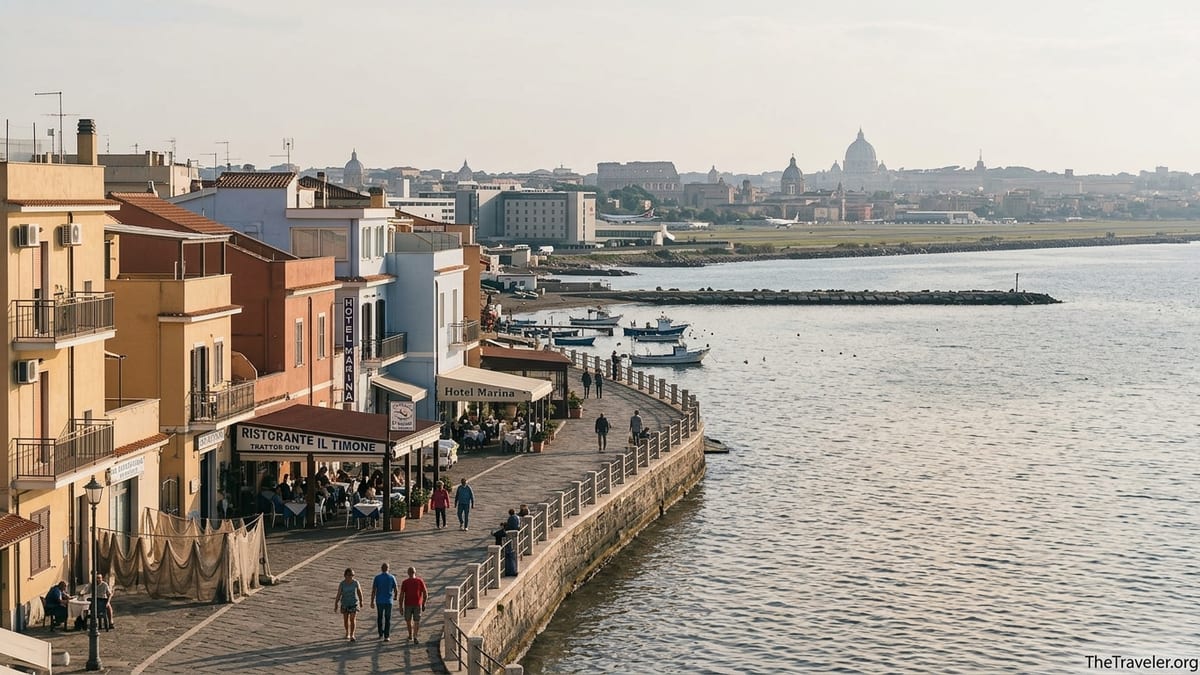
Although Fiumicino is primarily known as an airport town, it has a surprisingly pleasant coastal vibe. The town’s seafront is lined with simple beach clubs and local trattorias serving grilled fish, fried calamari and carafes of house wine at prices that are often lower than what you would pay for similar dishes near Piazza Navona. On summer evenings, Italian families stroll the promenade, kids ride bikes and the atmosphere feels more like a laid-back local resort than a big-city suburb.
If your dream of Italy includes at least one day by the sea, but you do not have time to detour to the Amalfi Coast or Cinque Terre, a short stay in Fiumicino can scratch that itch. You might, for example, spend your last day in Italy relaxing on a rented sun lounger, grabbing a gelato and watching fishing boats come in, then walk back to your hotel, repack in peace and be at the airport early the next morning without rushing. This can be particularly appealing at the end of a long multi-city itinerary when your energy is low and your luggage is heavy.
Evenings in Fiumicino look very different from evenings in central Rome. There are fewer monumental views and cocktail bars, but also fewer crowds and less noise. Travelers who feel overwhelmed by big cities or who are traveling with young children that need a calmer environment may appreciate the quieter streets and family-run hotels of Fiumicino. For them, sacrificing a bit of convenience for sightseeing can be worth the trade-off for better sleep and simpler dinners.
Who Should Almost Always Stay in Central Rome
For most first-time visitors and anyone whose primary goal is to explore Rome’s famous sights, staying in central Rome is the clear winner. If your itinerary includes the Colosseum, Roman Forum, Vatican Museums, St Peter’s Basilica, Trevi Fountain, Pantheon and Trastevere, you will be much happier in a neighborhood like Centro Storico, Monti, Trastevere, Prati or near Termini station. From these bases, you can walk or use short metro or bus rides to reach almost everything on your list, return to your room for a rest, then go back out for dinner without budgeting an hour to get “home” each time.
Consider a couple arriving for four nights with a mid-morning arrival and an early afternoon departure. If they stay near Piazza Navona or Campo de’ Fiori, they can check in, drop bags, and by late afternoon already be wandering the historic streets, stopping for an espresso and visiting the Pantheon. In the evening they can stroll to a restaurant in Trastevere. Back at the hotel, they know that the next day’s visit to the Vatican Museums is just a short bus or taxi ride away. If they were staying in Fiumicino, every excursion into Rome would start with calculating train schedules and end with a late return to the coast.
Central Rome also offers far more variety in accommodation. You can find everything from budget guesthouses around Termini to historic palazzi turned into boutique hotels near the Spanish Steps. Many of these hotels include breakfast and are located on charming side streets where you can step out to a morning cappuccino bar, something that feels worlds away from the primarily functional airport hotels near Fiumicino.
Costs, City Tax and Value for Money
The cost difference between staying in Fiumicino and central Rome is often smaller than travelers expect. While rooms near the airport or in Fiumicino town can be slightly cheaper on busy weekends, central Rome has thousands of options across every price band, from budget-friendly B&Bs to luxury properties. It is common to find mid-range double rooms in areas like Monti, Termini or Trastevere that are competitively priced with chain hotels near the airport, especially outside of high summer or major holidays.
Rome applies a nightly tourist tax that is charged per person, typically added to your bill at the end of the stay. This tax applies whether you stay near the airport or in the city center, so it does not usually tip the scale in favor of one area. What does change the value calculation is transport. A solo traveler staying out in Fiumicino and commuting in every day will spend around 14 euros each way on the dedicated airport train or a bit less on slower options, while a couple or family will multiply that cost by two, three or four. Over a three- or four-day stay, those transport costs can eat up any savings on the room rate.
On the other hand, a family of four arriving at Fiumicino may find that an official flat-fare taxi to a central neighborhood works out cheaper and far simpler than four separate train tickets, particularly if they have young kids and multiple suitcases. When you divide a 50- to 55-euro cab across four people, the per-person cost drops to roughly the same as the train while eliminating the need to drag luggage through train stations or change lines with tired children.
Itinerary Scenarios: Fiumicino vs Central Rome in Practice
Imagine a traveler on a 24-hour layover between long-haul flights. They land at 21:00 and depart at 19:00 the following evening. In this case, a hotel in Fiumicino is ideal. They can check in by 22:00, sleep, enjoy breakfast, then decide whether to take a mid-morning train into Rome for a few hours. Even if they spend 30 minutes each way on the Leonardo Express and give themselves a safety margin coming back, they still have a solid five to six hours to see the Colosseum exterior, walk via the Roman Forum and grab lunch near Piazza Venezia before returning for their evening flight.
Now consider a couple visiting Italy for the first time with three full days in Rome. They arrive at 10:00 and leave at 18:00 on the fourth day. Here, staying in Fiumicino would be a mistake. Each of their sightseeing days would start with an early train, followed by navigating from Termini to whatever area they plan to visit. After dinner they would face a 30- to 40-minute ride back to the coast instead of an evening passeggiata past illuminated fountains on the way to their centrally located hotel. Choosing a base in Monti or near the Pantheon would effectively give them two to three extra “usable” hours per day.
For a third scenario, picture a family with two young children finishing a two-week Italian trip. Their last day in Rome is in mid-August, temperatures are high and everyone is tired. An early morning flight looms the next day. Booking a small seafront hotel in Fiumicino allows them to sleep a bit later, let the kids play on the beach before lunch, then pack in the afternoon and be at the terminal early without the stress of crossing the city in peak summer heat. In this case, Fiumicino provides both emotional and logistical relief.
How Long Is “Too Long” to Base in Fiumicino?
As a rule of thumb, if you have more than one full day planned inside Rome’s historic center, staying in Fiumicino for the entire visit rarely makes sense. The longer your stay, the more the daily commute erodes your time and energy. For a two-night visit focused mainly on Vatican City, the Colosseum and the classic baroque squares, being based in a central district allows you to spread those sights across your days without booking everything back-to-back under the pressure of train timetables.
There are exceptions. Some travelers combine remote work with a slow-paced visit and only plan the occasional day trip into Rome. Someone spending a week by the sea in Fiumicino who wants to take a couple of day trips to Rome might appreciate the quieter evenings and larger apartment-style hotels. They might commute in twice for long sightseeing days and spend the remaining time on the beach or exploring coastal towns like Ostia. In this “Rome as a side trip” model, Fiumicino is a perfectly valid base.
For most tourists, however, particularly first-timers and those with limited vacation days, central Rome is the smarter choice for any stay longer than a quick overnight. You will simply see and feel more of the city when you are not constantly calculating train times back to the airport.
The Takeaway
Choosing between Fiumicino and central Rome is really about deciding whether airport convenience or immersion in Rome’s daily life matters more for your particular trip. Fiumicino is ideal for jet-lag recovery nights, tight layovers, business trips based at the airport and final nights before dawn departures, especially if you like the idea of one last walk by the sea and a stress-free ride to your terminal.
Central Rome, by contrast, is where nearly everyone who wants to experience the city’s history, street life and food should stay. Basing yourself near the major sights turns spontaneous evening walks, quick returns to your room and leisurely dinners into part of the experience, instead of turning every outing into a half-day excursion from an airport town. When in doubt, if you have at least two full days of sightseeing in Rome, choose a neighborhood in the city center and treat Fiumicino as what it primarily is: a very useful airport, and a convenient overnight stop, rather than the main stage for your Roman holiday.
FAQ
Q1. Is Fiumicino safe to stay in compared with central Rome?
Both Fiumicino and central Rome are generally safe for visitors, especially in main hotel and restaurant areas. Central Rome is busier and can feel hectic, with more pickpocket risk in crowded spots like Termini station and around major sights. Fiumicino tends to feel quieter and more residential at night, which some travelers find more relaxing.
Q2. How much time should I allow to travel from Fiumicino to central Rome?
Plan on around 30 to 35 minutes on the Leonardo Express train from the airport station to Roma Termini, plus extra time to walk or use metro or taxis to your final destination. With waiting times and connections, the overall door-to-door journey from a Fiumicino hotel to a central Rome attraction often takes 45 to 60 minutes.
Q3. Is staying in Fiumicino cheaper than staying in central Rome?
Room rates in Fiumicino can sometimes be slightly lower, especially for chain hotels near the airport, but central Rome has a huge range of options and frequent deals. When you factor in the daily cost of transport between Fiumicino and the city, any savings on accommodation often disappear, particularly for couples and families who must buy multiple train tickets.
Q4. Should I stay in Fiumicino for an early morning flight?
If your flight leaves very early, many travelers choose to stay in Fiumicino the night before to avoid navigating across Rome in the dark. Being five to ten minutes from the terminal reduces stress and gives you a bit more sleep. For mid-morning or later flights, staying in central Rome and taking an early train or taxi is usually easy enough.
Q5. Can I base in Fiumicino and do day trips into Rome?
Yes, you can, especially if you value quiet evenings and do not mind the commute. Many travelers staying several days by the sea in Fiumicino take one or two long day trips into Rome using the train or bus. However, this approach is less convenient if you plan to be in the city every day or want to pop back to your hotel midday.
Q6. Which Rome neighborhoods are best if I choose central Rome instead of Fiumicino?
For first-time visitors, popular choices include Monti near the Colosseum, the historic center around the Pantheon and Piazza Navona, Trastevere for lively evenings, and Prati near the Vatican. Staying near Termini station can also be practical if you are arriving or departing by train and want straightforward airport connections.
Q7. Is Fiumicino a good base for visiting the Vatican and Colosseum?
Fiumicino is not ideal if the Vatican, Colosseum and other central sights are your main focus. You will need to take a train into Rome and then switch to metro, bus or taxi to reach those specific areas. Over multiple days, that commute becomes time-consuming compared with staying in a central district where many landmarks are within walking distance.
Q8. What is Fiumicino town like in the evening?
Fiumicino’s evenings are quieter and more local than central Rome. You will find waterfront promenades, seafood restaurants, gelato shops and families out for a stroll, rather than grand piazzas packed with tourists. It can be charming if you enjoy a relaxed, small-town atmosphere and simple meals by the sea.
Q9. Is it easy to reach Fiumicino from Rome late at night?
There are late-evening trains and buses from central Rome to Fiumicino Airport, but frequencies drop compared with daytime. If you plan to stay in Fiumicino and have dinner in the city, you should always check the last train or bus times in advance. Many travelers returning late opt for a regulated taxi directly from central Rome to their Fiumicino hotel.
Q10. For a first visit to Rome, should I split my stay between central Rome and Fiumicino?
Splitting can work well if you have an early departure. Many visitors spend most of their stay in a central neighborhood, then move to a hotel in Fiumicino for the final night. This way you enjoy maximum time in the heart of Rome but still benefit from being close to the airport when it matters most.