


I’ve been to Culebra enough times to know that comparing Flamenco Beach and Zoni Beach is like comparing two versions of the same dream. One comes with bathrooms, food kiosks, and an easy rhythm. The other comes with quiet, raw scenery, and the feeling that you’ve slipped off the map. On my most recent visits, I spent full beach days at both, swam in both sets of water, and dealt with the practical stuff that never makes it into glossy photos: getting there, finding shade, locating a restroom, and figuring out where my next cold drink would come from. Here’s what I actually experienced and which one I’d pick, depending on the kind of day I want.
Get the latest updates straight to your inbox!
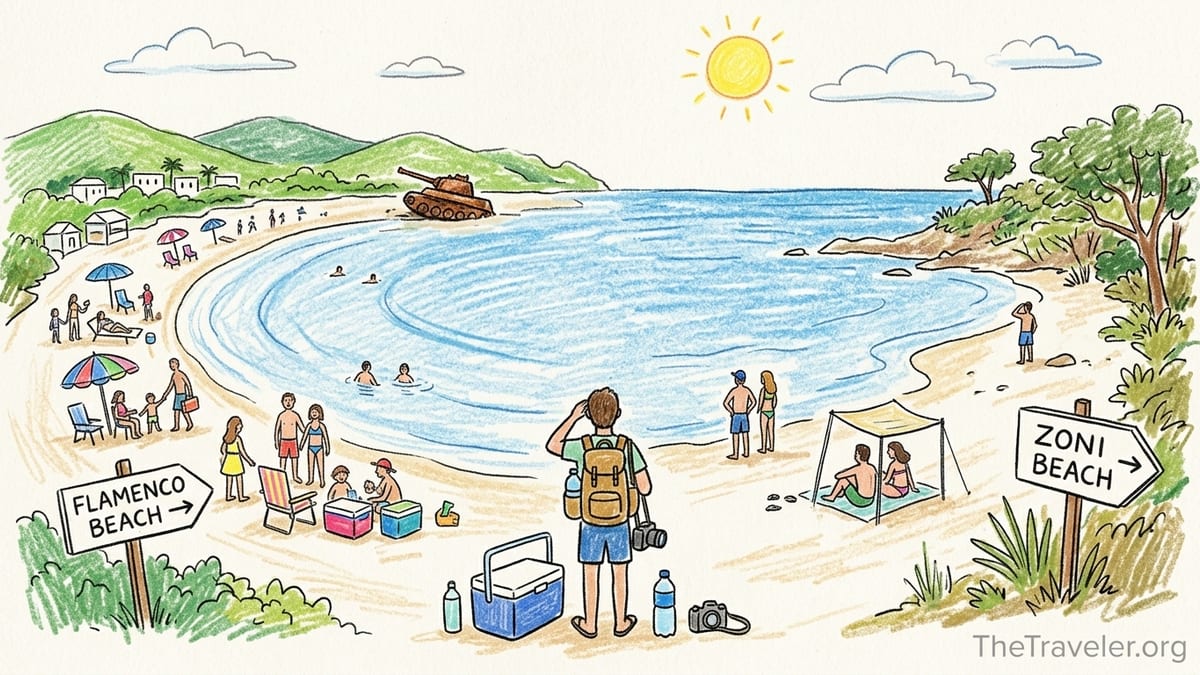
First, What I Had to Do Just to Reach Each Beach
Every Flamenco versus Zoni debate starts before your feet touch sand, because Culebra itself takes planning. I arrived via the public ferry from Ceiba, which is the main jumping-off point on Puerto Rico’s east coast for Culebra. The ride is roughly an hour, and the biggest “first-hand” lesson I’ve learned is that ferry logistics can shape your entire beach day. If your departure is early, Flamenco feels effortless and long. If your departure is later, you’ll feel rushed no matter which beach you choose.
Once I stepped off at the ferry dock in Dewey, Flamenco was the simple option: a steady stream of travelers funneled toward shared taxis and shuttles. I’ve paid about $5 per person for the shuttle-style ride to Flamenco, the kind where you squeeze in with other beach-bound strangers and your cooler rides in the back. I didn’t need to negotiate much, and I didn’t need to worry about being stranded later. It felt like a well-worn path.
Zoni took more intention. It’s on the northeastern side of the island and feels farther in a way that’s not just distance. I had to be more deliberate about timing my ride, confirming the pickup plan, and making sure I had everything I’d need because I wasn’t going to “buy my way out” of any forgotten item once I got there. That difference in access is the first reason Zoni stays quieter: fewer people choose the beach that requires a bit more commitment.
By the time I actually arrived at each beach, I’d already spent my energy differently. Flamenco felt like I’d been carried there by the island’s default current. Zoni felt like I’d chosen it, on purpose, with no safety net.
Water and Swimming: Where I Felt Most Comfortable Getting In
Flamenco’s water, on my visits, has been the more immediately inviting swim. The bay shape makes it feel protected, and the entry was straightforward: wade in, get past a gentle shore break, then settle into a long, easy float. I spent a lot of time just swimming parallel to shore, turning my head to watch families set up umbrellas and couples taking photos near the surf line.
Zoni’s water felt more wild to me. Even when it looked calm from the sand, it had a different energy once I stepped in, with more open-ocean presence and a sense that conditions could change quickly. I still swam, but I stayed closer to shore and treated it like a “dip and reset” beach rather than a “swim for an hour without thinking” beach. I listened more carefully to what the water was doing and watched sets more closely before going deeper.
When I wanted a low-stress swim day, Flamenco won. When I wanted to feel like I was swimming in a place that hasn’t been softened for visitors, Zoni delivered, but I approached it with more caution and more respect. If I were traveling with a nervous swimmer, I’d steer them toward Flamenco first, then decide on Zoni based on the day’s conditions.
One practical note from experience: the more facilities a beach has, the more I’m willing to stay in the water longer because I know I can rinse off, regroup, and hydrate easily after. That alone changed my swim habits. At Flamenco I swam again and again. At Zoni I made each swim count.
Sand, Comfort, and the Small Things That Define a Beach Day
Flamenco’s sand felt like the kind that forgives you. I could drop my towel almost anywhere and feel comfortable. The beach is wide enough that even with plenty of visitors, I still found space to stretch out without feeling like I was camping in someone else’s living room. On one of my visits, I arrived mid-morning and still had no trouble finding a spot that felt “mine” for the day.
Zoni’s sand experience was more about choosing a setup based on sun and wind. I found myself scanning for the best patch of shade and the best angle to avoid getting blasted by breeze-driven grit. It wasn’t uncomfortable, but it demanded more attention. If Flamenco lets you arrive unprepared and still have a great day, Zoni rewards the person who shows up with a plan.
At Flamenco, I watched people set up like they were moving in: folding chairs, full coolers, floaties, and even a little portable speaker soundtrack. It gave the beach a friendly, social feel. At Zoni, I felt like most people were trying to disappear into the scenery. No one was being unfriendly, but the vibe was quieter, more private, and more nature-forward.
The biggest comfort difference, for me, wasn’t the sand. It was the knowledge that at Flamenco I could buy what I forgot. At Zoni, what I forgot became my problem for the rest of the day.
Crowds and Atmosphere: Party Beach vs Quiet Beach (Without the Cliches)
Flamenco is popular for a reason, and that popularity is visible. On my Flamenco days, I heard multiple languages, saw tour groups arriving in waves, and watched the beach subtly change tone as the day went on. Earlier in the morning, it felt almost serene. By late morning into early afternoon, it felt like the island’s main stage. Not chaotic, but unmistakably busy.
That energy can be exactly what you want. I’ve had Flamenco days where I enjoyed the hum: kids laughing, people sharing sunscreen, someone offering to take another traveler’s photo. It felt safe and communal. If you’re traveling solo and you want a beach where you don’t feel alone, Flamenco is easy companionship without requiring conversation.
Zoni felt like the opposite kind of luxury: emptiness. Discover Puerto Rico’s description matches what I experienced, that Zoni can be similarly beautiful but substantially quieter because it lacks Flamenco’s bathrooms, kiosks, and other visitor facilities. When I was there, I had stretches of time where the loudest sound was wind and the steady push of waves. The fewer amenities weren’t a downside in the moment; they were the reason the place still felt untouched.
If you’re the kind of traveler who equates “best beach” with “most peaceful,” Zoni will feel like a secret. If you equate “best beach” with “most enjoyable all-day hang,” Flamenco’s atmosphere makes it easier to stay happy for longer.
Facilities and Food: The Real Reason Flamenco Is Effortless
Flamenco is not just a pretty shoreline. It’s a functioning beach day machine. I paid the small per-person beach fee at the entrance and immediately felt the difference: there are bathrooms, outdoor showers, and a line of kiosks where you can actually solve problems. Hungry? Buy lunch. Thirsty? Cold drink. Forgot sunscreen? Someone nearby is selling something, or you can ask around because people are set up for the day.
On one visit, I grabbed a quick kiosk lunch instead of rationing what I’d packed. It wasn’t “fine dining,” but it was the kind of hot, salty, satisfying beach meal that changes your mood. That’s the subtle magic of Flamenco: it supports you, so you spend more time enjoying the beach and less time managing yourself.
Zoni was the opposite. No bathrooms. No kiosks. No easy reset button. Discover Puerto Rico is explicit that Zoni doesn’t have amenities like bathrooms, parking, or kiosks, and that matched what I dealt with on the ground. I packed my own water and snacks, and I was acutely aware of how quickly a beach day can fall apart if you miscalculate. If I’d forgotten extra water, I would have ended up cutting my visit short.
That lack of facilities is exactly what many travelers love. But it changes the type of visitor who shows up. Zoni attracts people willing to be self-sufficient. Flamenco attracts everyone, including travelers who are new to island logistics or who just want to show up and relax.
Scenery and the “Culebra Feeling”: What Stayed With Me After I Left
Flamenco’s scenery is iconic in a way that feels almost unreal in person. The bay curves softly, the water shifts through bright, tropical blues, and the whole place looks like the photo you came for. Even with people around me, I could look up and feel that little jolt of gratitude that I made the effort to get to Culebra in the first place.
But Zoni’s scenery lingered in my head longer. The beach felt wilder, more spacious, and more elemental. I remember standing at the shoreline, facing the open water, and feeling like I was looking at the island from its quiet side. Zoni gave me the sensation that nature was the main character and I was just passing through.
If I’m being honest about “first-hand experience,” I took more photos at Flamenco, but I felt more at Zoni. Flamenco is the beach I document. Zoni is the beach I internalize. That doesn’t make Zoni objectively better, but it explains why travelers who crave solitude talk about it with a certain reverence.
For scenery alone, it’s a tie in beauty but not in mood. Flamenco is cinematic. Zoni is meditative.
Which One I Prefer, and When I’d Return to the Other
If I had to pick one beach as my personal favorite, I’d choose Flamenco more often, simply because it consistently gives me the best overall day. The combination of easy swimming, soft sand, and reliable facilities means I can stay longer, swim more, eat when I’m hungry, and not worry about minor inconveniences turning into major ones. If I’m traveling with friends, family, or anyone who doesn’t want a “survival-lite” beach day, Flamenco is my default.
But I return to Zoni for a different reason: it’s where I go when I want Culebra to feel like Culebra. When I want space, quiet, and the sense that I’m not sharing my shoreline with half a ferry load of people, Zoni is the reset. I’d choose it on a weekday if I had the flexibility, or anytime I felt overstimulated and wanted the beach to be simpler, not busier.
Here’s the most practical way I decide. If I’m arriving with minimal gear, I go to Flamenco. If I have a cooler, plenty of water, and enough daylight to treat the beach like a slow experience, I go to Zoni. Flamenco is my “make the most of a day trip” beach. Zoni is my “pretend I live here” beach.
The truth is that the best Culebra beach depends on what you want the beach to do for you. Flamenco takes care of you. Zoni asks you to take care of yourself, and in return it gives you quiet.
The Takeaway
From my own visits, Flamenco Beach is the better choice for most travelers most of the time: easier access, easier swimming, more comfort, and facilities that let you stay out all day without stress. Zoni Beach is the better choice when you want the beauty without the buzz, and you’re willing to bring everything you need because the beach won’t provide it.
If you’re planning only one beach day on Culebra and you’re not sure about logistics, I’d personally send you to Flamenco. If you’re returning to Culebra, or you’re the kind of traveler who measures a beach by how quiet it feels when you stop talking, I’d point you to Zoni and tell you to pack water like you mean it.
I’ll keep going back to both, but for different versions of the same island. Flamenco is my celebration beach. Zoni is my exhale beach.
FAQ
Q1. Which beach is easier to visit on a quick day trip to Culebra?
Flamenco Beach, because transportation from the ferry dock is straightforward and the on-site facilities make it easy to stay comfortable without overpacking.
Q2. Does Zoni Beach really have no bathrooms or food kiosks?
Yes. On my visit there were no bathrooms, kiosks, or easy food options, which is a big reason it stays quieter than Flamenco.
Q3. Do I have to pay an entrance fee at Flamenco Beach?
Yes. When I entered, I paid a small per-person beach fee at the gate, and there is also a separate parking fee if you arrive with a vehicle.
Q4. Which beach has better swimming for nervous swimmers?
In my experience, Flamenco felt more forgiving for a casual swim, while Zoni felt more exposed and required more attention to conditions.
Q5. Which beach is less crowded?
Zoni. It stayed noticeably quieter for me, largely because it lacks the visitor facilities that make Flamenco so easy and popular.
Q6. Can I buy lunch and drinks at Flamenco?
Yes. Flamenco has kiosks where I was able to buy food and drinks during my beach day, which made it easier to stay longer.
Q7. If I forget water or sunscreen, which beach is more forgiving?
Flamenco. The facilities and vendors make it much easier to recover from forgetting something compared to Zoni.
Q8. Which beach feels more “untouched” and natural?
Zoni felt more wild and undeveloped to me, with fewer people and fewer signs of visitor infrastructure.
Q9. Is Flamenco still worth it even if I don’t like crowds?
Yes, if you go early. On my visits, mornings felt calmer, and the beach atmosphere got busier later in the day.
Q10. Which beach would I personally choose if I could only return to one?
I’d return to Flamenco more often for the overall quality of a full-day beach experience, but I’d go back to Zoni whenever I specifically want quiet and solitude.