


More news on this day
Hundreds of passengers were left stranded at Cairo International Airport after widespread disruption saw more than 100 flights delayed and several canceled across major carriers serving regional and long-haul routes.
Get the latest news straight to your inbox!
Widespread Disruptions Hit Cairo’s Main Hub
Reports from airline tracking platforms and local aviation coverage on June 21 indicate that operations at Cairo International Airport were heavily disrupted, with 103 flights delayed and at least four canceled across the day. The disturbance affected a mix of domestic and international services, complicating connections for travelers heading to and from the Middle East, Europe, and Africa.
Cairo International Airport, the main hub for EgyptAir and a key gateway between Africa, the Gulf, and Europe, typically handles a dense schedule of departures and arrivals through its three passenger terminals. When that timetable is significantly pushed back, knock-on effects quickly spread across connecting banks of flights, leaving transit passengers stranded in the terminal and local travelers forced to rebook at short notice.
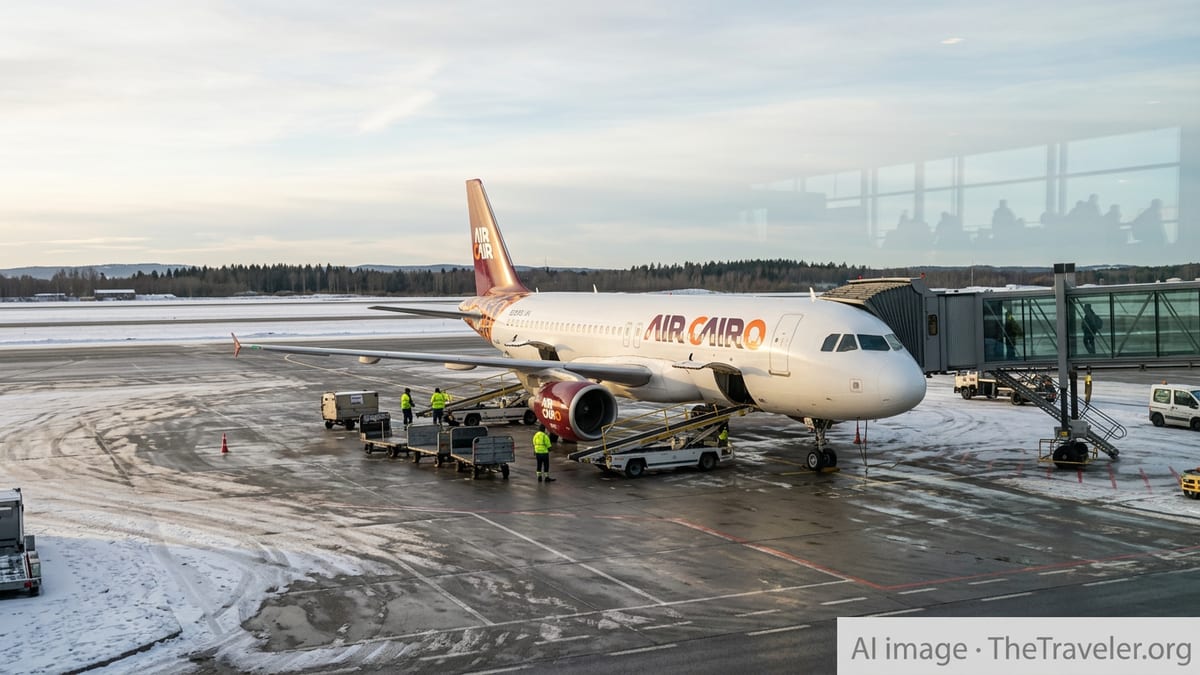
On Saturday’s schedule, EgyptAir and its subsidiary Air Cairo were among the most heavily impacted, but disruption was not limited to local airlines. Published flight-status data showed delays or schedule changes involving services operated by Emirates, Saudia, Lufthansa, Turkish Airlines, and other international carriers that rely on Cairo as an important regional node.
While the number of outright cancellations remained relatively limited compared to the volume of delayed services, the scale of the timetable slippage created long queues at check-in and transfer desks as passengers sought rerouting or accommodation. For many travelers, missed connections onward to Gulf hubs and European cities turned what should have been routine journeys into overnight ordeals.
Key Routes to Gulf Hubs Among the Worst Affected
The most severe disruption centered on routes linking Cairo with major Gulf and Red Sea gateways. Flights serving Dubai, Riyadh, and Jeddah experienced significant delays, with some departures pushed back by several hours. These routes are heavily used by labor travelers, religious pilgrims, and transit passengers connecting between Africa, Asia, and Europe, magnifying the impact of each delayed service.
Emirates’ operations to Dubai and Saudia’s busy rotations to Riyadh and Jeddah were among those affected, alongside EgyptAir and Air Cairo services that feed passengers into partner networks at Gulf hubs. Indirectly, delays on Cairo-originating flights also rippled into onward connections bound for destinations in Asia and Europe, compounding frustration for travelers facing multiple missed legs in a single itinerary.
Lufthansa and Turkish Airlines, which operate key links from Cairo into their Frankfurt, Munich, and Istanbul hubs, also saw schedule disruptions recorded throughout the day. For passengers booked on complex itineraries involving multiple carriers, even a moderate delay out of Cairo could nullify minimum connection times at these hubs, requiring wholesale rebooking and extended layovers.
Some reports suggested that aircraft and crew rotations were knocked out of sequence as the day progressed, forcing airlines to hold or swap equipment and deepening delays into the evening. With Cairo functioning as a critical interchange between regional and intercontinental routes, relatively small operational issues can cascade rapidly when multiple carriers are all working to recover their schedules at the same time.
Operational Strain Amid a Volatile Regional Backdrop
The disruption in Cairo unfolded against a backdrop of heightened operational complexity for Middle Eastern and North African aviation. In recent months, carriers across the region have been adjusting schedules, rerouting aircraft, and occasionally suspending services in response to shifting airspace restrictions, higher fuel costs, and localized security incidents affecting key hubs.
Industry coverage has highlighted how drone and missile incidents in the Gulf and broader regional tensions have forced airlines to reroute around contested or restricted airspace, adding flight time and complicating crew planning. As carriers adjust, tight turnarounds and busy evening banks at major airports such as Cairo, Dubai, Riyadh, and Jeddah have become more vulnerable to delay cascades when any single link in the chain falters.
At the same time, passenger demand through Cairo has been rebounding, supported by the city’s role as a transit point between Africa and the Gulf and by Egypt’s efforts to position the airport as a competitive hub. Increased volumes mean that any bout of disruption now affects more travelers than in the quieter years of the pandemic era, stretching terminal facilities, ground handling resources, and airline customer-service teams during peak waves.
Although no single cause was immediately pinpointed in public reporting for Saturday’s pattern of delays and cancellations, aviation observers note that even modest operational disturbances can be amplified by regional rerouting, staffing constraints, and the tight scheduling typical of hub operations. Once several early flights depart late, on-time recovery often becomes challenging without aircraft and crew spare capacity.
Passengers Face Missed Connections and Overnight Stays
For travelers caught in the disruption, the most immediate consequence was the loss of onward connections. Cairo’s role as a transfer point means many passengers are ticketed on multi-leg journeys that depend on precisely timed links to Gulf, European, or African destinations. When a departure is held on the ground for an extended period, minimum connection times are quickly breached, invalidating pre-booked itineraries.
Publicly available accounts from recent disruptions at regional hubs provide a picture of what stranded passengers commonly experience: long waits at transfer desks, lines for rebooking on later departures, and uncertainty around eligibility for hotel accommodation or meal vouchers. In Cairo, similar scenes unfolded as travelers attempted to secure seats on the limited number of remaining flights later in the day, or else accepted overnight stays and rebooked departures on Sunday.
Some passengers with separate tickets or self-arranged connections found themselves particularly exposed, since airlines generally prioritize assistance for those on through-tickets booked under a single reservation. For these travelers, missed connections often translate directly into additional costs for new tickets, hotels, and ground transportation, with only limited recourse through standard airline policies.
For families traveling with children, elderly passengers, and those on tight schedules for work or religious obligations, the effect of even a few hours’ disruption can be especially acute. The combination of crowded terminals, fatigue, and uncertain information flows frequently turns what begins as an operational issue into a stressful and disruptive personal experience.
Guidance for Travelers Using Cairo in the Coming Days
In the wake of Saturday’s disruption, travel advisers are encouraging passengers booked through Cairo International Airport to build extra buffer time into itineraries, especially when connecting to long-haul departures for the Gulf or Europe. Where possible, booking through-tickets on a single reservation and avoiding self-connecting on separate tickets can make it easier to secure assistance and rerouting if delays arise.
Travelers are also urged to monitor flight status closely in the 24 hours before departure via airline apps and airport information channels, as same-day schedule changes have become more common across the region. Early awareness of a significant delay or cancellation can open up more options for rebooking or adjusting ground transport and accommodation plans before arriving at the airport.
For those already stranded in Cairo, customer-service desks inside the terminals remain the primary point of contact for rebooking, while airline conditions of carriage and regional passenger-rights frameworks can provide guidance on entitlements to care such as meals or lodging in the event of extended delays. Travelers are advised to keep all receipts for out-of-pocket expenses and to follow up in writing with their airline and, where relevant, travel insurance providers.
With Cairo positioned as a central link in Middle Eastern and African aviation, further periods of congestion and delay cannot be ruled out as airlines navigate a volatile operating environment. For now, passengers preparing to pass through Egypt’s busiest airport are being reminded to allow additional time, remain flexible, and stay informed as flight schedules evolve.