


More news on this day
Passengers at New York’s LaGuardia Airport faced another day of disrupted travel as six flight cancellations and more than 80 delays impacted services operated by Jazz, American Airlines, Endeavor Air and Delta Air Lines, snarling connections to Toronto, Montreal, Miami, Orlando, Boston and Houston.
Get the latest news straight to your inbox!
Fresh Operational Strains At A Constrained Airport
Publicly available tracking data on June 21 indicates that LaGuardia Airport once again struggled to keep flights on schedule, despite long-running caps on movements designed to ease congestion. Federal regulators have extended reduced slot requirements in the New York region into 2027 in an effort to contain chronic delays, yet demand for access to LaGuardia remains high and the airfield’s runway capacity limited.
Within that environment, even a relatively small cluster of cancellations can ripple across the network. The latest count of six cancellations and 84 delays hit regional and mainline services operated by Jazz, American Airlines, Endeavor Air and Delta Air Lines, all significant players on LaGuardia’s short-haul routes to the Northeast, Florida and key business centers in Canada and Texas.
Operational stress has been heightened in recent months by a combination of factors. Reports and archived airline bulletins reference ongoing air traffic controller shortages, tighter safety margins following a deadly collision involving a regional jet at LaGuardia in March, and periodic weather systems along the busy Northeast corridor, all of which can force ground stops or extended spacing between arrivals and departures.
For carriers, these constraints translate into compressed schedules and little slack in aircraft and crew rotations. When an inbound aircraft or crew fails to arrive on time, the knock-on effect can quickly cascade across multiple departures from LaGuardia, aggravating what would otherwise be short delays into multi-hour disruptions.
Key Routes To Toronto, Montreal And Major U.S. Hubs Affected
The latest disruptions were particularly visible on transborder routes to Toronto and Montreal, as well as heavily trafficked domestic links to Miami, Orlando, Boston and Houston. These city pairs are typically served by a mix of mainline jets and regional aircraft, with Jazz and Endeavor Air operating flights on behalf of larger network carriers alongside American and Delta mainline services.
Published destination schedules show that LaGuardia remains an important U.S. gateway for Canadian travelers, offering frequent service to Toronto and Montreal that supports both business and leisure demand. When delays and cancellations cluster on these routes, passengers can lose same-day connections onward through Canadian hubs, compounding travel time and complicating rebooking.
On the U.S. side, links to Florida, New England and Texas are similarly sensitive. Miami and Orlando serve as major leisure and cruise gateways, while Boston and Houston support dense business and medical travel flows. Disruptions on LaGuardia departures to these airports can strand travelers on both ends, as late-arriving aircraft from the south and southwest then struggle to depart on time back to New York.
Recent coverage of severe travel days at other U.S. airports, including Fort Lauderdale, Minneapolis and San Juan, has highlighted how weather and infrastructure constraints in one part of the network can spread delays nationwide. LaGuardia’s role as a slot-controlled, high-demand airport means its own operational challenges are more likely to propagate quickly along these trunk routes.
Safety Scrutiny And Capacity Limits Shape LaGuardia’s Recovery
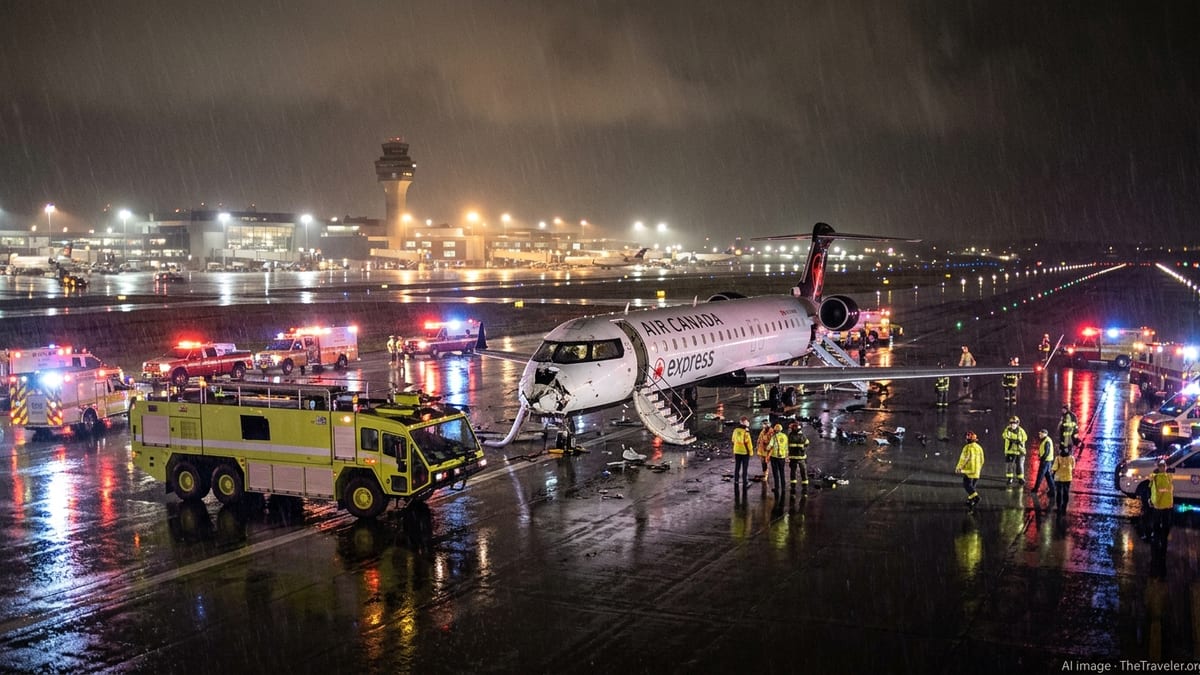
LaGuardia’s latest day of disruption comes against the backdrop of heightened safety scrutiny and constrained capacity. In March, an Air Canada Express flight operated by Jazz collided with an airport vehicle on landing, prompting a full closure and days of reduced operations as investigators and recovery crews worked on site. Subsequent weeks saw elevated cancellation levels as airlines and the airport adjusted to tighter procedures and capacity limits.
Reports from that period describe reduced runway throughput and temporary schedule cuts as airlines sought to maintain greater buffers between movements. Anecdotal passenger accounts from March and April referenced multiple cancellations in a single day on certain carriers at LaGuardia, with some travelers resorting to overnight stays in the terminal when hotel options ran short.
Regulators have continued to emphasize capacity management at New York’s airports. According to recent coverage of Federal Aviation Administration decisions, the agency has extended relief from minimum slot-use rules at LaGuardia and neighboring airports, acknowledging that without such measures, congestion-related delays would likely worsen. The goal is to give airlines flexibility to trim schedules without permanently surrendering access rights, allowing a gradual rebuilding of reliability.
For passengers, this environment can be paradoxical. Fewer scheduled flights are intended to improve on-time performance, yet any unplanned disruption, such as localized thunderstorms or a temporary ground stop, can still overwhelm the reduced network, as seen in the latest wave of LaGuardia delays.
Impact On Travelers: Missed Connections And Overnight Stays
The practical impact of six cancellations and 84 delays at a compact, high-volume airport like LaGuardia extends far beyond those flight numbers. Seating on later departures is already tight due to capacity limits, so rebooking displaced travelers can be slow, particularly on popular routes to Florida, Texas and major Canadian hubs.
Recent passenger accounts from LaGuardia and other U.S. airports describe a familiar pattern on such days: rolling delays announced in 30-minute increments, long lines at customer service counters, and difficulty securing hotel vouchers once disruptions spill into late evening hours. When irregular operations coincide with busy weekends or holidays, available hotel rooms near the airport can sell out, forcing some travelers to remain in the terminal overnight.
Connections are especially vulnerable. A delayed evening departure from LaGuardia to Toronto, Montreal or Miami can cause passengers to miss early-morning long-haul flights the following day. In some cases, onward itineraries to Latin America or Europe have to be rebooked by a full day or more, significantly extending travel time and adding out-of-pocket expenses for meals and lodging.
Families traveling to Orlando for cruises or theme park vacations are also exposed, as missed embarkation times or prepaid park reservations can result in financial losses. Travel insurance policies sometimes cover such contingencies, but coverage varies and often requires careful documentation of delays and cancellations.
What Passengers Can Do On High-Disruption Days
While the latest disruptions at LaGuardia stem from structural and operational issues beyond individual control, travelers can take practical steps to reduce risk. Airline and airport advisories consistently recommend checking flight status frequently on the day of departure, enrolling in carrier text or app notifications, and arriving early when widespread delays are reported.
Travel experts also note that early-morning departures are statistically less prone to long delays, as they are less affected by knock-on effects from earlier disruptions. When possible, booking nonstop flights rather than tight connections, especially on routes linking LaGuardia with Toronto, Montreal, Miami, Orlando, Boston and Houston, can provide a buffer if the outbound leg is delayed.
For those already at the airport when disruption unfolds, access to real-time information is crucial. Monitoring both airline apps and departure boards can help identify alternative routings, such as connecting through different hubs or switching between New York-area airports if ground transport options are available.
As LaGuardia continues to adjust to safety requirements, staffing challenges and regional weather patterns, travel analysts expect days of relatively smooth operations to be punctuated by episodes of significant disruption. The latest round of six cancellations and 84 delays underscores how quickly conditions can deteriorate at one of the country’s most constrained airports, and how vital preparation and flexibility have become for anyone flying through New York.