


More news on this day
Hundreds of Qantas and Jetstar passengers in Sydney and Auckland have been caught in a fresh wave of schedule disruption, as a spike in cancellations and rolling delays strands travelers across key trans-Tasman and domestic routes.
Get the latest news straight to your inbox!
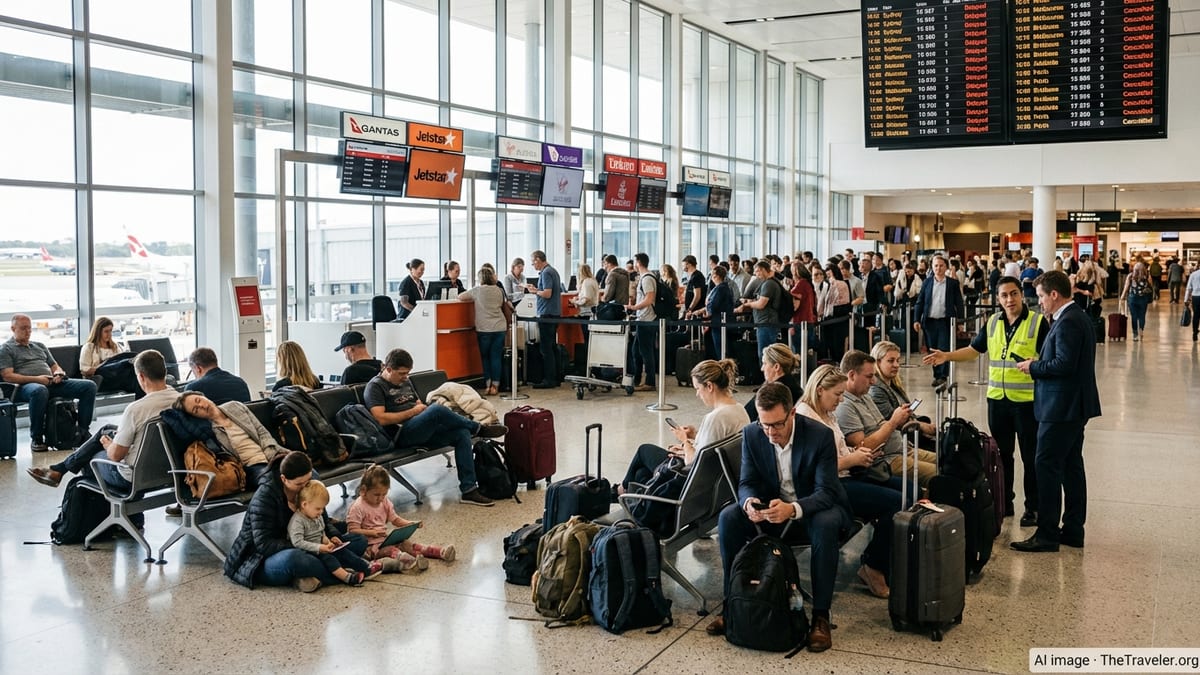
Wave of Disruptions Across Australia and New Zealand
Published flight-status dashboards and airline tracking data for late June indicate an unusually high volume of disrupted services on Qantas and Jetstar routes touching Sydney and Auckland, with cancellations and extended delays stacking up across multiple days. Aggregated counts from airport boards, airline feeds and independent trackers suggest more than 700 individual flight movements affected in the current disruption window, including outright cancellations and late departures.
The disruptions have centered on Sydney, Qantas’s main hub, and Auckland, a key focus city for Jetstar, causing knock-on effects across domestic Australian routes and popular trans-Tasman services. Passengers report extended waits, last-minute gate changes and missed onward connections as aircraft and crews fail to arrive in position on time.
The pattern reflects the kind of cascading operational stress that has periodically hit the Australian market in the past two years, where a small number of initial cancellations quickly spread through tightly timed schedules. Once a morning wave of flights is disrupted, aircraft and crews may be out of place for the rest of the day, multiplying delays for subsequent departures.
Although individual days of disruption are not unusual during peak travel seasons, analysts note that the intensity and breadth of recent issues affecting both Qantas mainline and low-cost affiliate Jetstar has drawn particular attention, especially given the carriers’ continued efforts to rebuild reliability after the pandemic.
Operational Pressures Behind the Latest Chaos
Publicly available guidance from Qantas and operational summaries from aviation authorities highlight several concurrent pressure points that can push the network into instability. These include tight aircraft utilization, ongoing crew availability challenges, weather-related airspace restrictions and air traffic control constraints at Sydney Airport, all of which can compound to produce large volumes of disrupted flights in a short period.
Industry reporting on recent months points to continuing strains in the domestic Australian market, where carriers, including Qantas and Jetstar, have sought to match strong demand with dense schedules. When aircraft rotations are planned with limited slack, even minor maintenance issues or short bursts of bad weather can force airlines to cancel services or significantly delay departures to avoid breaching airport curfews and crew duty-time limits.
Analysts also point to the lingering effects of earlier fleet and staffing decisions. Qantas has been transitioning parts of its domestic and regional fleets and is preparing for the arrival of new long-haul aircraft, while Jetstar continues to balance its Airbus A320-family operations with newer Boeing 787 and A321neo aircraft on key leisure and international routes. These transitions can temporarily reduce operational flexibility if spare aircraft and crews are in short supply.
For Sydney and Auckland in particular, the combination of airport curfews, runway maintenance windows and strong seasonal demand makes it difficult to recover from disruptions once they occur. When early-morning departures run late, aircraft may arrive back after their intended time slots or miss curfew cut-offs altogether, forcing schedule reshuffles that ripple into the following day.
Impact on Travellers Across the Qantas and Jetstar Networks
For passengers, the immediate impact of the latest disruption burst has been long queues at check-in, packed customer-service desks and last-minute scrambles to rebook missed connections. Travelers moving between regional Australian centers and Sydney have been particularly exposed, as delays on short-haul sectors can cause them to miss long-haul departures to Asia, North America or Europe.
Reports from affected travelers on public forums and social media describe long waits for information and limited same-day alternatives on heavily booked routes. For some Jetstar passengers, the lack of spare capacity on budget services has meant either overnight waits for the next available departure or the costly option of switching at short notice to Qantas or another full-service carrier.
Families and holidaymakers heading to or from New Zealand have also been hit as trans-Tasman rotations have been adjusted. When a Sydney-based aircraft fails to arrive in Auckland on time, the return service is often delayed or cancelled, leaving passengers stranded on both sides of the Tasman Sea. In peak periods, hotels near the airports can quickly fill, complicating rest and accommodation options.
Travel-insurance providers and consumer advocates in both countries have reiterated existing guidance on what passengers can expect in such scenarios, noting that coverage and airline obligations differ depending on whether disruptions are caused by weather, air traffic control restrictions or airline operational decisions. Passengers are encouraged to retain documentation of delays, cancellations and additional expenses to support any subsequent claims.
Airlines’ Response and Passenger Options
According to published travel updates, Qantas has maintained flexible rebooking policies during recent disruption periods, including fee-free date changes and, in some cases, refunds or credits when flights are significantly delayed or cancelled for reasons within the carrier’s control. Similar flexibility has been advertised on previous occasions by Jetstar during major disruption events, particularly when severe weather or airport closures are involved.
However, passengers report that exercising these options can be challenging in practice during high-volume disruption days, when call centers are overwhelmed and airport staff are stretched. Some travelers have turned to self-service tools and airline apps to secure alternative flights before queues at service desks grow, while others have opted to rebook themselves on rival carriers to protect critical connections, then seek reimbursement later.
Consumer groups in Australia and New Zealand have continued to call for greater transparency on schedule reliability, including clearer real-time data on on-time performance and cancellation rates at major hubs such as Sydney and Auckland. They argue that better disclosure would allow passengers to make more informed decisions when choosing between carriers or deciding on connection times.
Regulators have already been tracking the performance of domestic airlines, publishing monthly statistics on delays and cancellations and examining how schedule planning practices contribute to recurring disruption. Observers suggest that the latest wave of chaos will likely add pressure on carriers to build more resilience into timetables, even if that means operating fewer flights or leaving more buffer time between rotations.
Calls for More Resilient Networks Ahead of Peak Travel
The current episode of travel chaos has arrived as Qantas and Jetstar prepare for an ambitious period of growth, including new long-haul routes and expanded domestic and regional flying. Analysts note that without additional investment in backup crews, spare aircraft and ground handling capacity, the risk of similar large-scale disruption events will remain elevated, especially during school holidays and major events.
Industry commentators argue that Australian and New Zealand travelers have become more sensitive to reliability issues after multiple years of pandemic-related disruptions, staffing shortages and high fares. In that context, a high-profile cluster of cancellations and delays involving hundreds of flights can quickly erode customer confidence, even if safety is never in question.
For now, passenger advocates are recommending that travelers passing through Sydney and Auckland build longer connection times into itineraries, particularly when linking a domestic Qantas or Jetstar sector with a long-haul flight. They also suggest monitoring flight-status tools closely in the 24 hours before departure, as airlines adjust schedules in response to operational constraints.
With peak northern winter and southern summer travel seasons on the horizon, the performance of Qantas and Jetstar in stabilizing their operations will be closely watched by travelers and industry analysts alike. Whether the latest wave of cancellations and delays is a short-lived spike or a sign of more persistent structural strain within the carriers’ networks remains an open question for Australia and New Zealand’s aviation markets.