


The New Jersey Pine Barrens are one of the most surprising landscapes on the East Coast: a sprawling mosaic of pitch pine forest, tea-colored rivers, and quiet lakes that feel far removed from the turnpike and shore traffic. Whether you are planning a day trip from Philadelphia or New York, or a long weekend immersed in the pines, this is a place best experienced on the water and on foot. From easy canoe floats on the Mullica River to quiet swims at Atsion Lake and little-known ponds hidden down sandy tracks, here is how to make the most of the Pine Barrens right now.
Get the latest updates straight to your inbox!
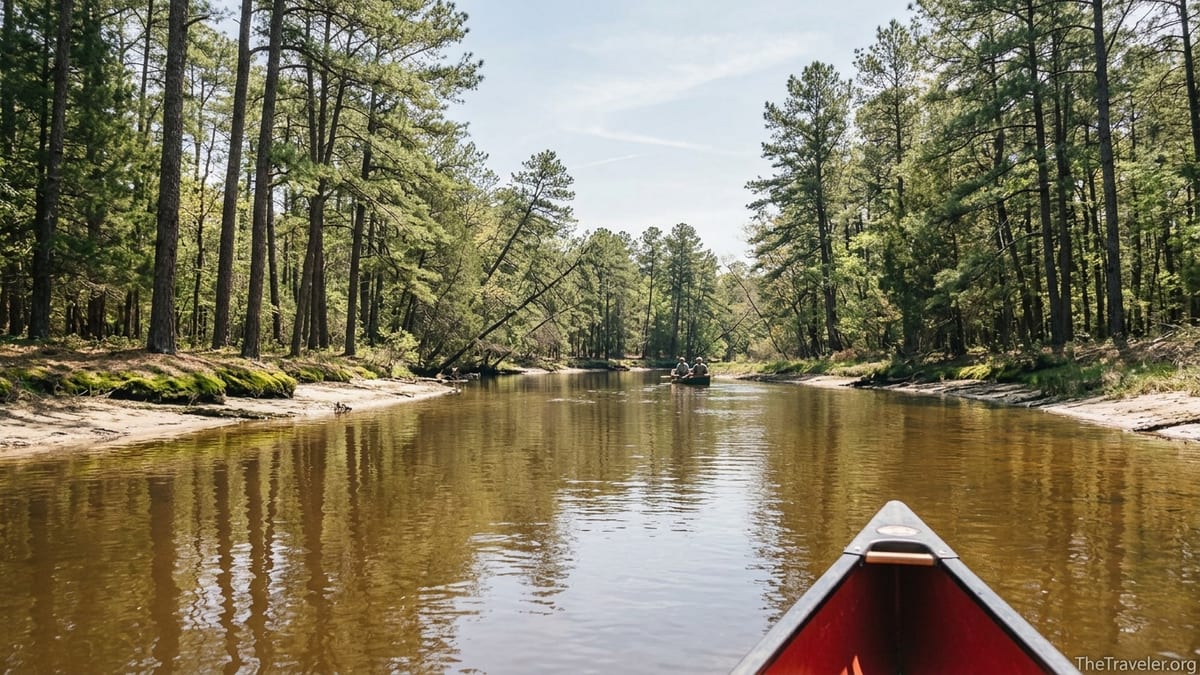
Canoeing the Classic Pine Barrens Rivers
If you only do one thing in the Pine Barrens, make it a river trip. The narrow, tea-colored streams here are calm enough for first-time paddlers but winding and wild enough to feel like an expedition. The Mullica, Batsto, Wading, and Oswego rivers all offer 2 to 8 hour routes, with gentle current, few rapids, and water typically 2 to 4 feet deep in summer. These are not whitewater runs; they are slow, meandering journeys through cedar swamps, sphagnum bogs, and stands of pitch pine where you are more likely to see turtles and herons than other paddlers on weekdays.
For rentals and shuttles, most visitors start with established outfitters clustered around Wharton State Forest. Pinelands Adventures, based near Atsion in Shamong Township, and Mick’s Canoe & Kayak Rental, near the Wading and Oswego rivers, both run seasonal canoe and kayak trips with transportation included. As of 2026, expect to pay roughly 70 to 100 dollars for a tandem canoe or double kayak for a half to full-day trip, including shuttle; single kayaks are usually slightly cheaper. Prices vary by route and day of the week, so it is worth checking ahead and reserving online during summer weekends.
One of the most popular beginner-friendly routes is the Mullica River run below Atsion Lake. Outfitters or the state-forest canoe launch off Route 206 put you in on a narrow, winding section framed by Atlantic white cedars. You paddle downstream with the current toward the Mullica River Wilderness Campsite and beyond toward Route 542 near Batsto. Another classic is the lake-and-river combination at Harrisville Pond and Lake Oswego, where you can paddle across a small, tannin-stained lake before following a tight, twisty stream under blueberry bushes and low-hanging branches.
Plan on getting your feet wet. Many stretches require quick three-point turns around downed trees or sandbars, and in late summer water levels can drop, requiring you to hop out and pull your boat over the shallows. Closed-toe sandals or water shoes are essential, both for traction on the sandy bottom and for protection from sticks and hidden roots. Even in July and August, bring a light synthetic layer because the shaded river corridors can feel cooler than nearby towns.
Choosing the Right Route for Your Group
The Pine Barrens rivers may be calm, but choosing the right section matters. Shorter routes, around 2 to 3 hours on the water, are ideal for families with kids or anyone still learning how to steer a canoe in tight bends. Pinelands Adventures, for example, commonly offers 1.5 to 4 hour “intro” trips on wide, slow sections of the Batsto or Mullica where the current is forgiving and there are plenty of sandbanks to pull over for a snack. Families with children as young as six often choose these runs, pairing them with a night at Atsion Lake Campground so they can be on the water early before the midday sun.
For more experienced paddlers, full-day or even overnight trips unlock a more remote side of Wharton State Forest. A popular overnight on the Mullica starts at the canoe launch just below the Atsion Lake dam and heads downstream about 5 to 6 hours to the Mullica River Campsite, a rustic, riverside campground with no vehicle access. The next morning, paddlers continue downstream another 3 to 4 hours to the take-out near Route 542 not far from Batsto Village. This itinerary requires advance campsite reservations with New Jersey State Parks, and you will need to pack in all food, water treatment, and gear.
Those seeking variety might combine rivers and lakes in a single weekend. You could, for example, paddle the Oswego River one day, starting from Lake Oswego’s sandy launch and ending at Harrisville Pond, then spend the next day on a shorter loop along the Wading River with a shuttle arranged through Mick’s. People who live within driving distance often return year after year, slowly ticking off different routes as water levels and seasons change. In high-water spring conditions, the narrow bends feel faster and more dynamic; by late summer, the same bends may be lazy corners where turtles sun themselves on half-submerged logs.
Whichever route you choose, keep an eye on water levels and weather. Outfitters will cancel or modify trips in extreme low water or after heavy rain, and it is common in late September and October for some narrower streams to become too shallow for heavily loaded canoes. The Pine Barrens’ sandy soil drains quickly, but cranberries are still grown in surrounding bogs and irrigation can lower local levels, especially around harvest. Calling a livery a day or two before your trip is the most reliable way to confirm whether your intended route is suitable that week.
Hidden Lakes, Ponds, and Quiet Swimming Spots
Beyond the well-known swimming area at Atsion Lake lies a network of smaller lakes and ponds scattered across Wharton, Bass River, Penn, and Brendan T. Byrne state forests. Some are easily reached from paved roads, others hide at the end of sugar-sand tracks that feel worlds away from highway rest areas. These “hidden” lakes are not truly secret, but they are much quieter than guarded beaches and offer a classic Pine Barrens scene: tea-brown water edged by white sand and twisted pines, dragonflies hovering over the surface.
Atsion Lake itself, a man-made impoundment on the Mullica River, remains the most accessible option for a swim with amenities. In season, its guarded beach area offers changing rooms, restrooms, picnic tables, and a roped-off swim zone that families favor. On hot July weekends it can feel busy, but arrive early on a weekday morning and you may have long stretches of shoreline almost to yourself. Nearby, Batsto Lake below the historic village is another atmospheric spot. While it is better known for canoe launches and fishing than for formal swimming, early risers often enjoy quiet, misty views from its sandy edges before the day’s tours begin.
For a more out-of-the-way feel, many locals point toward Lake Oswego in Penn State Forest, a tannin-rich lake accessible via a narrow paved road off Route 563. There is a primitive campground here and an informal launch that paddlers use to start routes down to Harrisville Pond. The shore is a patchwork of sand clearings and shrub thickets, and the water’s deep tea color comes from decaying pine needles and cedar roots, giving it a “root beer” look in bright sunlight. While some visitors wade or take a quick dip in summer, you should always respect posted signs, stay clear of spillways, and remember that there are no lifeguards or facilities.
Other Pine Barrens lakes worth a look include Harrisville Pond, with its ruins of a 19th-century industrial village on the shoreline, and Pakim Pond in Brendan T. Byrne State Forest, which offers a picnic area and small beach for day use. These are the kinds of places where you can bring a camp chair, a paperback, and a thermos of coffee and spend hours watching the light change on the water. Parking is typically free or covered by the standard New Jersey State Parks vehicle fee when applicable, but expect only basic amenities: vault toilets or none at all, a few tables, and maybe a charcoal grill stand.
Hiking and Exploring on Foot
Though the Pine Barrens are famous for paddling, the region’s trail network lets you explore the same rivers and lakes from another angle. The best-known path is the Batona Trail, a roughly 53 mile route that links Brendan T. Byrne, Wharton, and Bass River state forests. It threads through low pine stands, skirts cedar swamps, and passes ponds like Pakim and Buttonwood. Most travelers do not hike the whole thing; instead, they choose manageable day sections, such as a 7 to 10 mile walk between Ong’s Hat and Brendan T. Byrne’s Pakim Pond, or a loop starting near Batsto Village that uses both Batona and side trails.
Shorter routes abound. Around Atsion, sandy paths fan out from the lake and campground, with options to dip down to the Mullica River, explore abandoned cranberry bogs, or pick up segments of the Mullica River Trail. Near Batsto, a relatively flat loop around Batsto Lake lets you pair a morning hike with an afternoon village tour. Further east, Bass River State Forest offers trails like the Absegami and Falkinburg routes, some passing boardwalks over cedar swamps and interpretive signs explaining Pine Barrens ecology. Double Trouble State Park, north of Wharton, adds another layer of interest with historic cranberry bogs and easy sand-road loops following Cedar Creek.
Trail conditions are different from what many mountain hikers expect. The surface here is mostly sand, sometimes deep and loose, which can feel more tiring than packed dirt or gravel. On hot days the white sand reflects sunlight, so a wide-brimmed hat and sunglasses matter almost as much as water and snacks. There are few rocks and roots, so the walking is technically easy, but distances can feel longer because of the soft footing. Wayfinding is straightforward on marked trails like Batona, where pink blazes are frequent. On unmarked sand roads, however, it is surprisingly easy to wander in circles; a downloaded offline map or paper map from the Wharton or Brendan T. Byrne offices is highly recommended.
Wildlife sightings reward patient walkers. Early and late in the day you may spot white-tailed deer moving between upland pines and low-lying bogs, while painted turtles line up on half-submerged logs in ponds. Birders come for pine warblers, barred owls, and, in winter, occasional irruptions of northern finches. Although the legendary Jersey Devil remains stubbornly elusive, you will quickly understand why such a myth arose in these quiet, echoing woods where the wind in the pines can sound like whispers just out of hearing.
Camping, Cabins, and Making a Weekend of It
To really appreciate the Pine Barrens, stay the night. Camping here ranges from lakeside family campgrounds with flush toilets to primitive river sites accessible only by canoe. In Wharton State Forest, drive-in campgrounds at Atsion Lake and Godfrey Bridge are popular bases. Atsion offers tent and trailer sites near the swimming beach, along with rustic lakeside cabins that book out months ahead for peak summer weekends. Godfrey Bridge, set on the Wading River, provides a quieter forest setting with simple facilities and easy access to paddling routes.
For those seeking more solitude, the Mullica River and Lower Forge campgrounds sit along the river, reachable only by boat or hiking trail. These sites are essentially clearings in the pines with fire rings and pit toilets but no potable water or vehicle access. Overnight paddlers pack in everything they need, often using dry bags and barrel-style food canisters to keep gear organized in the canoe. Fees for state forest camping are relatively modest, with primitive sites typically under 20 dollars per night as of 2026, and reservations made through the New Jersey State Parks online system.
Cabins and yurts in the broader Pinelands add comfort for shoulder-season trips. Brendan T. Byrne State Forest has cabins and shelters near the edge of Pakim Pond, convenient for families who want easy access to both water and the Batona Trail. Bass River State Forest, centered on Lake Absegami, offers additional cabins and tent sites that work well for travelers combining a Pine Barrens stay with a visit to Long Beach Island or Atlantic City. These options often provide basic kitchens, mattresses, and screened porches, so you can enjoy the night sounds of the forest without needing a full camping kit.
If camping is not your style, small motels and independent inns in nearby towns like Hammonton, Egg Harbor City, and Chatsworth give you the option of day-tripping into the pines. Many paddlers choose this route in early spring or late fall, when nights can dip below freezing but daytime paddling stays comfortable in the 50s and 60s Fahrenheit. Just remember that bugs and humidity peak in June and July; if you prefer fewer insects and cooler nights, target late April to early June or mid-September through October.
Safety, Seasons, and Protecting the Pines
The Pine Barrens feel remote, but they sit within one of the most densely populated regions in the United States. That contrast creates both opportunity and responsibility. On the opportunity side, you can leave Philadelphia mid-morning and be on the water by lunch, or tack a half-day paddle onto a beach vacation on Long Beach Island. On the responsibility side, these sandy soils and shallow aquifers are fragile. Staying on established roads and trails, packing out all trash, and respecting seasonal closures help protect both rare plants and clean drinking water for the region.
Seasonally, late spring and fall are the sweet spots for active trips. April and May bring blooming mountain laurel and mild temperatures ideal for hiking and paddling in long sleeves. June through early September can be hot and humid, with air temperatures regularly in the 80s and low 90s Fahrenheit. That heat makes river trips and lakeside swims more appealing, but it also means dealing with mosquitoes, biting flies, and ticks. Lightweight long pants, insect repellent, and a habit of doing full-body tick checks after time in tall grass or leaf litter are non-negotiable. In October and November, the pines glow a muted gold and russet, and cooler weather can keep bugs at bay, though days grow shorter.
On the safety front, respect both water and sand. Although Pine Barrens rivers are shallow, their tea-colored water can obscure submerged logs and sharp sticks. Always wear a properly fitted life jacket when paddling, even in calm conditions, and keep a dry bag with at least a basic first-aid kit, a phone in a waterproof case, and a printed map. On land, it is easy to overestimate what a standard sedan can handle. Many sand roads grow increasingly soft and rutted the farther you go. If you are not confident in your vehicle or navigation, park at paved pullouts or official lots and walk the rest of the way rather than risking getting stuck miles from help.
Finally, a note about fires and local regulations. The Pine Barrens are adapted to burn, and wildfires are a natural part of the ecosystem, but drought and human activity can combine in dangerous ways. Respect all fire bans, build campfires only in designated fire rings, and extinguish them thoroughly until coals are cool to the touch. Off-road driving restrictions, seasonal closures of certain roads, and hunting seasons can all shift year to year, so check New Jersey State Parks advisories shortly before your trip. A little extra planning pays off in quiet rivers, clean lakes, and a landscape that remains wild for the next set of travelers.
The Takeaway
Spending even a day in the Pine Barrens quickly dispels clichés about New Jersey. Here, rivers run the color of strong tea through endless green, and small lakes flash between the trees like mirrors. It is a landscape that rewards slow travel: the unhurried arc of a canoe paddle, the crunch of sand under hiking boots, the stillness of a lakeshore at dusk as whip-poor-wills call from the woods. You do not need specialized skills or gear to experience it, only a bit of advance planning, respect for the environment, and a willingness to trade cell service for the sound of wind in the pines.
Whether you choose a guided paddle on the Batsto, a family swim at Atsion Lake, or a weekend of camping between Lake Oswego and Harrisville Pond, the Pine Barrens offer a rare combination of accessibility and wildness. For travelers accustomed to crowded boardwalks and busy shore towns, this quiet interior feels like an entirely different state. Pack your dry bag, pick a river, and follow the water. The Pine Barrens will take it from there.
FAQ
Q1. Do I need prior canoeing experience to paddle in the Pine Barrens?
Most Pine Barrens rivers are beginner friendly, with gentle current and shallow water. Outfitters commonly take first-timers and provide basic instruction before you launch.
Q2. What is the best time of year to visit the Pine Barrens for canoeing and hiking?
Late April through early June and mid-September through late October offer comfortable temperatures, fewer bugs, and generally reliable water levels for both paddling and hiking.
Q3. Can I swim anywhere I like in Pine Barrens rivers and lakes?
You can wade or swim at your own risk in many areas, but it is safest to stick to designated swim zones like the guarded beach at Atsion Lake and to respect all posted signs.
Q4. Are there guided tours available, or do I have to go on my own?
Several outfitters in and around Wharton State Forest run guided trips, particularly on the Batsto and Mullica rivers, which are good options if you prefer local insight or do not want to manage shuttles.
Q5. How far in advance should I reserve campsites or cabins?
For peak summer weekends, book state forest campsites and cabins several weeks to a few months ahead. Shoulder seasons are more flexible, but reservations are still recommended.
Q6. Is cell service reliable in the Pine Barrens?
Coverage is spotty once you leave main highways and towns. You may have reception at trailheads or villages like Batsto, but should not rely on a phone for navigation in the interior.
Q7. What kind of wildlife should I be prepared for?
Expect deer, turtles, frogs, and a wide range of birds. Less welcome are mosquitoes, ticks, and greenhead flies in summer, so pack repellent and wear long sleeves and pants.
Q8. Can I camp anywhere I want along the rivers?
No. Camping is allowed only at designated campgrounds and river campsites with a valid reservation. Dispersed camping along sand roads or riverbanks is not permitted.
Q9. Do I need a special permit to canoe or kayak in the Pine Barrens?
You generally do not need a special paddling permit for day trips, but you may need reservations or permits for parking and camping, and rental outfitters include necessary access in their fees.
Q10. Are the Pine Barrens suitable for young children?
Yes, with planning. Short canoe trips on calm sections, easy walks near lakes, and a base at a family-friendly campground like Atsion Lake work well for kids who enjoy the outdoors.