


More news on this day
Thousands of travelers at Atlanta’s Hartsfield-Jackson International Airport faced hours-long waits and missed connections after a fresh wave of storms and system knock-on effects triggered 123 flight cancellations and 591 delays across key carriers including Delta Air Lines, Frontier Airlines, and American Airlines.
Get the latest news straight to your inbox!
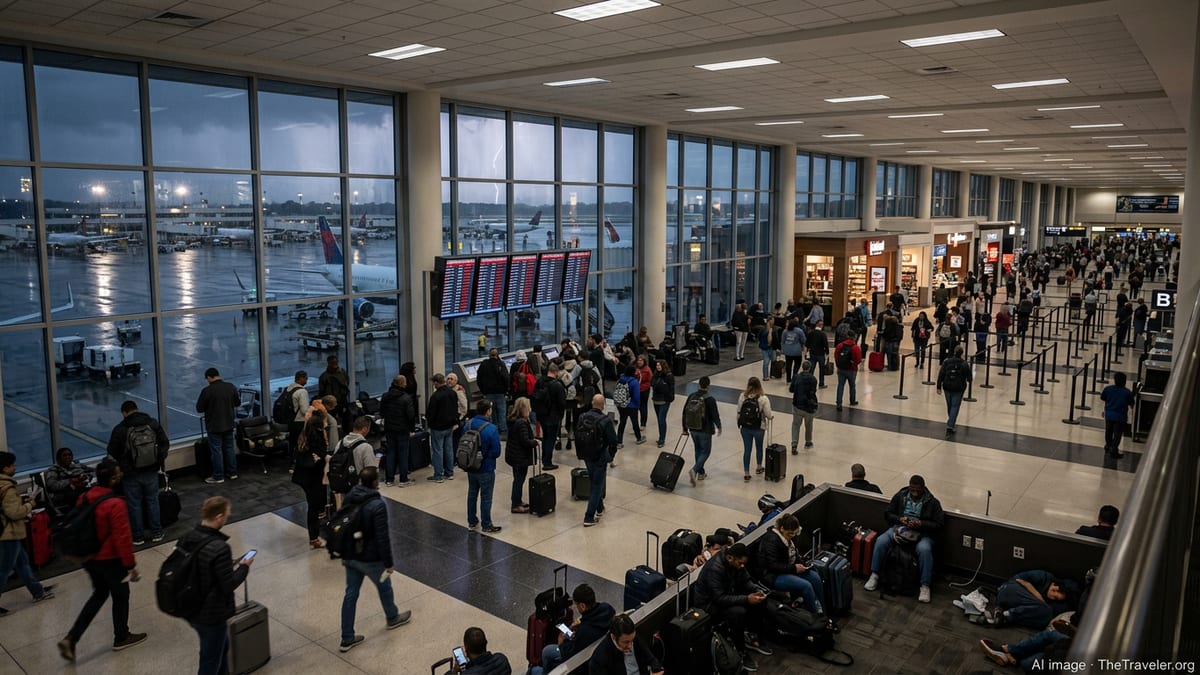
Severe Weather and Hub Congestion Turn Routine Day into Gridlock
Publicly available flight-tracking data for Saturday, June 20, show operations at Atlanta’s primary airport coming under heavy strain, with a combination of lingering thunderstorms, ground stops, and arrival slowdowns pushing the nation’s busiest hub into widespread disruption. The impact has been particularly acute for Delta, which uses Atlanta as its largest hub, and for low-cost competitor Frontier, which has been rapidly expanding its presence at the airport.
Reports from passengers on social media and aviation message boards describe departure boards dominated by yellow and red status lines as rolling delays stretched from minutes into hours. Travelers recount aircraft held on taxiways, crews timing out after extended gate holds, and a growing number of flights ultimately cancelled as the schedule buckled under continued weather and congestion.
Recent online discussions focused on thunderstorms and a tropical-style rain pattern in the Southeast, with users referencing repeated alerts about “Southeast weather” affecting Atlanta. Those accounts align with the operational picture aviation data providers are publishing, which show departure and arrival banks at Hartsfield-Jackson heavily compressed as airlines work within tighter airspace and ramp constraints.
While weather is the initial trigger, the scale of cancellations and delays reflects how quickly the effects can cascade through a tightly wound hub system. Aircraft and crew rotations that depend on precise timing have been thrown off, leading to late-arriving inbound planes, missed connections, and a shortage of available aircraft and staff in the right place at the right time.
Delta, Frontier, and American Bear Brunt of Disruptions
With Delta accounting for a substantial majority of movements at Atlanta, the carrier is absorbing a disproportionate share of the operational pain. Publicly visible schedules show multiple Delta departures from Atlanta facing long departure pushes or status changes through the day as the airline reworks rotations and attempts to create viable connection opportunities for stranded customers.
Frontier, which has been promoting its Atlanta expansion and new route network from the hub, is also heavily affected. Online forums dedicated to the airline include fresh accounts from passengers whose flights into or out of Atlanta were cancelled or significantly delayed, often with limited same-day rebooking options because of the tight, low-frequency nature of the ultra-low-cost carrier’s schedule.
American, while a smaller player in Atlanta relative to its presence in Charlotte and Dallas, is nonetheless caught up in the broader system disruption. Because many of American’s passengers in Atlanta are connecting onward through other hubs, disruptions at Hartsfield-Jackson can reverberate into secondary delays and misconnections throughout the airline’s network, according to publicly available operational data and passenger reports.
The combined total of 123 cancellations and 591 delays captures only part of the traveler experience. Many additional flights are operating but are doing so with substantial schedule padding removed, tighter turn times, and onboard holds that do not always appear in headline statistics but translate into longer, more stressful journeys for customers across all three airlines.
Knock-On Effects Across the National Network
The scale of Atlanta’s disruption means the effects are not confined to Georgia. As the primary connecting point for Delta and an increasingly important station for Frontier, issues at Hartsfield-Jackson ripple outward, affecting flights and crews across the continental United States and on select international routes.
Travel discussion boards over recent days have highlighted travelers in other cities grappling with late aircraft and rolling delay notifications tied back to previous segments through Atlanta. Travelers in airports as far apart as Washington, New York, and various mid-sized Southeastern cities describe receiving alerts citing downstream disruptions from earlier storms and operational challenges at Atlanta.
These network-wide effects are compounded when storms move through the region over several days. Passengers have described email and app notifications referencing Southeast weather days in advance, indicating that airlines anticipate that tight turn times and aircraft utilization plans will leave little margin if lightning, heavy rain, or strong winds again force ramp closures or air traffic flow restrictions in and out of Atlanta.
Once a hub’s schedule becomes heavily compressed, even minor follow-on issues such as a short mechanical inspection or late-arriving crew can transmute into substantial departure pushes. That pattern appears to be playing out this weekend, as public tracking tools and first-hand accounts align around a picture of extended airline recovery times following Friday’s storms and Saturday’s renewed operational stress.
Stranded Passengers Face Rebooking Challenges and Extra Costs
For many travelers, the most immediate consequence of Atlanta’s disruption is the difficulty of getting rebooked. With Delta and Frontier both operating near peak summer schedules, empty seats on later flights are limited, particularly on popular East Coast and Midwest routes and on transatlantic services. Some passengers report being offered next-day or even multi-day rebooking options when attempting to secure confirmed seats after cancellations.
Customers of ultra-low-cost carriers such as Frontier can face particular constraints. Because the airline operates relatively few frequencies on many routes, a single cancelled flight may have no same-day alternative, leaving travelers to seek options on other airlines at higher walk-up fares. Reports circulating online describe passengers shouldering unexpected hotel stays, last-minute rental cars, or alternative flights purchased out of pocket in an effort to bypass long delays at Atlanta.
Even for mainline carriers, connection-heavy itineraries through Atlanta are vulnerable. Travelers misconnecting from delayed inbound flights can find onward options fully booked, leading to overnight stays at or near the airport. Social media posts from late Friday and Saturday show images of crowded concourses, long customer-service lines, and passengers attempting to sleep on terminal seating while awaiting new itineraries.
Travel experts commonly note that trip-interruption coverage on certain credit cards or standalone travel insurance policies can help offset some of these out-of-pocket costs in severe disruption events. However, not all passengers have such protections in place, leaving many to absorb incidental expenses during major hub meltdowns like the one unfolding in Atlanta.
What Travelers Can Do If Flying Through Atlanta Now
Consumer and aviation resources emphasize several practical steps for passengers scheduled to travel through Atlanta while disruptions of this magnitude are under way. First, travelers are advised to monitor their flight status frequently using airline apps or flight-tracking tools, as departure and arrival times can shift repeatedly throughout the day when hubs are recovering from severe weather and network imbalances.
Second, passengers are encouraged to consider schedule flexibility where possible. In some cases, publicly posted advisories and travel waivers allow customers to move their trips to earlier or later flights, or even different days, without change fees. For those with time-sensitive commitments, rebooking to a morning departure or accepting a connection through an alternate hub can reduce the risk of being caught by late-day congestion and further weather impacts.
Third, travelers may benefit from building extra time into itineraries that rely on tight connections in Atlanta. Several recent online accounts from passengers describe initially short connections being rendered unworkable by modest delays, leading to missed long-haul flights and complex rebooking scenarios. When disruption risk is elevated, longer layovers can offer an extra margin of safety.
Finally, the current disruption underscores broader advice that frequent travelers share whenever storms and operational issues converge on major hubs. Keeping essentials such as medications, chargers, and a change of clothes in carry-on bags, having contingency funds available for unexpected hotels or meals, and understanding one’s rights under airline contracts of carriage and credit card protections can all make a measurable difference when widespread cancellations and delays strike a hub as central to the U.S. system as Atlanta.