


More news on this day
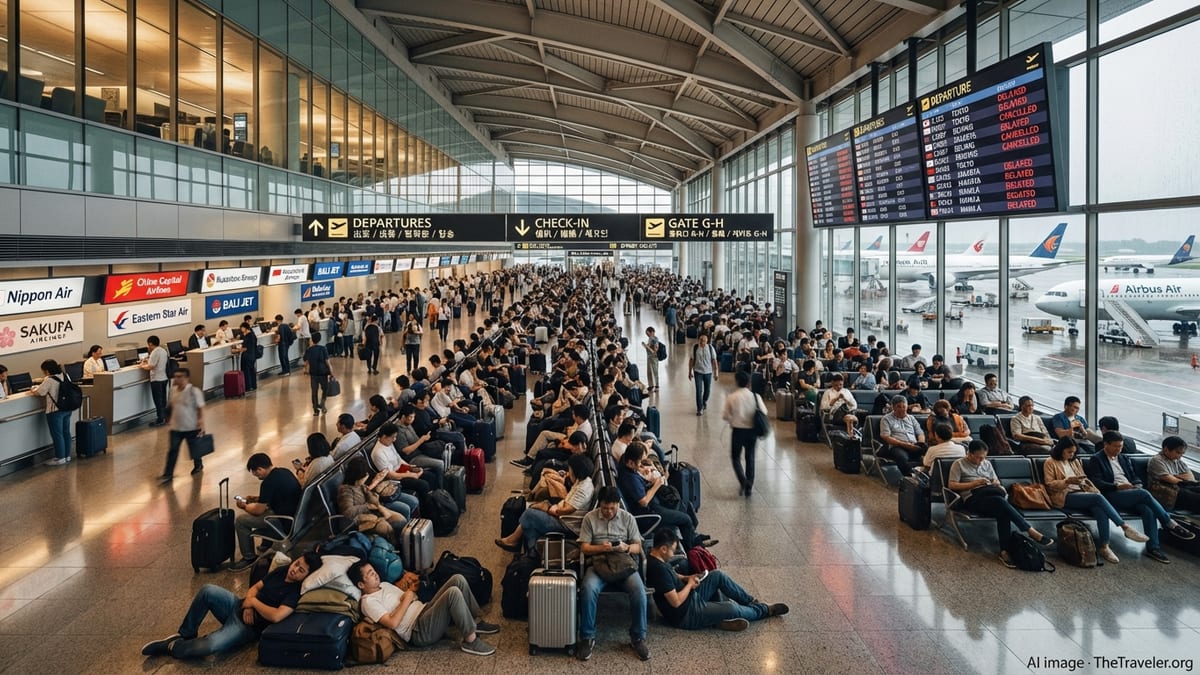
Asia’s peak travel season is being rattled by a fresh wave of flight cancellations and delays, as volatile monsoon storms, intensifying typhoons and lingering airspace constraints converge along some of the region’s busiest aviation corridors.
Get the latest news straight to your inbox!
Weather Systems Turn Key Hubs into Bottlenecks
Recent weeks have brought a succession of severe weather events across East and Southeast Asia, with monsoon downpours and tropical systems repeatedly disrupting schedules at major gateways. Publicly available flight boards and tracking dashboards point to hundreds of cancellations and thousands of delays clustered around Japanese, Chinese and Southeast Asian airports as storms move through heavily used air routes.
Storm belts sweeping across Japan, Taiwan and coastal China have turned busy hubs into operational chokepoints, particularly when typhoons intersect with already crowded airspace. Data compiled from flight-status platforms shows that airports such as Tokyo Haneda and major Chinese gateways have experienced sustained periods of delayed departures, diversions and ground holds as air traffic managers meter arrivals for safety.
Forecasts indicate that the pattern is set to continue. Meteorological advisories for early July highlight a rapidly strengthening typhoon tracking near the Northern Mariana Islands and the broader northwest Pacific, while China’s southern coast and the South China Sea are bracing for gale-force winds and heavy rain. These conditions are likely to trigger further airport flow restrictions, especially at island and coastal facilities that are more exposed to crosswinds and flooding.
In mainland Southeast Asia, seasonal monsoon conditions are similarly eroding schedule reliability. Storm systems over Laos and neighboring countries have prompted intermittent suspensions at regional airports and recurrent rerouting of services, feeding additional pressure into already busy regional corridors linking Bangkok, Hanoi, Ho Chi Minh City and beyond.
Monsoon Gridlock Ripples Through Asian Corridors
Monsoon season has long been associated with operational volatility, but the current wave of disruption is notable for how widely it is being felt across the Asian network. Aggregated figures from flight tracking dashboards, airport status pages and regional media reports in recent weeks suggest that many days have seen several thousand flights across Asia either cancelled outright or subject to significant delay.
Gateway airports in Indonesia, India and the Gulf have been particularly prominent in disruption tallies. Recent operational data points to hundreds of cancellations and more than eight thousand delays in a single day across hubs including Jakarta, Mumbai, Dubai and Jeddah, illustrating how quickly localized weather and congestion issues can cascade through interconnected schedules.
In China, persistent thunderstorms, low cloud and ongoing congestion at large hubs such as Beijing have led to elevated cancellation and delay rates that spill into neighboring networks. Regional carriers operating dense short-haul patterns to and from these hubs are often forced into rolling schedule adjustments, with late-running aircraft and crews feeding further knock-on delays into evening waves.
Travel and consumer advisory platforms consistently emphasize that the combination of heavy seasonal weather, high passenger loads and tightly timed aircraft rotations limits the system’s ability to recover. When early-morning sectors are disrupted by storms or ground stops, subsequent rotations can remain off-schedule for much of the day, affecting passengers far from the original weather event.
Geopolitics and Airspace Constraints Add Further Strain
Alongside weather, aviation corridors across Asia and its adjoining regions continue to face pressure from airspace restrictions linked to geopolitical tensions. Publicly available industry analyses and travel reports describe a landscape where parts of the Middle East and neighboring regions remain subject to overflight limitations, forcing long-haul services between Europe and Asia onto more southerly or northerly tracks.
These diversions add distance and time, raising fuel burn and complicating crew planning. They also concentrate traffic along fewer available corridors, routing more flights through already busy hubs in South and Southeast Asia. Airport operators and tourism agencies from Singapore to Bangkok and Delhi are closely watching how prolonged rerouting away from certain Gulf and Levant corridors is reshaping transfer flows and competitive dynamics between hubs.
Some Asian carriers have reacted by trimming or reshaping their international schedules to manage the combined impact of longer routings, seasonal demand dips and higher operating costs. In India, for example, schedule filings summarized by aviation data specialists and reported in business media show that leading low cost carriers are suspending services to multiple leisure destinations in Southeast Asia and China during the July to September period, describing the move as a capacity recalibration for a weaker quarter.
Travel forums and passenger advisories also point to scattered examples of airlines citing evolving geopolitical conditions as a factor in adjusting or suspending particular routes in recent months. Although the absolute number of such changes remains limited compared with weather-related disruption, they layer additional complexity into network planning and passenger decision-making.
Capacity Constraints Expose Structural Weaknesses
The recent wave of cancellations and delays is exposing structural constraints that have built up during Asia’s rapid post-pandemic recovery. Industry monitors highlight that departures across key Asian markets are now close to or above pre-crisis levels, but infrastructure expansion, staffing and air traffic control capacity have struggled to keep pace.
In Southeast Asia, longstanding congestion challenges at some primary hubs have led aviation authorities and airlines to experiment with decongestion measures. These include shifting turboprop and regional operations to secondary airports to free up runway and gate capacity for larger jets, and tightening slot management rules. Such efforts can reduce bottlenecks at individual airports but may also lengthen journeys or increase connection times for travelers.
At a regional level, analytics shared by multilateral aviation organizations show that China, India and several Southeast Asian states now sit among the world’s largest aviation markets by total departures. This sheer volume means that any localized shock, whether a thunderstorm over a single hub or a temporary runway closure, can generate ripple effects across multiple countries within hours.
Airlines are attempting to rebuild buffers into their schedules by adding ground time between rotations and increasing spare aircraft or crew coverage on vulnerable routes. However, with margins still under pressure and demand patterns shifting quickly between corporate, leisure and visiting friends and relatives travel, there is limited appetite to maintain large operational reserves that are not generating revenue.
Travelers Face a Tough Peak Season
For passengers, the confluence of monsoon weather, typhoon threats, congested hubs and rerouted long haul services is translating into a more unpredictable peak travel season across Asia. Travel rights groups and advisory services urge travelers to plan for potential disruption, particularly on itineraries involving multiple connections or transits through weather-prone or heavily congested hubs.
Public guidance from these organizations tends to stress the value of flexible tickets, direct services where possible and close monitoring of airline communications and airport status channels in the 24 to 48 hours before departure. Independent flight tracking tools and airport-specific alerts are also frequently cited as useful supplements to airline apps when conditions deteriorate rapidly.
Industry commentary suggests that disruption may remain elevated through at least the late summer period, as monsoon dynamics continue and typhoon season intensifies across the northwest Pacific and South China Sea. At the same time, any further flare-ups in geopolitical tensions that result in new or extended airspace closures could compound the strain on already crowded alternative corridors.
With Asia’s aviation system operating close to its practical limits on many days, the current episode of cancellations and delays is underscoring how sensitive the region’s travel flows have become to simultaneous shocks. For now, travelers, airlines and airports are all adjusting to an environment where flexibility and real-time information have become essential tools for navigating the region’s skies.