


More news on this day
Passengers across Saudi Arabia, Ethiopia, Jordan and the United Arab Emirates are facing mounting disruption as a cluster of cancellations and prolonged departure slowdowns on Saudia, Royal Jordanian and Air Arabia Abu Dhabi routes shrinks already fragile regional connectivity and leaves terminals struggling with backlogs.
Get the latest news straight to your inbox!
Targeted Cancellations Hit Key Short-Haul Corridors
Publicly available operational data and regional aviation coverage indicate that at least 10 flights involving Saudia, Royal Jordanian and Air Arabia Abu Dhabi have been removed from schedules serving major gateways in Saudi Arabia, Jordan, Ethiopia and the UAE. The reductions focus heavily on short and medium haul links that normally move large numbers of passengers between Gulf hubs and neighboring capitals.
Recent analysis of Saudia’s network shows that the Saudi flag carrier has sharply curtailed or suspended several high-frequency services to cities such as Amman, Kuwait City, Abu Dhabi, Dubai, Doha and Bahrain, routes that ordinarily function as dense feeder corridors into Riyadh and Jeddah. Reports describe a pattern of rolling suspensions and trimmed frequencies rather than isolated one-off cancellations, amplifying uncertainty for travelers who rely on these links for onward long haul connections.
For Air Arabia’s Abu Dhabi operation, coverage from regional business publications highlights a shift to limited, approval-based schedules after weeks of airspace disruption and weather-related strain on UAE airports. Flights touching Addis Ababa, Amman and multiple Saudi destinations are operating with reduced frequencies and are subject to late operational changes, increasing the risk that passengers will find their plans altered after arrival at the airport.
Royal Jordanian, which continues to use Amman’s Queen Alia International Airport as a key transfer hub, has also adjusted regional flying amid reduced demand and constrained routings around restricted airspace. While the carrier has maintained many core connections, selective cuts on certain Middle Eastern routes have contributed to the tally of removed flights and helped push load onto a narrower range of remaining departures.
Sixteen Departures Slowed by Rerouting and Congestion
Alongside outright cancellations, at least 16 additional departures operated by the three carriers have been affected by significant slowdowns, with flights either subject to extended ground holds or elongated routings in congested corridors. Aviation industry reports link these delays to a combination of regional airspace restrictions, weather events and operational bottlenecks at key hubs.
Analysts tracking Middle East air traffic note that ongoing closures or partial restrictions over several neighboring states have forced airlines to funnel more traffic through fewer safe corridors, especially over Turkey, Egypt and parts of Saudi Arabia. This has increased flight durations and reduced overall network capacity, turning previously straightforward segments between the Gulf and the Levant or Horn of Africa into longer, less predictable journeys.
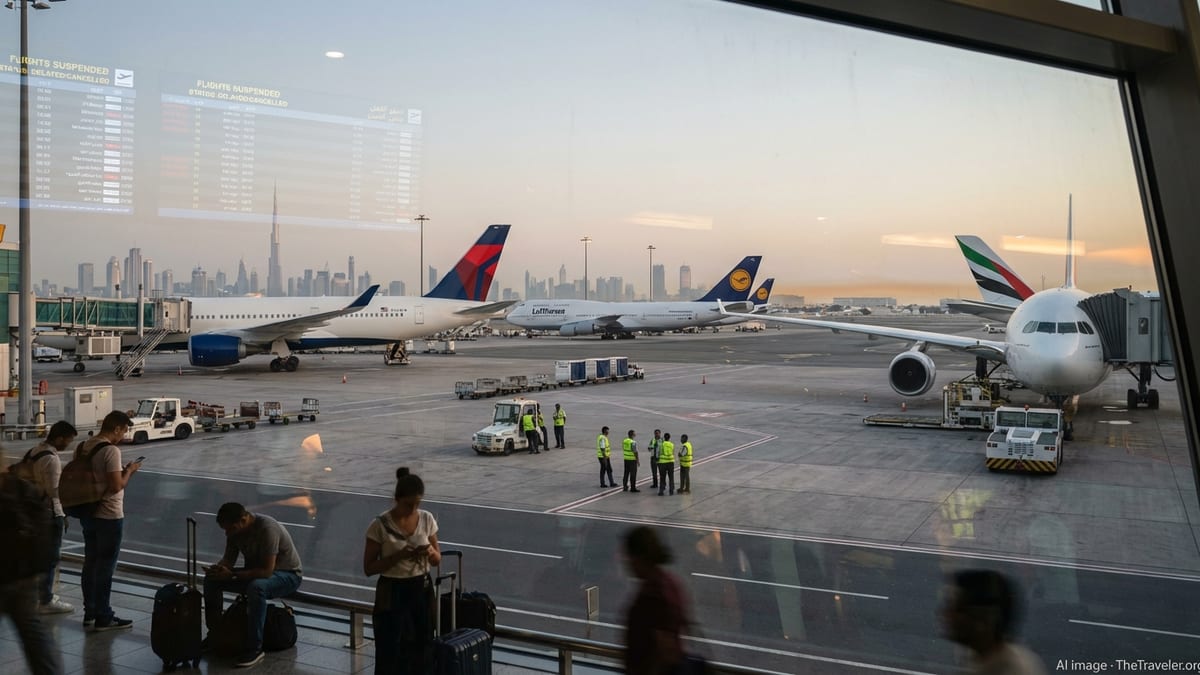
In the UAE, coverage of recent disruptions at Dubai, Abu Dhabi and Sharjah describes departure boards dominated by red delay markers and trimmed schedules. Air Arabia Abu Dhabi in particular has been cited as operating a skeleton pattern of flights to about 50 global destinations, with schedules explicitly labeled as subject to change. Passengers on affected departures report multi-hour holds and rolling retimings as aircraft and crews are repositioned.
Saudi airports are facing similar congestion pressures, with reports of backlogs at rebooking counters and departure gates as Saudia restructures services to nearby Gulf and Levant destinations. Even when flights ultimately operate, departure pushes may be staggered to accommodate air traffic flow restrictions, contributing to a wave of late arrivals and missed connections across the region.
Stranded Travelers and Mounting Passenger Frustration
For travelers on the ground, the combination of 10 removed flights and more than a dozen slowed departures has translated into mounting frustration and a growing sense of fatigue with regional travel. Published accounts from passengers describe long queues at service desks, crowded seating areas and uncertainty about when or how they will be able to continue their journeys.
Travel-focused outlets that monitor Middle East operations report that some travelers have endured repeated rebookings over several days, particularly at UAE hubs where limited outbound capacity has been tightly rationed. Social media and forum posts referencing Saudia, Royal Jordanian and Air Arabia Abu Dhabi highlight experiences of last-minute cancellations, same-day schedule changes and overnight waits without clear onward options.
Budget-conscious passengers are especially exposed, as lower-fare tickets on regional carriers often come with more restrictive change conditions and fewer protections if itineraries fall apart. Commenters documenting their experiences with Air Arabia Abu Dhabi, for example, reference policy changes on refunds and rebooking windows that can leave travelers choosing between lengthy delays on the next available flight or additional out-of-pocket costs to switch plans.
At Amman and key Saudi airports, reports indicate that stranded passengers have resorted to piecing together alternative journeys via overland segments or separate tickets on other airlines, sometimes transiting through secondary gateways in Saudi Arabia and Oman that are less affected by the current wave of schedule cuts. These ad hoc workarounds can dramatically increase travel time and expense, intensifying dissatisfaction with the original carriers.
Knock-On Effects for Regional Connectivity
The latest disruptions underscore how fragile regional connectivity has become across the Middle East and adjacent African markets. With Saudia, Royal Jordanian and Air Arabia Abu Dhabi all trimming certain services at the same time that other Gulf and European airlines are rerouting or reducing flights, the redundancy that once characterized intra-regional travel has eroded.
Industry commentary notes that when multiple carriers simultaneously restructure networks around constrained airspace, secondary city pairs suffer first. Links between Saudi Arabia and Ethiopia, for example, often rely on connections through Gulf or Levantine hubs. When those hubs slim down schedules and reallocate capacity to trunk routes, marginal connections can quickly become less frequent or temporarily vanish from booking systems.
Observers also point out that disruptions on short-haul feeders have an outsized impact on long haul connectivity. Missing a one-hour hop from Riyadh, Jeddah or Amman can mean losing access to transatlantic or Asia-bound flights that operate only a few times per week. The present round of cancellations and slowdowns therefore risks rippling far beyond the immediate region, affecting travelers bound for Europe, North America and East Africa.
Corporate travel managers and tour operators active in the region are reportedly revising itineraries and steering clients toward more resilient routings, sometimes via alternative hubs outside the Gulf. This can involve longer journeys through Europe or North Africa, but offers a greater likelihood that key segments will operate as ticketed while regional schedules remain volatile.
How Airlines and Travelers Are Adapting
According to published airline statements and travel advisories, carriers are emphasizing flexibility and safety as they navigate constrained airspace, volatile demand and operational challenges. Saudia has focused on consolidating traffic through its main Saudi hubs while scaling back some short-haul Gulf services, while Royal Jordanian has highlighted route adjustments and precautionary measures aimed at maintaining a core network from Amman despite shifting conditions.
Air Arabia’s Abu Dhabi operation, meanwhile, has leaned on a strategy of limited but broad coverage, maintaining links to more than 50 destinations across the Middle East, Africa, Europe and Asia while warning that individual flights may be altered or withdrawn at short notice. Passengers are being urged in public advisories to check flight status frequently, arrive early at airports and anticipate extended transit times.
Travel experts recommend that passengers affected by the latest wave of disruptions build additional buffers into their plans, especially when relying on regional connectors to reach intercontinental flights. Booking longer connection windows, opting for flexible fares where possible and keeping accommodation plans adjustable are all being promoted as practical steps in light of the current instability.
As airspace patterns, demand levels and airline schedules continue to evolve, the number of cancellations and slowed departures affecting Saudia, Royal Jordanian and Air Arabia Abu Dhabi is likely to fluctuate. For now, however, travelers across Saudi Arabia, Ethiopia, Jordan and the UAE are bearing the brunt of a fragile system in which even a handful of removed flights and protracted delays can cascade into days of disruption.