


More news on this day
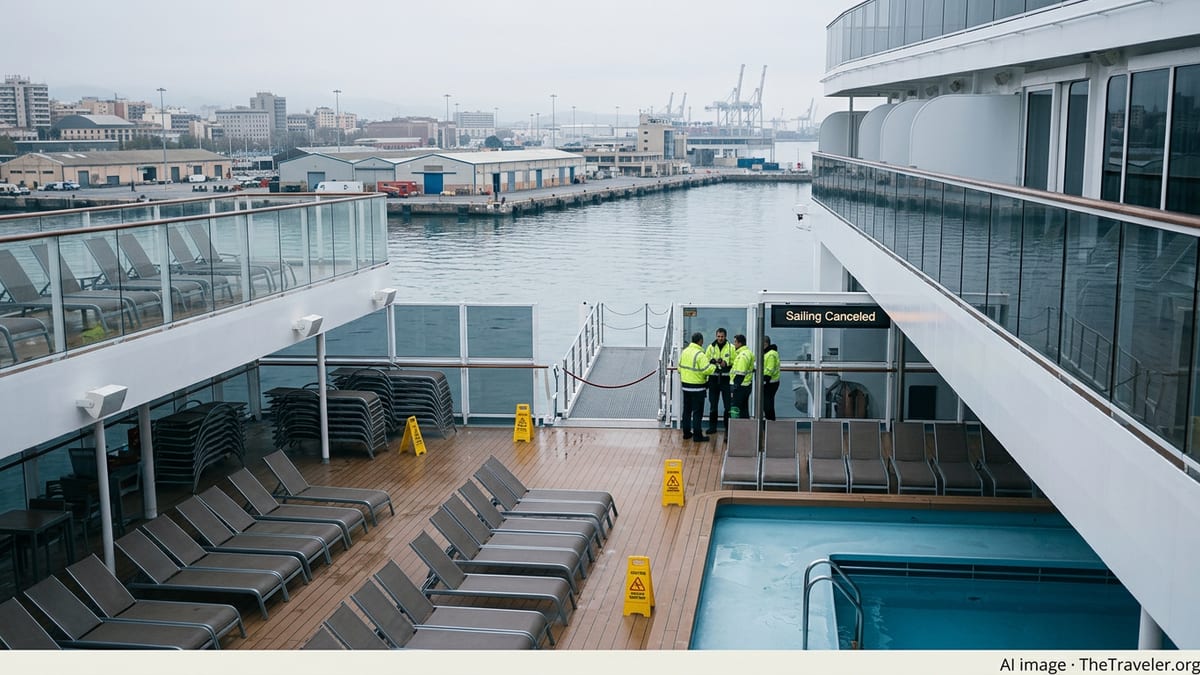
Royal Caribbean has canceled a scheduled cruise in Asia as Super Typhoon Bavi disrupts marine traffic across the West Pacific, marking one of the first major cruise itinerary losses directly tied to the powerful storm.
Get the latest news straight to your inbox!
Storm Intensifies Across the West Pacific
Publicly available meteorological bulletins describe Super Typhoon Bavi as a Category 5 system over the western Pacific, with sustained winds well above 150 miles per hour at its peak. Forecast discussions indicate that the storm has tracked west and northwest across the Philippine Sea, affecting conditions around Guam and the Northern Marianas while moving toward waters that are important corridors for regional shipping and passenger traffic.
Reports from regional outlets and weather agencies show Bavi prompting suspension of coastal projects and ferry routes in parts of eastern China, as well as preparations across Taiwan and Japan’s southwestern islands. The storm’s broad wind field and heavy seas have made sections of the West Pacific unsafe for smaller craft and challenging even for large ocean-going vessels. Cruise lines operating in the region have been forced to reassess schedules, with Royal Caribbean among those adjusting itineraries.
Travel industry coverage notes that Bavi is arriving in a region still recovering from earlier severe weather, with some island communities contending with damaged infrastructure and ongoing rebuilding. As the storm’s track and intensity projections shifted over recent days, cruise operators faced narrowing windows to alter routes or cancel sailings ahead of its arrival.
Royal Caribbean Scraps Affected Sailing
According to cruise trade reporting and traveler accounts, Royal Caribbean has opted to cancel at least one planned cruise in Asia rather than attempt a significant rerouting around Super Typhoon Bavi. The affected sailing was scheduled to operate in the West Pacific at a time when forecasts showed Bavi or its remnants intersecting with key ports and sea lanes, posing risks of heavy seas, port closures, and schedule disruption.
Publicly available information on general Royal Caribbean policies shows that the company typically seeks to modify itineraries rather than cancel outright, often substituting alternative ports when storms threaten. In the case of Bavi, however, the combination of a powerful, wide storm system and limited alternative ports within safe range appears to have led to a full cancellation. The decision aligns with longstanding industry practice that prioritizes vessel safety and port accessibility when major cyclones develop along projected routes.
Background documents outlining what happens when Royal Caribbean cancels a cruise indicate that guests are normally offered full refunds of cruise fares and taxes, along with varying levels of future cruise credit or onboard credit depending on circumstances and timing. While specific compensation for the Bavi-related cancellation has not been detailed in public materials, traveler discussions suggest that the line is following its established framework for weather disruptions.
Passenger Impact and Rebooking Challenges
Online forums and social media posts show affected passengers learning of the cancellation shortly before departure, with some reporting that they had already arranged flights and hotels around the now-scrapped itinerary. Experiences shared from previous weather and operational cancellations suggest that while cruise fare refunds are generally straightforward, secondary costs such as air tickets and independent shore plans can be more difficult to recover, often depending on travel insurance coverage or airline waivers.
In the wake of Bavi, Royal Caribbean is reported to be offering rebooking options on alternative sailings, though availability can be constrained in peak travel periods. Some travelers describe being shifted to shorter substitute cruises or different regional routes when a voyage cannot operate as planned. Others opt for a full refund and the flexibility to plan a future trip once storm season has passed.
Travel advisors note that major storms can also affect connecting flights and regional airports, compounding the disruption when a cruise is canceled. With Bavi influencing weather over a large swath of the West Pacific, passengers who planned pre or post-cruise stays in affected areas face additional uncertainty around local transport, hotel operations, and sightseeing activities.
Growing Weather Risks for Asian Cruise Itineraries
The cancellation underscores how increasingly intense tropical systems can disrupt cruise operations in Asia, a region where itineraries frequently cross open ocean between island chains and coastal cities. Recent seasons have seen powerful typhoons affecting ports in Taiwan, Japan, and coastal China, prompting more frequent port closures, altered routes, and last-minute schedule changes for international cruise lines.
Analyses of cruise operations suggest that ships sailing in the West Pacific rely heavily on accurate, short-range forecasts to plot courses that avoid the worst of typhoon conditions. When storms like Bavi intensify quickly or pursue tracks that intersect several planned ports, the range of safe alternatives narrows. In such cases, full cancellations, while disruptive for guests, are often the most conservative operational choice.
Industry observers point out that cruise companies have invested in dedicated meteorological support and route-planning tools to minimize disruption and maintain safety. Nonetheless, the scale of Bavi and its timing relative to scheduled sailings demonstrate that even advanced planning cannot fully insulate cruise operations from extreme weather, particularly during the height of typhoon and hurricane seasons.
What Travelers Can Expect When Cruises Are Canceled
General guidance documents on Royal Caribbean’s approach to cancellations indicate that when a cruise is called off for reasons such as severe weather, guests usually receive a refund of the cruise fare and taxes, with additional consideration sometimes provided as a future cruise credit. Fees and add-ons purchased directly through the cruise line, including onboard packages and shore excursions, are typically refundable when the underlying sailing does not operate.
Travel experts often recommend that passengers booking itineraries in typhoon or hurricane seasons secure travel insurance that explicitly covers trip interruption, cancellations due to severe weather, and missed connections. Policies vary widely, but some plans can help cover nonrefundable flights and pre-cruise hotel stays when a voyage is canceled for safety reasons. Others may provide only limited compensation, making policy details an important part of advance planning.
The disruption caused by Super Typhoon Bavi is likely to reinforce that message for travelers considering future cruises in the West Pacific. While cruise lines aim to keep ships clear of storms and avoid canceling entire voyages, the Bavi-related decision by Royal Caribbean illustrates how fast-changing tropical systems can still overturn carefully laid plans, even for some of the world’s largest cruise operators.