


More news on this day
Travelers across the Gulf are facing renewed turmoil as airlines including FlyDubai, IndiGo, Gulf Air, Oman Air and Qatar Airways suspend or cancel services involving Kuwait International Airport, disrupting at least 15 flights and severing key links between Kuwait, the United Arab Emirates, Qatar, Saudi Arabia, Egypt and other destinations.
Get the latest news straight to your inbox!
Fresh Disruptions After Months of Volatility
The latest round of cancellations comes after a prolonged period of instability at Kuwait International Airport, which has been repeatedly affected this year by airspace closures, security incidents and shifting regional tensions. Publicly available information shows that air traffic in and out of Kuwait has only recently begun to recover from a near two month suspension that followed missile and drone attacks earlier in the year, and the system remains fragile.
Reports from regional outlets indicate that on top of earlier structural disruptions, a cluster of short notice cancellations and suspensions by major Gulf and South Asian carriers has again left passengers scrambling for alternatives. While some Kuwait based airlines have resumed partial operations, international and regional carriers remain cautious, leading to an uneven recovery and inconsistent schedules across key routes.
The impact is being felt most acutely on high demand corridors linking Kuwait with Dubai, Doha, Riyadh, Jeddah and Cairo, as well as onward connections to South Asia and Europe. Many of these flights are traditionally operated by low cost and full service carriers such as FlyDubai, IndiGo, Gulf Air, Oman Air and Qatar Airways, which together form the backbone of regional connectivity for business, migrant and leisure travelers.
Airline advisories and airport updates reviewed by TheTraveler.org point to a mix of outright cancellations, temporary suspensions on specific routes and limited rerouting through alternative Gulf hubs, producing a patchwork of options that is proving difficult for travelers to navigate in real time.
Airlines Trim Kuwait Services Amid Ongoing Security Concerns
According to published coverage from regional aviation and business media, several carriers have scaled back or temporarily halted flights touching Kuwait as they reassess security exposure and operational risk. IndiGo has extended the suspension of its Kuwait services, advising passengers to monitor flight status closely and seek refunds or rebooking where possible. Other Indian and Gulf based airlines have adopted similar caution, particularly on overnight and early morning rotations.
FlyDubai, which usually maintains an intense shuttle schedule between Dubai and Kuwait, has curtailed a number of frequencies, including services that provide onward connectivity to South Asia and Europe via Dubai. Operational notices circulated to trade partners show that some flights are being consolidated, while others are withdrawn entirely on certain days, reducing choice for passengers who rely on the carrier’s dense regional network.
Publicly available updates also show that Bahrain based Gulf Air and Muscat based Oman Air have canceled or suspended select Kuwait rotations in response to the shifting risk environment and airspace limitations. These airlines play a key role in linking Kuwait with Saudi Arabia, the wider Gulf and the Indian subcontinent through their hubs, meaning that even a handful of suspensions can ripple across multiple itineraries.
Doha based Qatar Airways, a major player on Kuwait Doha routes used heavily for long haul connections, has also canceled flights on specific days, including at least one Kuwait to Doha service this week. Travel notices reviewed by TheTraveler.org indicate that affected customers are being moved to later departures where space permits or encouraged to reroute via other gateways when possible.
Regional Network Strain Spreads to UAE, Qatar, Saudi Arabia and Egypt
The localized disruption at Kuwait is spilling over into the wider Gulf and beyond, straining capacity at alternative hubs in the United Arab Emirates, Qatar, Saudi Arabia and Egypt. Aviation tracking data and regional reporting highlight increased loads on services from Dubai, Abu Dhabi, Doha and Riyadh as passengers stranded by Kuwait related cancellations attempt to rebook through neighboring airports.
For travelers heading to or from Egypt, the suspension and consolidation of Kuwait flights operated by Gulf carriers has complicated access to cities such as Cairo and Alexandria. Many passengers typically route from Kuwait via Dubai, Doha, Manama or Muscat, but with frequencies cut and aircraft reassigned, competition for remaining seats has intensified, particularly in peak travel periods.
Saudi Arabia’s major airports in Riyadh and Dammam are also absorbing additional transit traffic. Earlier in the year, several airlines temporarily rerouted Kuwait bound passengers through these Saudi gateways while airspace restrictions were in place, and public information suggests that some of these interim patterns have reemerged as airlines again adapt to a changing risk picture.
This redistribution of traffic has knock on effects along the broader network, with airlines redeploying capacity away from secondary routes and adjusting schedules in other regions to free aircraft and crew. As a result, passengers without any plans to travel to Kuwait may still encounter delays, retimings or aircraft changes on flights that connect through the Gulf.
Passengers Confront Cancellations, Rebookings and Extended Journeys
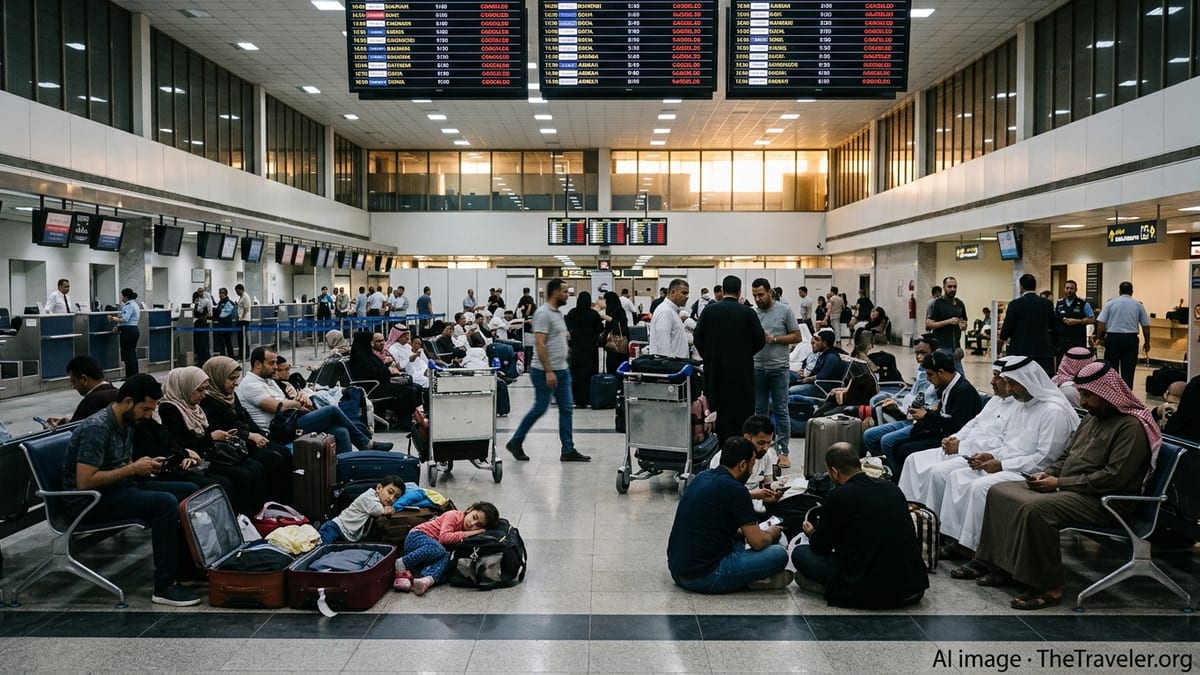
For individual travelers, the immediate reality of the Kuwait disruptions is a maze of cancellations, rebookings and extended journey times. Based on airline advisories and airport statements, some passengers have experienced last minute flight withdrawals at the check in stage, while others learned of suspensions only after arriving at the terminal.
With at least 15 flights involving multiple carriers suspended or canceled in a compressed timeframe, queues at service counters have reportedly grown as passengers seek alternative arrangements. In some cases, airlines have rebooked customers on later departures from Kuwait once operations allow, while in others they have offered rerouting through Dubai, Doha, Riyadh or other hubs with available capacity.
Travel industry guidance circulating among agents in the region emphasizes the importance of checking booking status frequently, using airline apps and third party tools to confirm whether flights are still operating before leaving for the airport. Passengers holding nonrefundable tickets or separate connecting itineraries are being urged to review fare rules carefully, as eligibility for complimentary changes or refunds can vary by carrier and route.
With security, regulatory and operational conditions in flux, many travelers are also considering backup plans such as overland travel to neighboring countries, particularly Saudi Arabia, where they can access more stable flight options. However, such alternatives can add significant time and expense to a journey that would normally involve a short nonstop sector from Kuwait.
What Travelers Should Watch in the Coming Days
Looking ahead, industry observers expect continued volatility on Kuwait related routes in the near term, with airlines likely to adjust capacity day by day as more information on security conditions, airspace restrictions and infrastructure readiness becomes available. Published coverage indicates that local authorities and airport operators are working to restore full functionality at Kuwait International Airport, but the timeline for a complete and sustained return to normal operations remains uncertain.
Travelers with imminent plans involving Kuwait, Dubai, Doha, Riyadh or Cairo are being advised by regional travel advisory services to adopt a flexible approach, including allowing extra time for connections, considering alternative routings and monitoring airline channels closely for schedule changes. Those yet to purchase tickets may wish to favor itineraries with generous change policies or book through carriers that have demonstrated a willingness to offer waivers during previous disruptions.
Analysts note that the Kuwait situation is part of a broader pattern of instability affecting Middle Eastern airspace this year, with several hubs experiencing temporary shutdowns, capacity constraints or reroutings related to security concerns. As a result, even modest incidents can have outsized effects on regional schedules, especially during busy travel periods when spare capacity is limited.
For now, the disruption at Kuwait International Airport serves as a reminder of the region’s interconnected aviation ecosystem, where an incident affecting a single terminal or airspace corridor can reverberate quickly across networks linking the Gulf with Europe, Africa and Asia, leaving travelers grounded far from the original point of impact.