


More news on this day
Thick fog across the Sydney Basin disrupted air travel on Tuesday, triggering delays, diversions and weather advisories as low visibility slowed operations at Sydney Airport.
Get the latest news straight to your inbox!
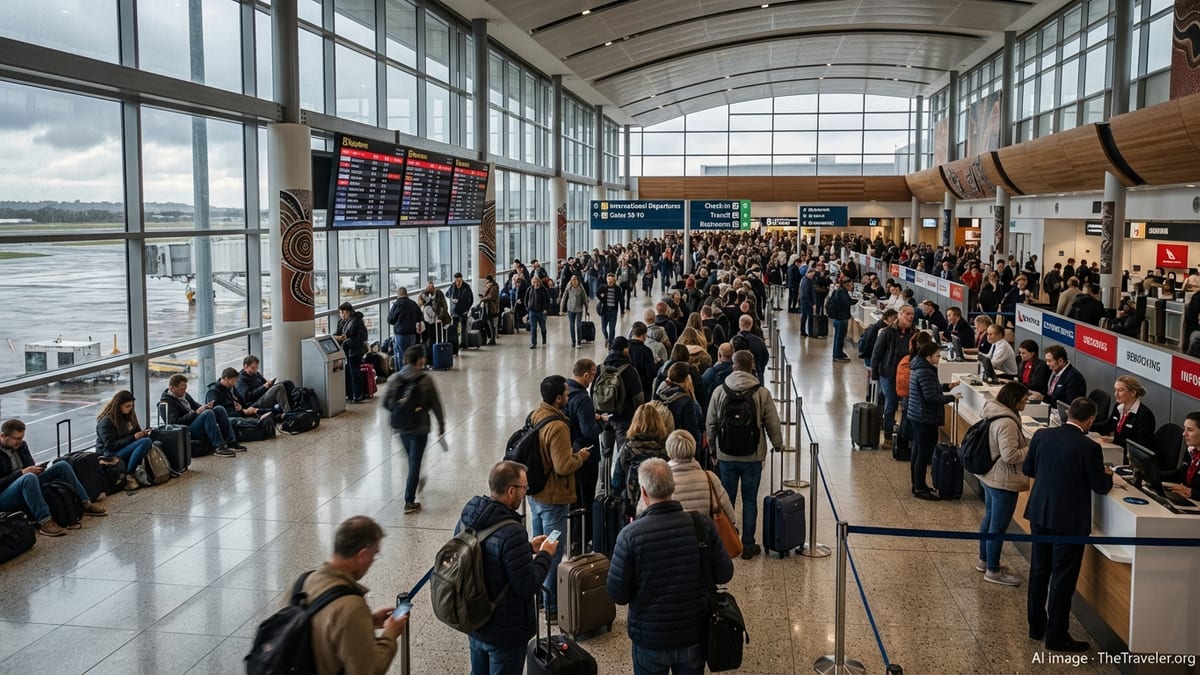
Dense Fog Settles Over Sydney Basin
Extensive fog and low cloud formed over Sydney in the early hours of Tuesday, with aviation weather briefings describing widespread reductions in visibility around Sydney Airport and the surrounding basin. Publicly available data from the Bureau of Meteorology indicated that the conditions developed overnight and persisted into the morning peak, creating challenging conditions for aircraft movements.
Airport weather briefings described a combination of fog and low stratus cloud affecting approach and departure paths, a pattern that has been noted in past guidance for Sydney’s airfield. The local environment means fog can form quickly when light winds and moist air coincide, leaving operations dependent on how rapidly visibility improves after sunrise.
While surface observations during the morning fluctuated as the fog bank shifted, reports indicated that visibility remained low enough at times to require more spacing between aircraft. Even modest reductions in runway capacity during the busy morning bank can lead to rolling delays that ripple across domestic and trans-Tasman networks.
Flight Delays, Cancellations and Diversions
Real-time flight tracking and schedule information showed a pattern of minor to moderate delays for several services into and out of Sydney on Tuesday. Some domestic services recorded arrival delays of around 10 to 20 minutes, consistent with reduced arrival rates as aircraft slowed on approach and increased spacing was applied.
Live status boards for Sydney Airport indicated that a small number of flights were cancelled, while others operated but arrived behind schedule. At least one northbound Jetstar service from Cairns, for example, showed a departure roughly 25 minutes late and a slightly delayed arrival into Sydney, aligning with broader disruption across the timetable.
Trans-Tasman flights were also affected, with at least one Sydney to Auckland service operated under a codeshare reporting a departure delay of around 20 minutes and a late arrival of roughly 10 minutes. Although the time lost was relatively modest, such delays can affect onward connections and crew scheduling later in the day.
Aviation tracking services and airline status pages together pointed to a picture of incremental disruption rather than wholesale shutdown, but the cumulative effect of small delays across dozens of flights remained significant for travellers with tight connections or fixed arrival times.
Operational Constraints Under Low Visibility
Fog is one of the most significant routine weather hazards for aviation, and Sydney is no exception. Guidance material for local air traffic operations notes that fog can develop at any time of year and has prompted the development of specialised tools, such as the Sydney Airport Fog Aid, to help forecast and manage low-visibility events.
Under dense fog, runway capacity is often reduced as controllers increase spacing between arriving and departing aircraft. Instrument landing systems and onboard avionics enable aircraft to land in very low visibility, but airport infrastructure, taxiway layouts and ground-movement procedures still limit how many flights can be safely processed each hour.
When visibility falls below key thresholds, airlines and network managers may hold departures at origin airports, reroute flights, or divert arrivals to alternate destinations with better conditions. Archived air traffic management plans for previous weather events in Australia show that extended periods of low visibility can lead to formal ground-delay programs and wider restrictions on airspace near Sydney, underscoring how sensitive the network is to conditions at this key hub.
The latest event appears to have been managed without large-scale diversion programs, but the morning’s pattern of schedule changes and cancellations highlights how even short-lived fog can strain airline and airport operations.
Advice for Travellers Passing Through Sydney
For travellers, Tuesday’s fog disruption in Sydney is a reminder that weather-related delays can develop rapidly and with limited advance notice. Publicly available airline statements and travel advisories consistently encourage passengers to monitor their flight status closely on days when fog or storms are in the forecast.
Experts in commercial aviation scheduling note that early-morning services are often most vulnerable to fog, particularly during the cooler months, because visibility can drop quickly before sunrise and only improve once temperatures rise. Travellers with critical connections may wish to factor seasonal fog patterns into their planning, leaving additional buffer time between flights where possible.
On days like Tuesday, passengers are typically encouraged to arrive at the airport earlier than usual, allow extra time for ground transport, and keep a flexible mindset about potential rebooking. As airlines work to reposition aircraft and crews after weather disruptions, later departures in the day can also be affected, even after fog lifts and the skies over Sydney clear.
With Sydney remaining one of the busiest gateways in the region, the latest bout of fog-related disruption illustrates how intertwined local weather, airspace management and global travel plans have become. For visitors and residents alike, staying informed about changing conditions is increasingly central to a smooth journey.