


More news on this day
Fort Lauderdale-Hollywood International Airport has been hit by a fresh bout of operational turmoil, with publicly available flight-tracking data showing more than 100 combined cancellations and significant delays affecting JetBlue and Delta services and triggering hours of disruption for departing and arriving passengers.
Get the latest news straight to your inbox!
Wave of Disruptions Hits Busy South Florida Hub
The latest disruption unfolded during an already busy early summer period, when Fort Lauderdale typically sees heavy demand from both domestic vacationers and international travelers connecting to the Caribbean and Latin America. Data from multiple flight-tracking dashboards indicated that JetBlue and Delta were among the hardest-hit carriers, with more than 100 flights canceled or running substantially late over the course of the day, rippling across their wider networks.
Operational information reviewed by TheTraveler.org shows that JetBlue, the airport’s largest carrier by passenger share, recorded dozens of delayed departures and arrivals on core routes including New York, Boston and several Caribbean leisure destinations. Delta, a key player on domestic trunk routes from Fort Lauderdale, also logged a cluster of cancellations and long delays, particularly on flights heading to major southeastern and Midwestern hubs.
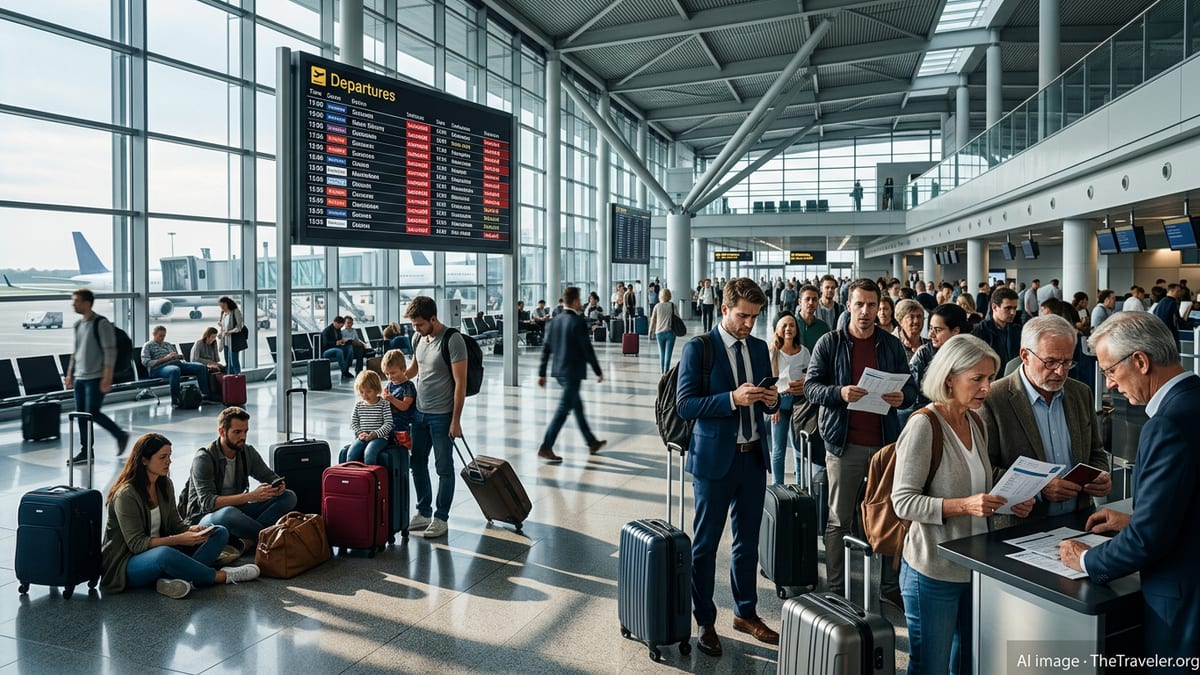
Passengers described on social media a chaotic scene of crowded concourses, long customer service lines and difficulty rebooking, as disruptions at Fort Lauderdale compounded existing tight capacity at alternative airports in South Florida. For many travelers booked on infrequent leisure routes, a same-day rebooking option was limited or unavailable, turning what was planned as a short getaway into an unplanned overnight stay or a significantly shortened trip.
Published coverage of the episode situates the Fort Lauderdale meltdown within a broader pattern of volatility affecting several high-traffic U.S. leisure gateways this year, where dense schedules, weather variability and ongoing construction work have made operations more vulnerable to cascading setbacks.
Why JetBlue and Delta Bore the Brunt
Fort Lauderdale’s carrier mix helps explain why JetBlue and Delta featured prominently in the latest wave of disruption. Recent traffic reports from Broward County show JetBlue commanding the largest share of passenger volumes at the airport, followed by major players including Spirit, Delta, Southwest and United. With extensive networks that combine point-to-point leisure flying and connections to northern and Midwestern hubs, JetBlue and Delta flights are tightly interlinked, so localized disruption can quickly spread across multiple routes.
Industry data shows that JetBlue has been rapidly expanding its Fort Lauderdale schedule in 2026, adding new destinations and boosting frequencies on existing routes as it seeks to capture demand following Spirit’s retrenchment in the market. While that growth brings more options for travelers, it also increases the operational complexity of its hub-style operation at Fort Lauderdale. On days when storms, air traffic congestion or technical issues strike, a dense schedule can leave little margin to recover.
Delta, which has been steadily adding capacity at Fort Lauderdale as part of a broader push into key Florida markets, similarly runs time-sensitive banks of flights feeding into hubs such as Atlanta, Detroit and New York. When a disruption affects one of these banks, the knock-on effects can be significant, particularly for customers relying on onward connections.
Analysts note that both airlines have, on average, recorded relatively strong cancellation performance across the wider U.S. network in recent federal statistics. However, those broad metrics can mask sharp, airport-specific spikes in disruption when storms or infrastructure constraints converge with peak travel periods, as appears to have been the case in Fort Lauderdale.
Passengers Face Misconnections, Extra Costs and Limited Options
For travelers caught in the Fort Lauderdale meltdown, the immediate impact was measured not just in hours lost at the airport but also in missed cruises, forfeited hotel nights and added out-of-pocket expenses. With same-day alternatives often sold out and nearby Miami International also running close to capacity, many passengers reported turning to last-minute one-way fares from other airports, rental cars or overnight accommodation near the terminals.
Publicly available consumer guidance from travel advocates underscores that, in the United States, airlines generally have discretion over what assistance to provide during disruptions that are not clearly weather-related, such as meal vouchers, hotel stays or rebooking on another carrier. The level of support can vary significantly between airlines and even between individual events, leaving many customers uncertain about their rights or options during fast-changing situations like the one in Fort Lauderdale.
In this latest incident, reports from travelers indicate that rebooking queues stretched for hours at some gates and service counters, with digital tools and mobile apps also under strain as thousands of passengers attempted to change itineraries simultaneously. While some were able to secure seats on later departures from Fort Lauderdale, others were rerouted through secondary hubs or advised to return a day or more later, depending on seat availability.
Travel experts recommend that passengers facing similar situations document all expenses, keep boarding passes and screenshots of delay information, and consult airline customer service dashboards that outline what each carrier typically provides during significant disruptions. These steps can help support later reimbursement claims or formal complaints if needed.
Strain on an Airport Already in Transformation
The turbulence at Fort Lauderdale comes as the airport continues a multi-year period of construction and capacity expansion. Federal infrastructure documentation details ongoing projects to add a new terminal, connect existing terminals via an enclosed walkway and upgrade critical airfield systems. While these works are designed to increase long-term capacity and resilience, they can temporarily constrain gate availability, alter taxi patterns and complicate day-to-day operations.
Local traffic statistics show that overall passenger volumes at Fort Lauderdale have been trending higher in 2026 compared with the previous year, even as some carriers adjust their presence in the market. The combination of strong demand, active construction and a busy roster of low-cost and network carriers has made the airport a bellwether for how U.S. leisure gateways are coping with rebounding travel.
Operational analysts suggest that on days when weather or air traffic restrictions intersect with construction-induced bottlenecks, an airport like Fort Lauderdale can tip quickly from manageable delays into severe disruption. This is especially true when multiple large carriers, such as JetBlue and Delta, are operating near the limits of their published schedules and have limited spare aircraft or crew to absorb shocks.
Airport performance data from recent months points to episodes of elevated average delay times at Fort Lauderdale, even on days without headline-grabbing meltdowns, underscoring how tight the operating environment has become at the fast-growing South Florida hub.
What Today’s Meltdown Signals for Peak Summer Travel
The latest chaos at Fort Lauderdale is likely to raise questions about how the airport and its largest carriers will cope with the heart of the summer travel season, when domestic vacation demand typically peaks and afternoon thunderstorms are a near-daily risk in South Florida. Travel planners note that the JetBlue and Delta disruptions could be a preview of further strain if schedules are not adjusted to build in more recovery time and contingency resources.
Consumer advocates are already advising travelers heading through Fort Lauderdale in the coming weeks to allow extra connection time, book earlier departures where possible and monitor flight status closely in the 24 hours before travel. Early-morning flights into and out of Florida hubs are often less exposed to the domino effects of afternoon weather and accumulated delays, potentially offering a small buffer against major disruptions.
For JetBlue and Delta, the optics of large numbers of cancellations and heavily delayed flights at such a visible leisure gateway come at a sensitive moment, as both carriers court price-conscious vacationers and frequent flyers seeking reliability. Operational performance at airports like Fort Lauderdale is likely to weigh heavily on customer perceptions as travelers decide where to place their loyalty for the rest of the year.
While the full operational postmortem of the Fort Lauderdale meltdown is still emerging through public data and industry reporting, the episode underscores how even well-established carriers can face sudden network snarls when a busy hub encounters multiple stressors at once. For passengers, it is a reminder that flexibility, preparation and real-time information remain crucial tools when flying through one of America’s most in-demand sunshine gateways.