


More news on this day
Travelers transiting the Gulf are facing renewed uncertainty as the United States, United Kingdom, Canada and Australia tighten Middle East travel advisories while Etihad Airways and Qatar Airways continue to adjust flight schedules and routings through the region.
Get the latest news straight to your inbox!
Western governments sharpen Middle East risk messaging
Recent updates to official travel advisories from several Western governments highlight continuing concern about security conditions across parts of the Middle East, including the wider Gulf region. Publicly available information from these advisories signals that authorities are maintaining a cautious stance even after a reduction in large-scale attacks linked to the 2026 Iran conflict.
The United States continues to urge heightened vigilance for travel across the region, with advisory language stressing the possibility of missile, drone or terrorist incidents and sudden changes to airspace availability. Canada has similarly reiterated guidance for travelers to avoid non-essential trips to areas affected by recent hostilities and to be prepared for short-notice disruption to commercial flights.
Updated UK guidance emphasizes the potential for attacks on transport infrastructure and notes that airspace or airport operations could be restricted with little warning, affecting both direct services and popular transit hubs. Australia’s current regional advice also reflects a conservative risk assessment, with particular attention to the implications for long-haul itineraries between Australia and Europe that typically route via Gulf airports.
Across these advisories, travelers are being encouraged to closely follow airline communications, register with consular services where available and maintain flexible plans, particularly when itineraries involve connections through major Gulf hubs such as Abu Dhabi and Doha.
Etihad adjusts routings while maintaining core Abu Dhabi hub
Against this backdrop, Etihad Airways has continued operating its core network from Abu Dhabi, but with a series of ongoing adjustments to flight paths and schedules in response to evolving airspace constraints. Publicly accessible flight tracking data and passenger reports indicate that many services are operating on modified routings that avoid higher-risk corridors while maintaining connectivity between Asia, Europe, Africa and North America.
Industry coverage shows that the carrier has used temporary reductions and retimings on selected routes during periods of heightened tension, particularly when regional airspace restrictions have been in place. In some instances, flights have experienced extended block times or technical stops as aircraft reroute around closed or congested air corridors, adding complexity for passengers with tight connections.
At the same time, Etihad has been restoring and expanding elements of its medium- and long-haul network where conditions permit, underscoring a strategy of retaining Abu Dhabi’s role as a global transfer hub while working within safety and regulatory constraints. Travelers continue to report relatively normal conditions at Abu Dhabi International Airport itself, even as they note increased attention to schedule changes and rebooking policies.
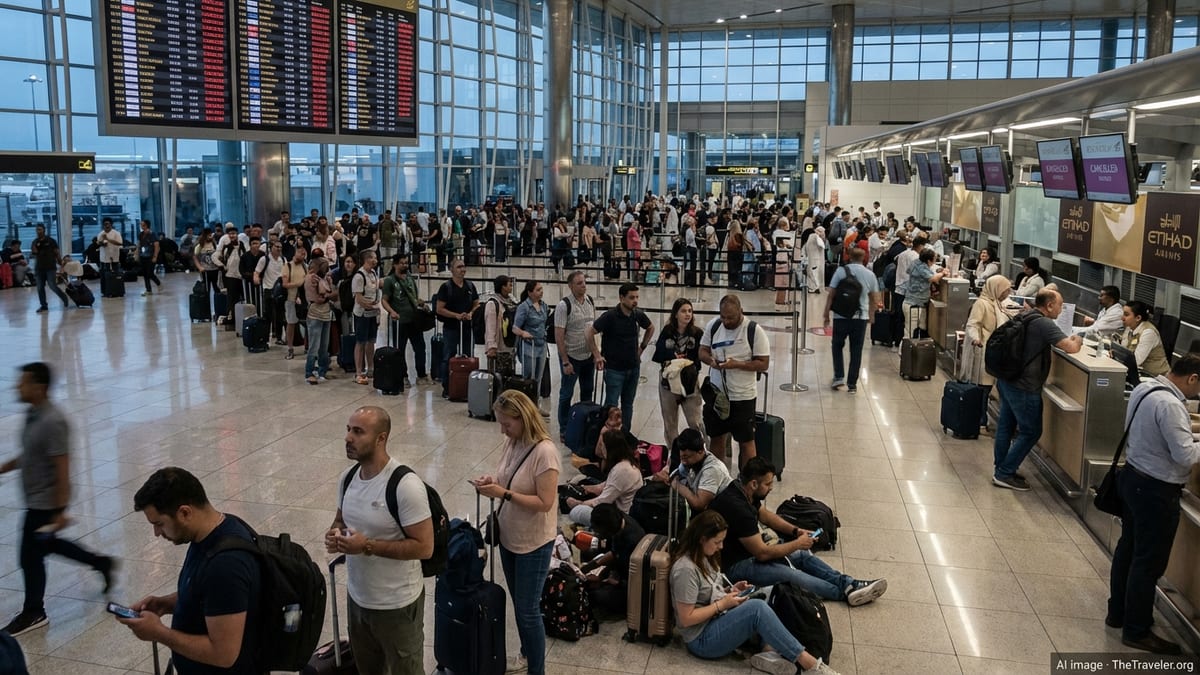
For passengers, the main operational impact has been a higher level of uncertainty around departure times and potential last-minute cancellations whenever security conditions deteriorate. Travel specialists advise building longer connection buffers, monitoring bookings closely and ensuring contact details are updated with the airline so that any operational changes are communicated promptly.
Qatar Airways continues to navigate airspace closures and corridor limits
Qatar Airways, which relies on Doha’s Hamad International Airport as its central hub, has also been navigating a fluid operating environment driven by regional tensions and episodic airspace closures. Airline statements and airport operations data during peak phases of the crisis show that the carrier has at times suspended selected services, consolidated frequencies or rerouted flights through designated safe corridors approved by civil aviation authorities.
During earlier periods of airspace closure in 2026, Qatar Airways operated limited repatriation and relief flights on specific days to key European cities while large portions of its regular schedule remained curtailed. More recently, schedules have appeared closer to normal, but with ongoing susceptibility to disruption when new alerts are issued or when regional authorities temporarily restrict certain flight levels or routes.
Passengers transiting through Doha report that airport facilities and ground operations generally function smoothly when flights are running, but that sudden changes in regional risk assessments can lead to clusters of delays or cancellations affecting multiple departures. Travelers are frequently reminded in public discussion forums and airline communications to rely on official Qatar Airways channels for the most current status information.
For long-haul itineraries linking Europe, Africa, Asia and Oceania, Qatar Airways remains an important connector, yet its reliance on a single regional hub means that any renewed escalation in the Middle East can quickly cascade into global schedule impacts. This dynamic is a key factor behind the latest rounds of government travel warnings that reference the potential for abrupt travel disruption.
What the latest travel alerts mean for UAE-bound and transit passengers
Although the most severe phases of airspace closure around the Gulf have eased compared with early 2026, the coordinated tone of recent travel alerts from the US, UK, Canada and Australia underlines that regional stability is still viewed as fragile. For many travelers, the practical implications center on insurance coverage, ticket flexibility and contingency planning rather than an immediate halt to all journeys.
Insurance policies in several markets now explicitly reference government advisories, with some underwriters excluding coverage for trips to areas flagged as higher risk or for routes transiting certain conflict-affected zones. This has prompted some travelers, particularly from Australia and Canada, to reassess whether to route via the Middle East or to consider alternative hubs in Europe or Asia that are perceived as less exposed to sudden airspace restrictions.
For those who continue to fly through Abu Dhabi or Doha, travel industry guidance highlights the importance of flexible fares or tickets with more generous change terms, along with clear understanding of airline policies on accommodation, rebooking windows and refunds in the event of major disruption. Publicly available commentary on recent disruption episodes suggests that passengers who built in additional connection time and maintained alternative options were better positioned when schedules shifted.
Overall, while Etihad and Qatar Airways are maintaining substantial parts of their networks and airports in the United Arab Emirates and Qatar remain operational, the renewed government advisories serve as a reminder that travel plans in the region can still be affected by fast-moving geopolitical developments. Travelers are being encouraged to treat itineraries through the Gulf with a higher degree of flexibility and to monitor both official government advisories and airline operational updates in the days leading up to departure.