


More news on this day
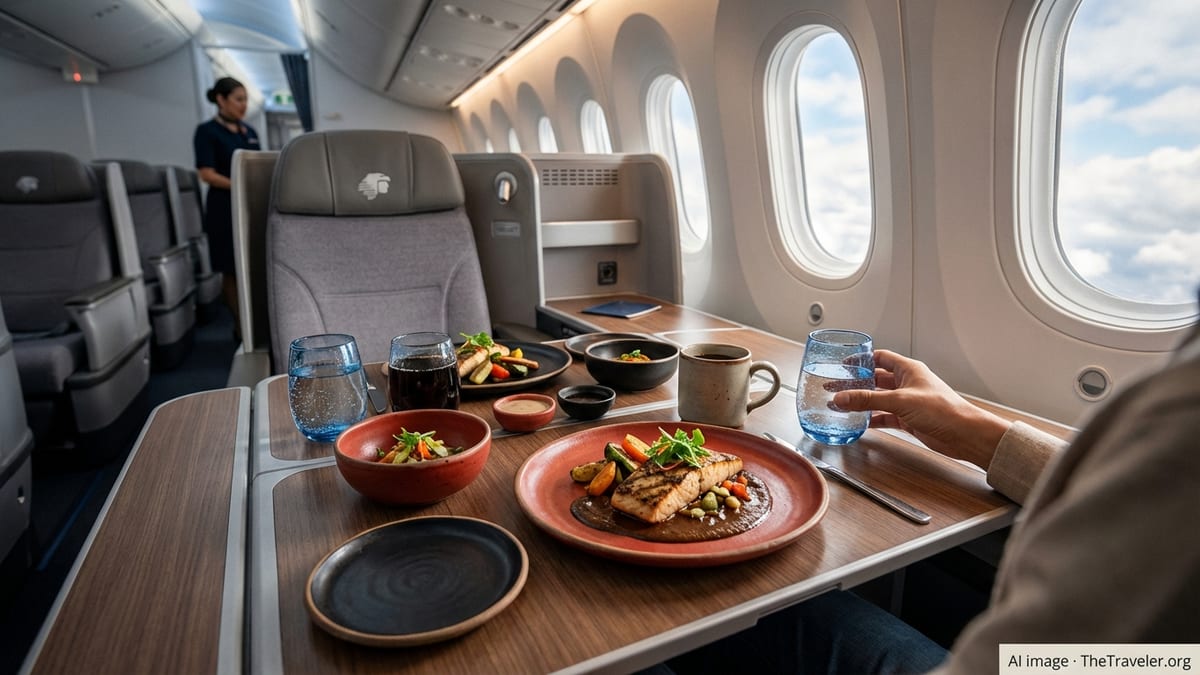
Business class cabins in 2026 are increasingly judged not only by flat-bed seats and privacy doors but by what arrives on the plate, as carriers from France, Japan, Singapore, Qatar and Turkey race to turn in-flight dining into a signature of their brand.
Get the latest news straight to your inbox!
Skytrax Rankings Put Culinary Competition in the Spotlight
Recent award cycles have sharpened the focus on premium inflight dining, with global rankings elevating business class catering to the same level of scrutiny as comfort and service. Skytrax airline surveys and regional travel awards have consistently highlighted Qatar Airways and Singapore Airlines at the top of business class categories, underscoring how sophisticated food and beverage programs now underpin overall brand perception.
Qatar Airways secured major wins in the 2024 Skytrax World Airline Awards, including World’s Best Business Class and recognition for its business class lounge, reinforcing Doha’s role as a hub where restaurant-style service continues well beyond the boarding gate. Industry coverage notes that these accolades reflect not just seat design but a holistic experience in which multi-course menus, expansive à la carte choices and curated wine lists are central to the carrier’s appeal.
Singapore Airlines remains close behind in key global rankings, frequently topping lists for premium service in Asia and collecting regional awards for full-service and business class excellence. The airline’s longstanding focus on “Book the Cook” pre-order menus and its collaboration with an international culinary panel demonstrate how Asian carriers have treated in-flight dining as a differentiator for more than a decade, setting a high bar that others are now keen to match.
Against this backdrop, the business class dining race in 2026 is less about a single “best” airline and more about an elite group refining distinct culinary identities. It is in this context that France, Japan and Turkey have intensified investment in gastronomic partnerships, positioning themselves alongside Gulf and Southeast Asian competitors at the top of the premium travel market.
France’s Air France Turns Haute Cuisine into a Flagship Asset
France’s national carrier has pushed aggressively into gastronomy as a pillar of its premium strategy, bringing the country’s fine-dining reputation into the cabin. Publicly available information from Air France highlights expanding collaborations with star chefs, including Michelin-recognized names crafting seasonal menus for long-haul business cabins departing Paris.
Recent corporate updates describe how Air France works with French catering specialist Servair and a dedicated Culinary Studio to design rotating menus that emphasize regional produce, lighter preparations and reduced food waste. In business class, this has translated into more structured multi-course services, where starters, mains and desserts echo brasserie and haute-cuisine traditions rather than generic international fare.
The airline has also put a spotlight on pastry and wine, areas closely associated with French gastronomic identity. Since 2024, Air France has expanded partnerships with award-winning pastry chefs, while its wine and champagne selection is curated by sommeliers recognized in national competitions. For business class travelers, this means pairings that mirror high-end restaurants in Paris and Lyon, rather than a simple red-or-white choice at altitude.
These culinary investments sit alongside a wider premium push that includes new-generation long-haul cabins on Boeing 777 and Airbus A350 aircraft. For business class, the upgraded hard product provides the stage for a more elaborate meal service, reinforcing France’s emergence as a serious contender in the global race for the finest onboard dining.
Japan and Singapore Double Down on Precision and Choice
In Japan and Singapore, business class dining has evolved into a showcase of national culinary culture, with carriers using precise presentation and extensive choice to stand out. Japan Airlines and All Nippon Airways have each refreshed premium cabins on new long-haul aircraft, with updated interiors accompanied by renewed food and beverage strategies.
Japan Airlines’ business cabins on the A350-1000, introduced in 2024, feature upgraded seating and an emphasis on its long-running “BEDD” dining program. Industry reviews describe how menus balance traditional Japanese kaiseki-style courses with contemporary Western dishes, served on elegant tableware and paired with sake or international wines. The attention to plating and timing, aligned with Japanese omotenashi principles, aims to deliver restaurant-quality meals despite the pressure of galley constraints.
All Nippon Airways, recognized by Skytrax for service standards and airport experience, has also invested in business class catering, with menus that combine seasonal Japanese ingredients and collaborative dishes from guest chefs. From delicately simmered fish and rice sets to modern fusion options, ANA’s approach underscores a belief that premium travelers value authenticity as much as luxury.
Singapore Airlines continues to be a benchmark for customization. Its business class passengers can pre-select from an extensive menu of chef-designed dishes on many routes, from regional specialties like laksa and beef rendang to Western classics. Combined with consistent cabin crew training and an emphasis on temperature control and reheating techniques, this level of choice has kept Singapore firmly in the conversation about the world’s best business class dining.
Qatar and Turkey Extend Restaurant Culture from Lounge to Cabin
In the Gulf and Turkey, premium dining starts long before passengers reach their seats. Qatar Airways and Turkish Airlines have each turned their hub airports into culinary showcases, using business lounges to preview the quality on offer in the air.
Reports on Qatar Airways’ flagship business lounge at Hamad International Airport frequently note the breadth of its made-to-order food, from Arabic mezze and grills to Western comfort dishes, presented in spaces designed to resemble upscale hotel restaurants. This ground experience feeds into expectations in the cabin, where business class menus feature complex entrées, regional flavors and a robust selection of desserts, often served on demand rather than in rigid service waves.
Turkish Airlines, meanwhile, leans heavily on the country’s gastronomic heritage. Its Istanbul hub lounges are known for live cooking stations that prepare pide, grilled meats and meze, while business class cabins showcase Anatolian-inspired menus alongside international options. Coverage of the airline’s premium strategy highlights how it uses abundant portions, fresh bread and visible preparation to create a sense of generosity that resonates strongly with long-haul travelers.
Both carriers have also placed weight on beverage programs. Qatar Airways is known for its rotating list of fine wines and champagnes in business class, while Turkish Airlines emphasizes Turkish coffee, teas and regional spirits. Together, these elements transform dining into an integral part of the brand narrative that stretches from check-in through arrival.
A New Standard for 2026: Restaurant Expectations at 35,000 Feet
The convergence of these trends in France, Japan, Singapore, Qatar and Turkey is reshaping what business travelers expect from their time on board. Flat beds and direct aisle access are now seen as baseline, while the real differentiator lies in whether dinner feels like an afterthought or a carefully curated experience that reflects the airline’s cultural DNA.
Industry analysts note that airlines are using gastronomy to attract both corporate travelers and a growing cohort of affluent leisure passengers willing to pay for comfort. Published reports on premium travel demand show that this segment remains resilient, encouraging carriers to invest in chef partnerships, upgraded catering infrastructure and training that brings restaurant disciplines into the galley.
In 2026, the world’s finest business class dining experiences are no longer confined to a single region. From Air France’s haute cuisine and cellar-driven service to the precision of Japanese menus, the bespoke choices on Singapore Airlines and the lounge-to-cabin continuity offered by Qatar Airways and Turkish Airlines, a new global standard is emerging. For travelers, it means that choosing a route increasingly involves choosing a culinary journey, with certain flags now clearly flying at the front of the cabin.