


More news on this day
Air travel across the United Arab Emirates has been severely disrupted as Dubai, Abu Dhabi, Sharjah and Ras Al Khaimah airports collectively delayed 462 flights and cancelled 20, affecting operations for Emirates, Etihad, Air Arabia, FlyDubai, SpiceJet and several other international carriers, according to published airport and airline data compiled on Monday.
Get the latest news straight to your inbox!
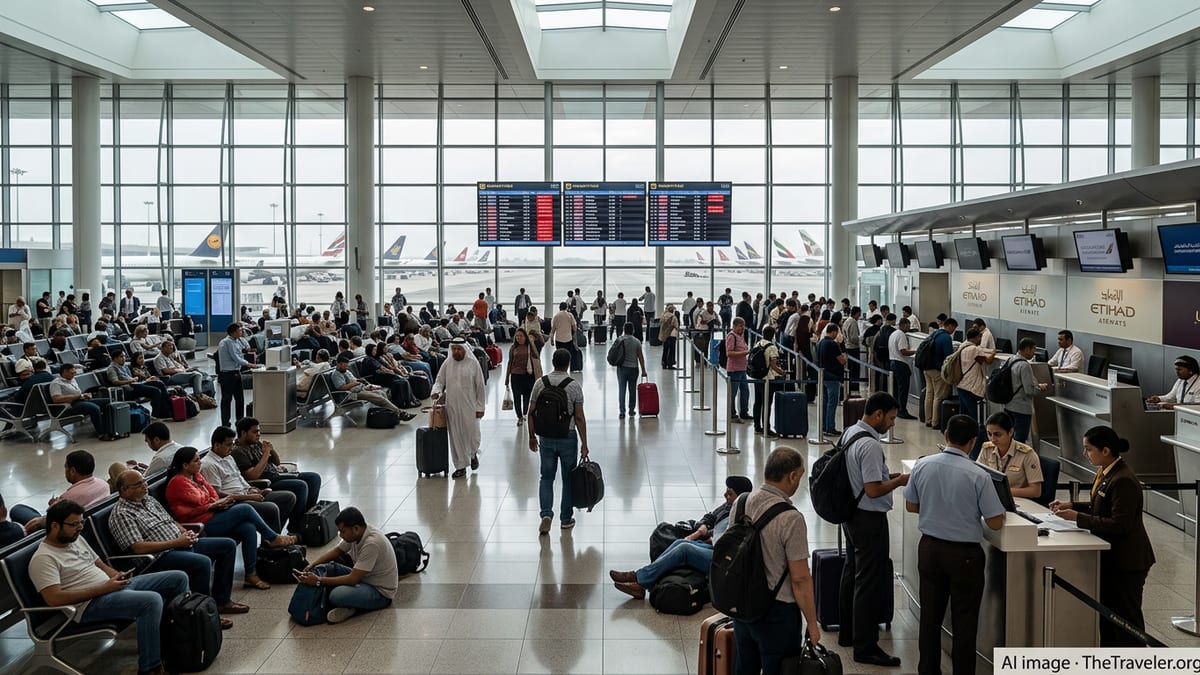
Wide-Ranging Disruption Across Major UAE Hubs
Publicly available flight boards and aviation tracking data show widespread delays across the UAE’s four key international gateways, with Dubai International, Abu Dhabi International, Sharjah International and Ras Al Khaimah International all experiencing significant schedule upheaval. The disruption spans both arrivals and departures, hitting regional connections within the Gulf as well as long-haul services to Europe, Asia and North America.
Reports indicate that the largest concentration of delays is at Dubai International, the world’s busiest international hub and the primary base for Emirates and FlyDubai. Dozens of Emirates widebody services have been pushed back by several hours, with knock-on effects for connecting passengers transiting through Dubai. FlyDubai’s short and medium-haul network has also seen rolling delays on routes to South Asia, the Levant and Eastern Europe.
Abu Dhabi, home base for Etihad Airways, has likewise reported a wave of late-running flights, particularly on heavily traveled corridors to Europe and Southeast Asia. Sharjah and Ras Al Khaimah, which serve as key bases for Air Arabia and a number of low-cost and charter operators, have also logged delays and a share of the total cancellations, adding to the regional ripple effect.
Airlines Adjust Schedules as Cancellations Mount
While the majority of affected services are delayed rather than outright cancelled, at least 20 flights across the four airports have been scrubbed, based on combined airport screens and airline status pages. The cancellations are spread across multiple carriers, including Emirates, Etihad, Air Arabia, FlyDubai and India-based airlines such as SpiceJet, alongside other regional and international operators.
According to published coverage and airline advisories, carriers are responding by trimming frequencies, consolidating lightly booked services and re-timing departures to secure available airspace slots. Some long-haul flights are being rescheduled to off-peak windows to reduce congestion, while selected intra-Gulf and South Asian sectors are being combined onto larger aircraft.
Indian carrier SpiceJet, which operates a number of services linking UAE airports with key Indian cities, is among those reporting delays and isolated cancellations on routes where turnaround times have been squeezed. Air Arabia and FlyDubai have meanwhile emphasized rebooking options in public-facing guidance, steering passengers toward later departures where capacity permits.
Operational Strain from Regional Turbulence and Airspace Constraints
The latest wave of disruption comes against a backdrop of ongoing regional instability and constrained airspace across parts of the Middle East. Recent weeks have seen airlines repeatedly adjust routings to avoid sensitive air corridors, which has lengthened flight times on some routes and tightened scheduling buffers at busy hubs such as Dubai and Abu Dhabi.
Analysts cited in regional business coverage note that carriers across the Gulf are still operating in a highly fluid environment, where sudden changes in airspace availability can quickly cascade into delays. Extended flight paths, higher fuel burn and complex crew-rotation requirements are all contributing to operating pressures, particularly for network airlines that rely on tightly timed connecting banks.
Publicly available information also shows that the UAE’s major carriers are juggling these constraints while maintaining extensive global networks. Emirates and Etihad continue to operate dense schedules to Europe, Asia, Africa and the Americas, while Air Arabia and FlyDubai serve dozens of regional destinations from multiple UAE bases. The current disruption illustrates how even limited bottlenecks can reverberate across such interconnected systems.
Impact on Passengers and Guidance for Travelers
The immediate impact for passengers has been long queues at check-in and security, crowded departure halls and missed connections on tightly timed itineraries. Social media posts and local reports describe travelers facing multi-hour waits, overnight stays and last-minute rebookings as they attempt to navigate the disruption at the four affected airports.
Airlines and airport operators, in their public updates, are urging passengers to check flight status frequently before leaving for the airport and to allow extra time for check-in and security. Several carriers are encouraging the use of mobile apps and digital channels for real-time notifications, boarding pass downloads and rebooking options where flights have been significantly delayed or cancelled.
Travel agents in the region are advising customers with imminent travel to build in longer connection windows, especially when transiting through Dubai or Abu Dhabi to onward long-haul destinations. Flexible tickets and travel insurance that covers disruption are being highlighted as useful safeguards while conditions remain unpredictable.
Recovery Timeline and Outlook for UAE Aviation
Despite the current disruption, available commentary from aviation analysts suggests that the UAE’s aviation sector remains structurally robust, with strong underlying demand for both business and leisure travel. Gulf-based carriers have previously demonstrated an ability to restore operations quickly following regional shocks, leveraging large fleets and deep airport infrastructure.
However, the precise recovery timeline from the latest wave of delays and cancellations is unclear. Much will depend on how quickly airspace constraints ease and whether additional operational shocks emerge in the wider region. Airlines are expected to continue recalibrating schedules over the coming days, which could mean further rolling delays even as the immediate backlog is cleared.
For now, passengers planning to travel through Dubai, Abu Dhabi, Sharjah or Ras Al Khaimah are being advised, in publicly available guidance, to monitor airline and airport updates closely and to remain prepared for last-minute changes. The scale of Monday’s disruption, with more than 460 flights delayed and 20 cancelled, underlines how swiftly conditions in one of the world’s busiest aviation markets can shift, even for some of its most experienced carriers.