

More news on this day
A freight train derailed after colliding with a lorry on a level crossing in the Port of Rotterdam’s Europoort district, disrupting rail freight traffic through one of Europe’s most important industrial hubs and triggering a complex recovery operation around the busy Elbeweg corridor.
Get the latest news straight to your inbox!
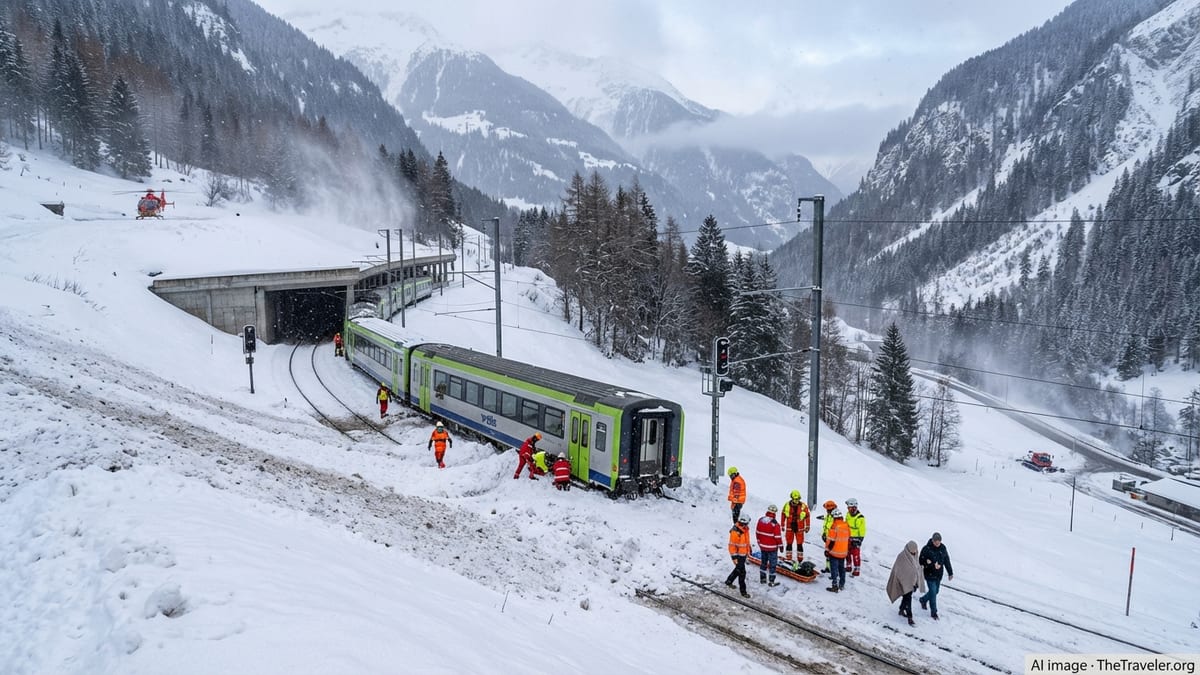
Collision at busy Europoort level crossing
According to Dutch media reports, the collision occurred on Sunday 26 July near the Elbeweg, a major access road serving heavy industry and container facilities in the outer port area. A lorry using a level crossing was struck by a passing freight train, causing several wagons to leave the tracks and come to rest at an angle along the line.
Coverage from local outlets indicates that the lorry ended up across the tracks shortly before impact. The train, operating on a route serving petrochemical and bulk terminals, was unable to stop in time. Images from the scene show a damaged truck cab and derailed freight wagons, but no signs of fire or large-scale spillage.
Rail infrastructure manager updates and regional news reports state that emergency services and specialist rail incident teams moved quickly to secure the site, assess the condition of the rolling stock and inspect the track structure. Initial information suggests that the driver of the lorry was able to leave the vehicle before the collision and that only minor injuries, if any, were recorded.
The incident took place in an area dominated by refineries, tank farms and bulk storage facilities, which rely heavily on rail connections for inbound raw materials and outbound products. The fact that the train remained largely upright and that no hazardous cargo leak was reported limited the immediate risk to nearby industrial sites.
Disruption for port and hinterland freight flows
Publicly available information from ProRail and local news platforms indicates that train movements through part of the Europoort rail network were halted while the damage was assessed. The affected line forms one of several freight corridors linking terminals on the Maasvlakte and Europoort peninsulas with marshalling yards closer to the city and with the wider Dutch and European rail system.
Operators use these routes to move containers, chemicals, fuels and dry bulk cargo to inland terminals in the Netherlands, Germany and beyond. Any blockage, even on a single track, can create delays for scheduled freight paths and force rail operators to reroute trains or temporarily shift some loads to road transport.
Port-focused coverage notes that traffic impact was initially concentrated around the local industrial cluster, with nearby level crossings and service roads partially closed to allow cranes, heavy recovery vehicles and track machinery to access the site. Lorry traffic serving nearby terminals experienced detours and slower flows, although the wider road network around Europoort remained open.
Rail planners are expected to prioritize clearing wagons and repairing the track so that freight connections can resume as quickly as possible. Depending on the extent of track, ballast and overhead line damage, similar incidents in the Netherlands have in the past required closures ranging from several hours to a few days.
Safety measures and investigation focus
Published updates from the infrastructure manager emphasize that the immediate priority has been to make the location safe, recover the derailed wagons and repair any damaged infrastructure. Once the site is stabilized, a technical investigation is expected to review the sequence of events and examine how the lorry came to be on the crossing when the train approached.
In the Dutch rail system, level crossings near freight-intensive areas are generally equipped with barriers, warning lights and acoustic signals. Investigators typically look at whether these systems functioned as designed, whether sightlines were clear for both road and rail traffic, and whether any operational or human factors contributed to the collision.
Recent international safety reports have drawn attention to the particular risks posed when heavy road vehicles encroach on railway rights of way, especially in ports where long truck combinations and slow maneuvering are common. The mass of a loaded freight train and its long stopping distance make collisions at low speeds potentially serious for both crews and bystanders.
Analysis of comparable incidents usually leads to recommendations on signal visibility, barrier timing, road layout around crossings and driver awareness. Any findings from the Europoort collision could feed into broader safety programs that aim to reduce the risk of conflicts between port truck traffic and growing volumes of rail freight.
Port of Rotterdam’s rail network under scrutiny
The Port of Rotterdam, the largest seaport in Europe, has invested heavily in rail connections to support more sustainable hinterland transport. Dedicated freight lines and on-dock rail terminals are central to efforts to shift cargo away from road and inland waterways and toward low-emission rail services.
In recent years, the wider Rotterdam rail area has already experienced infrastructure challenges, including cable damage near Rotterdam Stadion that affected both passenger and freight services. While unrelated to the Europoort collision, those disruptions highlighted how sensitive the regional network can be to single-point failures.
Transport analysts note that as more freight is concentrated on dedicated port corridors, resilience and redundancy become increasingly important. An incident on one link can quickly ripple through timetables, particularly when train paths are tightly scheduled to connect with ship arrivals, barge departures and just-in-time industrial supply chains.
The Europoort derailment is therefore likely to prompt renewed discussion about whether additional grade separations, alternative routings or technology-based safety systems are needed at key crossing points used heavily by trucks. Any such measures would seek to support the port’s long term strategy of expanding rail’s share in hinterland transport while maintaining a high safety record.
Travel and logistics implications in the short term
For travelers, the immediate impact of the Europoort derailment is limited, as the affected line primarily serves freight rather than passenger traffic. Long distance and regional passenger services into Rotterdam Central and surrounding stations continue to operate on separate routes, though minor timetable adjustments are possible when freight trains are diverted.
For logistics companies and shippers, the short term effects are more visible. Rail operators may need to reschedule trains, combine loads or temporarily hand over some cargo to road haulage while repairs proceed. This can introduce delays, increased costs and more complex planning for freight forwarders serving industrial clients in the port area.
Public information so far suggests that there is no long lasting closure of major freight arteries, but the exact duration of the disruption will depend on the speed of wagon recovery and infrastructure repairs. Until normal operations resume, companies moving time sensitive goods through Rotterdam’s outer port may face longer transit times and should monitor service updates from rail and terminal operators.
The incident serves as a reminder that even in highly engineered port environments, rail freight remains exposed to conflicts with road traffic at level crossings. For Europe’s largest port, maintaining confidence in rail reliability will be an important part of the recovery from this derailment and in planning future safety investments along the busy corridors of Europoort and Maasvlakte.