


The French Riviera, or Côte d’Azur, has been a byword for seaside glamour for more than a century, but you do not need a yacht or a movie star budget to enjoy it. Stretching roughly from Menton near the Italian border to the coves around Cassis, this coast mixes Belle Époque cities, quiet fishing villages, cliffside hiking paths and national parks, all stitched together by an efficient rail line. This guide focuses on concrete details: which towns work best as a base, what beaches are really like, how to tap into local markets and food culture, and the kinds of everyday experiences that will make a Riviera trip feel genuinely French rather than just a postcard backdrop.
Get the latest updates straight to your inbox!
How the French Riviera Fits Together
Geographically, the French Riviera runs along the Mediterranean in the Provence–Alpes–Côte d’Azur region, with Nice at its heart. Nice is the main transport hub, home to the Côte d’Azur airport and a busy regional rail line that runs west to Cannes and east to Menton and the Italian border. As a visitor, this means you can sleep in one town and comfortably day trip to several others without renting a car. Regional TER trains link, for example, Nice to Cannes in around 30 minutes for about 10 euros if you buy a standard ticket at the station or on SNCF’s app, with frequent departures throughout the day.
The Riviera’s beaches vary more than first-time visitors expect. Nice and much of the central coast have smooth grey shingle rather than sand, while sandy stretches become more common around Antibes, Juan-les-Pins, Cannes and the islands off Hyères. Some areas are lined with beach clubs where you pay for loungers and waiter service, others are free public beaches where you simply spread a towel. By French law beaches are public, but parts of them are sometimes leased to private operators who run those beach clubs, so a typical bay is a patchwork of free and paying zones.
The climate is one of the main reasons the Riviera is so popular. The coast averages well over 300 sunny days a year, and winter days often reach 13 to 15 degrees Celsius, so you can stroll seaside promenades in a light jacket in February. High season runs from late June through August, when hotel prices in hotspots like Nice, Antibes and Cannes can easily double. Shoulder seasons in May, early June, September and early October bring warm seas, long evenings and more manageable prices. For example, mid-range hotels that hit 260 euros a night in late July may drop closer to 150 to 180 euros outside school holidays, especially midweek.
Because this is a narrow strip of coast backed by hills and mountains, space is limited and crowds concentrate quickly. Visiting in shoulder season, booking well ahead for July and August, and using public transport rather than a car will make the experience smoother. Even small decisions, like planning beach days early in the morning and saving town explorations for late afternoon and evening, can transform how the Riviera feels at the height of summer.
Best Towns to Use as a Base
Nice is the most practical base for many travelers. It has a compact old town, long seafront promenade, tram lines that connect the airport to the center in about 25 minutes, and frequent trains in both directions along the coast. Staying near the Old Town or around Place Masséna puts you within a 10 to 15 minute walk of the main train station, the Promenade des Anglais and the Cours Saleya market. In high season you can expect a decent double room in a three-star hotel in this area to start around 180 to 220 euros a night, with apartments fluctuating depending on location and air conditioning.
Antibes suits travelers who want something smaller and more traditionally coastal. Its walled old town, stone ramparts and marina feel more intimate than Nice, yet it still has direct TER trains east to Nice and west to Cannes. The sandy Plage de la Gravette sits just below the old walls, and you can walk from a small hotel in the center to the beach in under 10 minutes. Antibes combines well with nearby Juan-les-Pins, a resort area with wider sandy beaches and a long-running summertime jazz festival, so you can sleep in the historic quarter and walk or take a short train hop to Juan-les-Pins for beach days.
Cannes works well if you are drawn to resort style and want easy day trips. Outside the film festival period in May, the city functions as a straightforward beach destination with a lively restaurant scene around Rue Hoche and the streets behind the Croisette. The main sandy beaches run along the Boulevard de la Croisette and closer to the old port, with a mix of public sections and private beach clubs where loungers often cost from about 25 to 40 euros per day in peak months. From Cannes station you can be in Antibes in around 10 minutes and Nice in about 30 minutes on frequent regional trains.
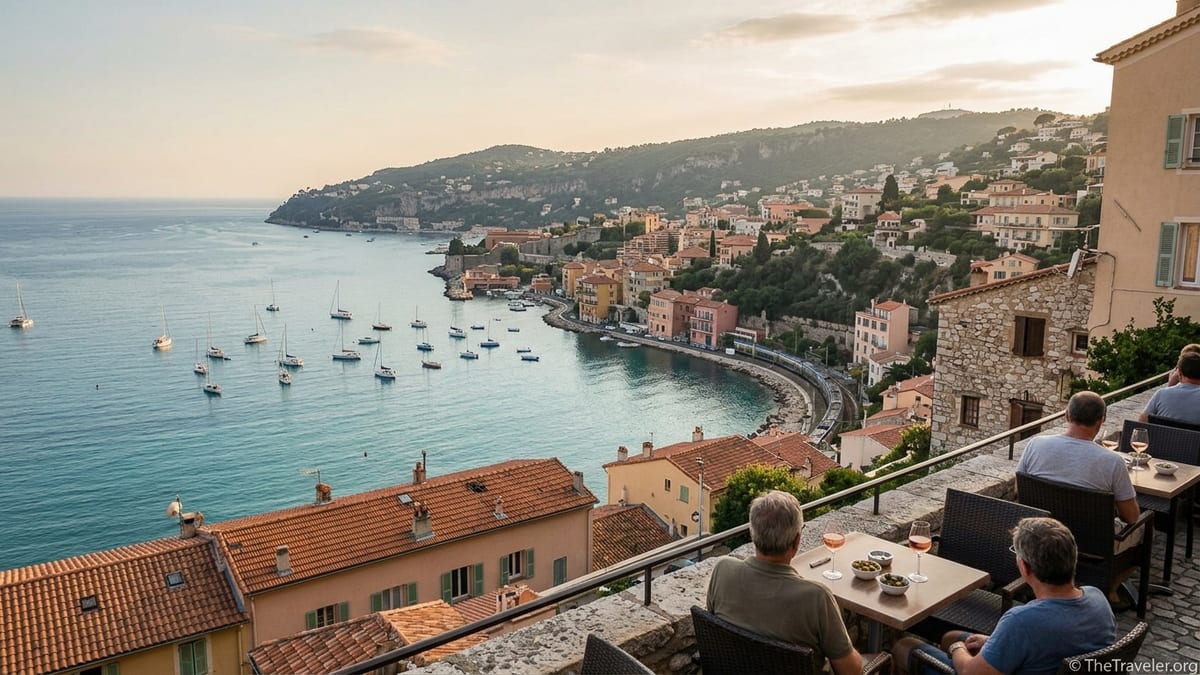
For a quieter base, Villefranche-sur-Mer and Menton stand out. Villefranche-sur-Mer, one stop east of Nice, has an amphitheater of pastel houses around a deep bay used by cruise ships. The main pebbly beach is sheltered and within a few minutes’ walk of the small station. It feels like a village but is only a 10 minute train ride from Nice, so it suits travelers who want calm evenings and simple seafood dinners on the quay. Menton, right by the Italian border, has an elegant old town, lemon groves and a reputation for a more laid-back, slightly older crowd. It is particularly good for longer stays where you want local routines like daily market shopping and evening passeggiatas rather than nightlife.
Choosing and Understanding Riviera Beaches
On the French Riviera, beach quality is less about finding a perfectly empty stretch of sand and more about understanding the character of each spot. In Nice, the central shoreline along the Promenade des Anglais is made of smooth pebbles that slope fairly steeply into clear water. Locals come prepared with foldable beach mats or padded loungers, and many visitors opt to pay for a private beach club bed where they get a cushion, umbrella, changing cabins and showers. Prices vary by club and season but in mid-summer a front-row lounger can easily cost 30 to 50 euros for the day, with basic sunbeds at the back from around 20 to 25 euros.
If sand matters, you will find more natural-feeling sandy beaches in places like Antibes, Juan-les-Pins, Cannes and the islands off Hyères to the west. In Antibes, Plage de la Salis and Plage du Ponteil have pale sand, gentle entry into the sea and family crowds in summer, with snack kiosks and simple beach restaurants. In Cannes, the public beach near the Palais des Festivals is wide and sandy, packed with families in August but relatively quiet early in the morning. Some sections of sand in Cannes are technically built up and maintained rather than completely natural, but for swimmers this makes little difference: they are comfortable to walk on and the water is usually calm.
Beyond the classic city beaches, small coves and coastal paths offer different experiences. Around Cap d’Antibes, for example, the Sentier du Littoral footpath winds past rocky inlets where locals climb down ladders for a quick dip before continuing their walk. On the peninsula of Saint-Jean-Cap-Ferrat, the walk between Paloma Beach and Passable Beach passes overlooks where people stop to swim off the rocks or from tiny shingle bays. These spots are free, but you need proper footwear and a willingness to climb.
Beach regulations are worth keeping in mind. French authorities emphasize that the coastline is a fragile public space, and in some areas it is now illegal to remove pebbles or large quantities of sand as souvenirs, with fines for damage to the public domain. During high fire-risk periods in summer, access to certain coastal massifs and pine forests behind beaches can be restricted or closed, especially around Marseille and Cassis where the Calanques National Park sits. Always check signs at trailheads or the official departmental website for daily access levels before setting off on hikes to remote coves.
Local Markets, Food Culture and Everyday Rituals
One of the most satisfying ways to experience the Riviera is through its open-air markets and regular food rituals. In Nice, the Cours Saleya in the Old Town hosts a famous flower and produce market on most mornings. Stalls pile up zucchini blossoms, sun-warmed tomatoes, local goat cheeses and bunches of basil, while another row sells freshly cut flowers. In peak season, some stands clearly cater to tourists with jars of tapenade and sachets of herbs at gift-ready prices, but the core of the market still serves locals doing their daily shopping. Arrive before 9 a.m. to watch restaurant chefs and home cooks choosing fish and vegetables before the crowds build.
Cannes has its own celebrated market, Marché Forville, a covered hall near the old quarter of Le Suquet. It is especially lively on weekend mornings, when people shop for fish, cheeses and seasonal produce, then linger over coffee in cafés spilling onto the surrounding streets. On Mondays, the food vendors give way to an antiques and flea market selling everything from old posters and silverware to mismatched plates. Travelers renting an apartment nearby can use Forville as their pantry, picking up ripe melons, olives and a piece of local cheese for an easy beach picnic instead of eating every meal in restaurants.
Street food and simple dishes offer another window into Riviera life. In Nice, look for socca, a thin chickpea pancake baked in a wood-fired oven and sold by the slice, usually for only a few euros. People eat it standing at counters with a glass of rosé or take it to a nearby bench on the Promenade des Anglais. Pissaladière, an onion tart topped with anchovies and olives, appears in many bakery windows and pairs well with a picnic by the sea. On hot afternoons, local ice cream shops doing classic flavors like lemon, fig and lavender become part of the daily rhythm, especially around Old Town squares.
For sit-down meals, you can still find reasonably priced fixed-price menus if you step a few streets away from seafront promenades. In Antibes and Menton, many bistros offer two or three-course lunch formulas starting around 20 to 28 euros, often featuring a fish of the day, a simple starter like a salad of tomatoes and burrata, and a dessert such as tarte au citron. Ordering a carafe of local rosé instead of individual glasses keeps costs in check. Ask what is local: in coastal villages west of Hyères, some restaurants now highlight fish supplied by small-scale fishers from Port-Cros National Park waters, reflecting a broader shift toward sustainable sourcing.
Getting Around: Trains, Ferries and Walking
The Riviera’s coastal train line is the backbone of most itineraries. Regional TER services run frequently, linking towns like Menton, Monaco, Villefranche-sur-Mer, Nice, Antibes, Cannes and beyond. Journey times between neighboring towns are short: Nice to Villefranche takes about 7 minutes, Nice to Antibes around 20 minutes, and Nice to Cannes roughly 30 minutes on a direct train. Standard one-way fares on these short hops usually range from about 4 to 10 euros depending on distance, with occasional regional promotions and passes that can bring costs down further, especially for couples or small groups traveling together.
If you plan to make multiple train trips in a day, it can be worth looking at regional day passes, which sometimes cost only a little more than two single tickets and permit unlimited travel within a defined area. Travelers have reported options like group discounts where five people traveling together between Nice and Cannes pay under 5 euros each when using special mini-group fares on certain dates. Timetables and tickets are available in English on the SNCF Connect app, which is widely used by locals and simplifies last-minute changes if you decide to stay longer at the beach.
Local buses fill in gaps where the train does not reach directly. For example, buses link Nice to hilltop villages like Èze Village and to smaller coastal towns such as Saint-Jean-Cap-Ferrat. Fares on these regional buses are usually low, often just a few euros per journey. In summer, some lines run less frequently in the middle of the day to avoid traffic jams, so checking the current timetable the evening before is sensible. Within towns, walking is usually the best way to get around: old centers like Antibes, Menton and Villefranche are compact, and seafront promenades are designed for strolling.
Ferries and small excursion boats offer a different perspective on the coast. From Cannes, regular boats cross to the Îles de Lérins, a pair of pine-covered islands with rocky coves and clear water where you can spend a full day swimming and picnicking. In high season, return tickets typically run in the range of 17 to 25 euros per adult depending on the operator. Around Cassis and Marseille, sightseeing boats take visitors into the Calanques, steep-walled inlets with turquoise water and white cliffs. These trips usually last 2 to 3 hours, and while they can be crowded in August, they give good access to scenery that would otherwise require long hikes in strong sun.
Beyond the Beach: Local Experiences and Day Trips
The Riviera rewards travelers who look beyond sunbathing. Hilltop villages like Èze, overlooking the sea between Nice and Monaco, offer narrow lanes, stone houses and panoramic views. You can take a train to Eze-sur-Mer station, walk to the coastal bus stop and ride up the steep road to Èze Village, then follow the Nietzsche Path back down to the sea in about an hour if you are reasonably fit and have sturdy shoes. The descent winds through scrub and rock with constant views of the Mediterranean and feels a world away from the traffic below.
Wine and olive oil provide another thematic thread for day trips. Inland from Antibes and Cannes, small family-run wineries in the Côtes de Provence region open for tastings, often by appointment. Visits typically cost a modest tasting fee or are free if you purchase a bottle or two to take back to your accommodation. Around Hyères and the Giens peninsula, estates cultivate local grape varieties and produce pale rosés that pair naturally with seafood. Combining a late morning cellar visit with a simple lunch in a village square can make for a relaxed break from the coast.
Hikers and nature lovers should consider the Calanques National Park between Marseille and Cassis, at the western edge of the broader Riviera. Access to some of the most fragile coves, such as Sugiton near Marseille, is now limited on peak summer days through a free reservation system that caps daily visitor numbers. In addition, high fire-risk days can trigger temporary closures of certain trails and massifs, especially during hot, windy spells. Planning a Calanques hike therefore means checking the current rules the day before, packing plenty of water and sun protection, and accepting that boat tours may be the more realistic option in mid-summer.
Back on the main stretch of coastline, simple routines can be the most memorable experiences. Joining locals for an early morning swim at a neighborhood beach in Nice, then buying still-warm baguettes and fruit at a corner bakery and market stand; lingering over an apéro of rosé and olives in a Menton square as the light turns golden; catching an outdoor concert or open-air cinema on a summer evening in Antibes or Cannes. These are the moments that anchor a trip in everyday life rather than in a checklist of sights.
Planning, Budgets and Practical Tips
Accommodation is usually the largest single expense on a Riviera trip. Prices vary widely by town, season and how far you are from the sea. In July and August, expect a mid-range double room within walking distance of the beach in Nice, Antibes or Cannes to start around 170 to 220 euros per night, rising higher for sea views and well-known brands. In late September or early October, those same rooms often drop closer to 120 to 160 euros, and small family-run hotels may offer attractive shoulder-season deals if you book directly by email or phone.
Daily food costs can be controlled with a mix of market picnics, casual street food and the occasional sit-down meal. A breakfast of coffee and a croissant at a bar typically costs 4 to 6 euros. A slice of socca or a takeaway pan bagnat sandwich in Nice might cost 5 to 8 euros. Fixed-price lunch menus at modest bistros hover in the 20 to 30 euro range, while dinner with a shared starter, two mains, dessert and a bottle of local wine at a mid-range restaurant can easily reach 70 to 100 euros for two, depending on the town and your choices.
Booking strategies matter in peak season. Many hotels and apartments now use dynamic pricing, so reserving several months ahead for late June to August often locks in better rates. In contrast, outside those months you may find last-minute discounts, especially midweek in business-oriented cities like Nice. When choosing an apartment, verify whether it has air conditioning, as older buildings in old towns sometimes rely on fans and thick walls alone. In July and August, air conditioning can be worth paying extra for, particularly in top-floor units under the roof.
Safety and etiquette are straightforward, but a few local norms are worth knowing. Swim only in designated areas when lifeguards are present, and heed colored flag systems indicating sea conditions. Keep valuables out of sight on busy city beaches and trains, as pickpocketing can be an issue in crowds, though violent crime rates remain relatively low. Dress codes are relaxed at the beach and promenades, but beachwear is not considered appropriate away from the seafront, so putting on a shirt or dress before entering shops and markets is appreciated. Attempting basic French greetings, such as saying “bonjour” when you enter a shop or approach a market stall, goes a long way to smoothing interactions.
FAQ
Q1. When is the best time of year to visit the French Riviera?
The most balanced months are May, June, September and early October, when the sea is warm enough for swimming, the weather is generally sunny, and prices and crowds are more moderate than in July and August.
Q2. Which town is the best base for first-time visitors?
Nice is usually the most practical base for a first trip because it combines an airport, frequent trains to other Riviera towns, a lively old town, a long seafront promenade and a wide choice of accommodation at different price points.
Q3. Are the beaches mostly sandy or pebbly?
Much of the central Riviera, including Nice, has smooth pebble beaches, while sandy stretches are more common around Antibes, Juan-les-Pins, Cannes and on certain islands and coves toward Hyères and the western part of the coast.
Q4. Do I need a car to explore the French Riviera?
You can comfortably explore the main coastal towns without a car by using the regional TER trains and local buses, which are frequent and relatively inexpensive; a car mainly becomes useful if you want to reach inland villages or rural wineries not served by public transport.
Q5. How expensive is the French Riviera compared with other parts of France?
The Riviera is generally more expensive than inland regions, especially for accommodation and seafront dining, but costs can be managed by visiting in shoulder season, staying slightly away from the water, using markets for picnics and focusing restaurant meals at lunchtime when set menus are cheaper.
Q6. Are the private beach clubs worth paying for?
Private beach clubs can be worthwhile if you value comfort, as they provide loungers, umbrellas, showers and food service, but budget travelers and many locals simply use the free public sections of beach with a towel, hat and reusable water bottle.
Q7. Is it realistic to combine the French Riviera with Provence in one trip?
Yes, many travelers spend three to five days on the coast and then move inland for a similar amount of time in Provence, using trains or rental cars to reach places like Aix-en-Provence or Avignon, though it is usually better to change bases than attempt long day trips inland every day.
Q8. How far in advance should I book accommodation in summer?
For stays in late June, July and August, booking several months in advance is sensible, especially in popular towns like Nice, Antibes and Villefranche-sur-Mer, as the most appealing mid-range options near the sea often sell out or rise significantly in price.
Q9. Are there dress codes or etiquette rules I should know?
Dress is casual, but it is polite to cover up beachwear away from the seafront, to greet shopkeepers and market vendors with a simple “bonjour,” and to speak in a moderate tone in residential streets late at night.
Q10. Is the French Riviera suitable for families with children?
Yes, many towns have family-friendly sandy beaches, promenades for stroller walks and easy train connections, though families may find it more comfortable to stay in quieter bases like Antibes, Juan-les-Pins or Menton rather than in the busiest parts of Nice or Cannes in peak season.