


On an island famous for champagne-soaked beach clubs and rows of sunbeds pressed shoulder to shoulder, Ftelia Beach caught me off guard. I arrived expecting another polished Mykonos scene. Instead, I found a broad, windswept bay where the meltemi winds whip up whitecaps, beach clubs sit low against the sand, and long empty stretches remain blissfully unclaimed. Ftelia felt wilder and more untouched than I thought still existed on Mykonos, and that contrast is exactly what makes it so compelling.
Get the latest updates straight to your inbox!
First Impressions of a Wild North-Coast Bay
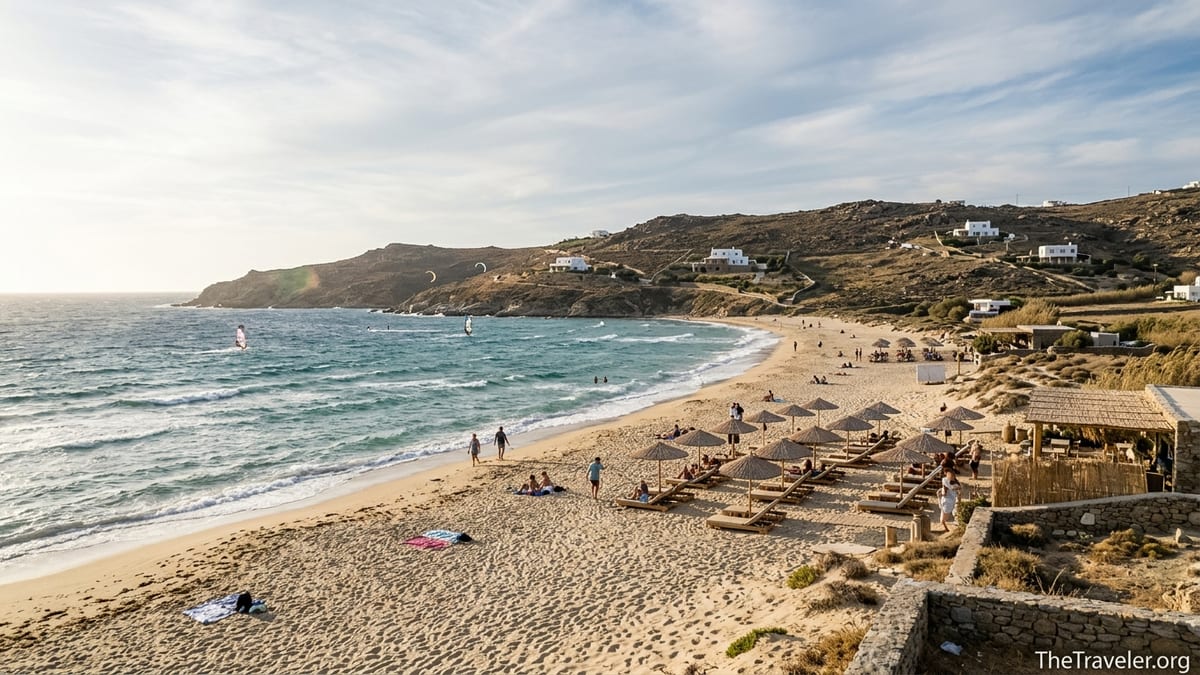
Ftelia sits deep inside Panormos Bay on the exposed north coast of Mykonos, about a 15-minute drive from Mykonos Town. The last stretch of road dips towards the sea and suddenly the whole curve of the bay opens up: pale-gold sand, low scrub-covered hills and, more often than not, streaks of white foam where the wind has ruffled the water. Compared with the built-up south coast, the first impression is how much sky and open space there is.
Even in high season, the beach here feels surprisingly empty once you move away from the clusters of loungers near the main venues. On a typical July afternoon, you might see a handful of windsurfers carving across the chop, a few locals walking their dogs along the far end of the sand, and a scattering of visitors who have escaped the packed terraces of Psarou or Super Paradise for somewhere that still feels close to nature.
The soundscape is different too. Instead of wall-to-wall music, what you hear most is the constant rush of the meltemi wind and the rhythmic crash of waves. Music does drift out from the beach clubs, but the scale is smaller, the energy lower. It feels like an island beach first and an entertainment venue second, which on Mykonos in 2026 is rare.
Ftelia’s wild character is not an accident. The north shore of Mykonos is more exposed, which historically made it less attractive for large-scale resort development. The result is a long, open bay where construction is still relatively low-rise compared with the densely built hillsides around Ornos or Platis Gialos. When you stand in the middle of the sand and look inland, you see rocky slopes and a few scattered villas rather than a wall of hotels.
Getting to Ftelia and Navigating the Elements
Reaching Ftelia is straightforward but still feels like a small departure from the usual Mykonos circuit. Most visitors come by rental car, quad bike or taxi from Mykonos Town or Ano Mera. The drive from town is roughly 8 kilometers and usually takes 15 to 20 minutes, depending on summer traffic. Taxis often quote the trip as a standard short hop, and ride-hailing-style transfer apps used on the island in summer will usually list Ftelia as a regular zone, not an out-of-the-way detour.
Public buses on Mykonos tend to favor the south-coast resort beaches, so you should not rely on a direct bus to Ftelia. A common workaround is to bus to Ano Mera, the inland village that serves as a crossroads for the island, then take a taxi the remaining few kilometers. In practical terms, though, if you plan to spend a day exploring more remote spots like Ftelia, Agios Sostis or Lia, hiring a small car for 24 hours often works out similar in price to two or three taxi rides, especially in July and August.
The trade-off for Ftelia’s open, uncrowded feel is its exposure. The north coast bears the full force of the meltemi, the strong seasonal wind that funnels through the Aegean in summer. On a breezy day, sand can sting bare legs, and the water surface becomes choppy enough that casual swimmers might prefer the sheltered south. It is sensible to pack a lightweight windbreaker or at least a long-sleeve layer, even in peak season, if you plan to stay until sunset.
If you are driving, parking is relatively relaxed by Mykonos standards. Behind the main beach clubs there are informal dirt areas where visitors pull in, and outside peak weekend afternoons it is usually easy to find a space. The surface can be uneven, so scooters and quads sometimes struggle if you park too far up a rutted track. Wear proper sandals or trainers rather than flimsy flip-flops for the short walk down to the sand, particularly if you plan to explore the far ends of the bay where the path becomes rocky.
Why Ftelia Still Feels Untouched
Part of what makes Ftelia feel wilder than many people expect is the amount of free, unorganized beach that remains. While sections in front of the main venues are lined with sunbeds and parasols, long stretches of sand are still open for anyone to spread a towel without charge. You can walk five to ten minutes away from the central zone and easily find yourself with dozens of meters of space between you and the next group, even in high season.
The backdrop reinforces that sense of space. The hills behind Ftelia are dotted with chic villas and a few small complexes, but there are no high-rise hotels or dense clusters of bars stacked above the shoreline. Stone walls and natural rock formations still dominate the view. From the waterline looking inland, you see a landscape that would not look out of place on a quieter Cycladic island with far fewer visitors.
The sea itself also feels less domesticated. On many Mykonos beaches, the water near the shore is a placid swimming pool, partly because they are sheltered and partly because floating toys, inflatables and moored tenders are everywhere. At Ftelia the sea is in motion far more often. Swells roll across the bay, and even on calmer days you are aware of the underlying energy in the water. It feels like an Aegean beach that still has weather and seasons, not just a backdrop for photos.
Perhaps the most telling detail is how locals talk about Ftelia. Many describe it as one of the last places on Mykonos where they go to feel the island as it was before tourism exploded. When Mykonos residents with time off choose to drive to a particular beach on a windy afternoon, they tend to choose somewhere that still feels like their own. Ftelia, despite hosting one of the island’s most fashionable boho venues, remains one of those places.
Beach Clubs, Loungers and the Bohemian Side of Mykonos
Ftelia is not completely undeveloped. The southern side of the bay is home to well-known beach venues that lean into a bohemian aesthetic rather than high-gloss glamour. These spaces have helped put Ftelia on the map while still feeling more integrated into the landscape than some of the concrete-heavy complexes elsewhere on the island.
Typical sunbed pricing at Ftelia reflects Mykonos’s overall level rather than budget-island rates, but the vibe is different from the champagne-spraying parties on the south coast. You are more likely to see groups lingering over shared mezze and carafes of wine than choreographed bottle parades. DJs play through the afternoon, but the soundtrack often skews towards laid-back electronic and world music instead of peak-hour club anthems.
One practical detail that surprises many visitors is that you do not have to commit to loungers at all. The organized sections cover only part of the bay. You can easily spend a full day here alternating between the public sand and a venue’s bar for coffee, lunch or a sunset drink. It creates a more flexible, less transactional relationship with the beach than at places where almost every square meter of sand is monetized through bed rental.
Because Ftelia’s venues are smaller in number than, say, Paraga or Elia, service can feel more personal. Staff often recognize repeat guests over a few days and may be more relaxed about lingering over a single drink while you use the shade. It is still Mykonos, so minimum spends can apply on the front-row beds in high season, but the overall atmosphere is less pressured than at the island’s marquee party spots.
Windsurfing, Archaeology and Other Reasons to Stay All Day
The wind that keeps casual swimmers away is exactly what draws board sports enthusiasts. Ftelia is widely known among those in the know as one of Mykonos’s primary windsurfing and kitesurfing spots. On breezy afternoons you will often see colorful sails and kites moving across the bay, carving through the chop in long, looping runs.
For experienced windsurfers traveling without their own gear, local operators can help arrange board and sail rentals on days when conditions are suitable. The meltemi typically blows strongest in July and August, with gusts that create challenging but rewarding sessions. If you are new to wind-based water sports, simply watching from the sand with a cold coffee in hand can be a show in itself, especially around mid-afternoon when the wind peaks.
Just above the beach lies one of the island’s most important Neolithic archaeological sites. Discreet signage marks the area where archaeologists uncovered remains of a settlement dated to the fifth millennium BCE. The site is not heavily commercialized, and there is no large visitor center. Instead, you climb a short, dusty path to low stone walls and interpretive panels that hint at a community that lived here thousands of years before Mykonos became shorthand for luxury holidays.
Combining windsurfing, a swim break and a quiet walk up to the archaeological site makes Ftelia more than a simple beach stop. It is entirely possible to arrive mid-morning, secure a shaded spot for your towels, break for a long lunch overlooking the bay and then wander up to the settlement in the late afternoon when the light softens and the colors of the rocks and scrub shift to warm gold.
Practical Tips: When to Go, What It Costs and How to Prepare
Choosing the right time of day and season has a big impact on your experience at Ftelia. In high summer, arriving before 11 a.m. usually means calmer conditions, easier parking and your pick of the free sections of sand. The wind tends to strengthen towards mid-afternoon, which is ideal if you have come for kites or sails but can be tiring if you plan to read on a towel for hours. Many visitors time their visit to arrive late morning, enjoy a swim and lunch, then move to a sheltered bar table as the gusts build.
Spring and early autumn can be ideal for those who want the wild atmosphere without peak-season crowds. In May or late September, air and sea temperatures are usually comfortable, but there is more variation in the wind. On some days the bay can be almost flat, revealing a softer side of Ftelia, while on others the meltemi returns and sends spray flying over the shallows. Bring layers in shoulder seasons; the exposed coastline cools quickly once the sun dips behind the hills.
In terms of budgeting, Ftelia sits somewhere in the middle of the Mykonos scale. A coffee or soft drink at a beachfront venue is typically priced similarly to Mykonos Town cafes, and a simple lunch of a salad or seafood pasta will reflect the island’s general restaurant costs rather than offering bargain exceptions. The real value is in the public sections of beach: you can enjoy the full wild setting for the cost of transport, water and whatever snacks you bring from town or Ano Mera’s bakeries.
Because of the wind and exposure, some packing choices are more important here than on sheltered beaches. A wide-brimmed hat with a chin strap or a snug cap stays put better than a fashion straw hat that will take off with the first gust. Sand-proof bags or simple plastic pouches help protect phones and cameras from blowing grains. If you plan to sit directly on the sand rather than renting loungers, a heavier beach blanket or mat that will not flap wildly is more practical than a lightweight sarong.
Ftelia Versus the Rest of Mykonos
Ftelia’s character stands in deliberate contrast to the island’s famous south-coast beaches. At Psarou, the hillsides are terraced with high-end hotels and clubs where a pair of front-row loungers can cost more than a night’s accommodation on a quieter island. At Super Paradise, the party often builds from late afternoon into night with large crowds packed into every available space. Those experiences have their place, but they can feel disconnected from the natural setting.
On Ftelia, even the most stylish venues are low-slung and built in earthy tones that recede into the sand and rocks. The soundtrack is more sunset session than peak-night anthem. You are more likely to see a board tacked up in the sand than a jet-ski cutting circles in the shallows. It is an island beach where the elements still dictate the terms of your day.
For travelers trying to decide where to spend limited time on Mykonos, the choice often comes down to mood. If you want calm, shallow water, easy access by bus and plenty of family facilities, then Ornos or Platis Gialos on the south coast are better fits. If your priority is to experience the full DJ and bottle-service spectacle, you might dedicate a day to Paradise or Super Paradise. But if you are curious to see a wilder side of the island, where Neolithic stones sit above a working windsurfing bay and long free sections of sand remain, Ftelia deserves a full day on your itinerary.
In practice, many visitors find that a single afternoon at Ftelia recalibrates how they see Mykonos. The island’s reputation as a purely party-focused destination softens when you stand on this windswept shore and watch the light shift across the bay. You realize that beneath the clubs and villas there is still a Cycladic landscape of wind, rock and sea that has been here far longer than the latest summer season.
The Takeaway
Ftelia Beach felt wilder and more untouched than I expected precisely because it allows the natural elements to dominate. The bay is broad, the wind is often fierce, and the water is rarely flat. Instead of fighting those realities with breakwaters and endless rows of loungers, Ftelia leans into them. Beach clubs are tucked low into the dunes, large areas of sand remain free for anyone to use, and the hills behind the beach are still largely open.
For travelers, that means Ftelia can be both exhilarating and demanding. It is not the right choice for toddlers splashing at the shoreline or for those who want guaranteed glassy water every day. It is, however, an ideal place for wind lovers, for visitors curious about Mykonos’s ancient past, and for anyone who wants to experience a different, more elemental side of one of Greece’s most famous islands.
Approach it with the right expectations and preparation and Ftelia rewards you with something that feels increasingly rare on Mykonos: the sense that you are sharing a genuine island landscape with the wind, the waves and a community that still values the wild beauty of its north coast.
FAQ
Q1. Is Ftelia Beach suitable for swimming if it is so windy?
Ftelia can be good for confident swimmers on calmer days, but the north-facing bay is often choppy, with waves and stronger currents than sheltered south-coast beaches. If you are not comfortable in rougher water, consider limiting yourself to shallow dips or choosing calmer spots like Ornos or Platis Gialos for long swims.
Q2. How do I get to Ftelia Beach from Mykonos Town without a car?
The most straightforward option is to take a taxi or app-based transfer directly from Mykonos Town, which usually takes 15 to 20 minutes. If you prefer to use public transport, you can bus to Ano Mera and then take a local taxi from the village to the beach, although this requires a bit more planning and flexibility.
Q3. Are there still free areas of beach at Ftelia, or is it all covered in sunbeds?
Ftelia still has substantial free sections of sand where you can lay your towel without charge. The organized sunbeds and umbrellas cluster in front of the main beach venues, but long stretches on either side remain unclaimed, especially if you are willing to walk five to ten minutes away from the central zone.
Q4. Can I visit the archaeological site above Ftelia Beach?
Yes, the Neolithic archaeological area sits just above the shoreline and can be reached by a short walk from the beach. It is a low-key site with simple signage rather than a full museum, so you should not expect extensive facilities, but it offers an atmospheric glimpse into very early settlement on Mykonos.
Q5. What should I pack for a day at Ftelia given the strong wind?
In addition to the usual beach essentials, it helps to bring a sturdier beach blanket or mat, a hat that will not blow away, and a light layer for when the wind picks up. Sand-proof pouches for phones and cameras are useful, and if you have sensitive eyes, sunglasses that fit securely make the swirling sand and bright glare more comfortable.
Q6. Is Ftelia a good choice for families with children?
It depends on your children and the day’s conditions. The beach is spacious and less crowded, which many families appreciate, but the waves and wind can be tiring for younger kids, and there are fewer shallow, sheltered areas than on south-coast beaches. Families often prefer Ftelia in calmer shoulder-season weeks or for shorter visits rather than full days.
Q7. Are there food and drink options on the beach, or do I need to bring everything?
You do not need to bring everything. Ftelia has beachfront venues where you can order coffees, drinks and full meals, from simple salads to seafood dishes. That said, many visitors still pick up water, fruit and bakery items in Ano Mera or Mykonos Town beforehand, especially if they plan to use the free sections of beach and only occasionally dip into the venues.
Q8. When is the best time of year to visit Ftelia Beach?
For a balance of atmosphere and manageable crowds, many travelers enjoy Ftelia in late May, June, September or early October. The meltemi wind is still a factor, but there is more variation in conditions, and the beach feels even more open. July and August bring the most consistent wind and energy on the water, which suits windsurfers but makes the bay feel wilder.
Q9. How does Ftelia compare in price to other popular Mykonos beaches?
Prices for food, drinks and sunbeds at Ftelia are broadly in line with mid- to upper-range spots elsewhere on the island, though usually less extreme than the most exclusive south-coast clubs. You should still expect Mykonos-level pricing rather than bargains, but you can reduce costs significantly by using the free sand and limiting venue time to meals or a couple of drinks.
Q10. Is Ftelia Beach open year-round?
The beach itself is always accessible, but many of the services and venues operate seasonally, typically from late spring through early autumn. Outside that window you can still walk the sand and visit the bay, but facilities may be limited, and the north-coast exposure means it can feel quite remote in winter months.