


On a compact island like Mykonos, beaches can feel surprisingly different from one another. Ftelia and Elia sit less than 30 minutes apart by car, yet they attract almost opposite types of travelers. One is wild, windy and stripped back to sand and sea. The other is long, sheltered and well organized, with sunbeds, cocktails and a famous nudist and LGBTQ+ friendly corner. Choosing between them can shape your entire day on the island. Here is a practical, on-the-ground comparison to help you decide which beach fits you better.
Get the latest updates straight to your inbox!
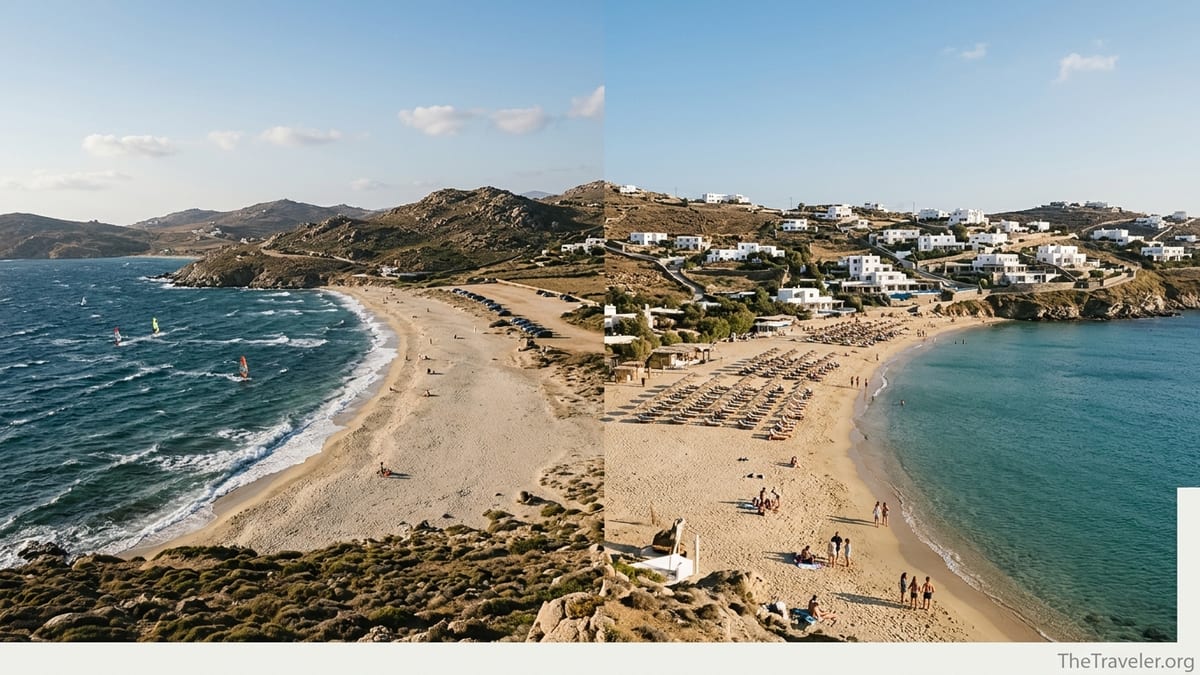
Understanding the Basics: Where Ftelia and Elia Sit on the Map
Both Ftelia and Elia sit roughly 10 kilometers from Mykonos Town (Chora), but in very different directions and landscapes. Ftelia is on the exposed north coast, reached via a small road beyond Ano Mera that drops down to a broad, wind-beaten bay. It feels remote the moment you arrive, with low scrubby hills and open countryside replacing whitewashed hotels. You are only about a 20 minute drive from town in normal traffic, but it feels like a different island.
Elia lies on the south coast, facing the open Aegean but sheltered from the prevailing summer winds. The approach is more developed, with villa complexes and resorts lining the hillsides as you descend. It is again about a 20 to 25 minute drive from town in normal summer conditions, but here you immediately see neat rows of sunbeds, beach bars and water sports stations that signal a much more organized experience.
In practical terms, the key difference is that Elia is plugged into the island’s public transport and boat network, while Ftelia is essentially a drive-in beach. Elia is on the regular KTEL bus route from Mykonos Town and also served by small shuttle boats from other south coast beaches in high season. Ftelia currently has no bus service at all, so you reach it by rented car, ATV, scooter or taxi, then park on informal flat ground behind the sand.
If you are staying without a vehicle in or near Mykonos Town, Elia is far easier and cheaper to reach. If you have your own wheels and enjoy short drives through the island’s interior, Ftelia becomes a realistic and rewarding option.
Atmosphere & Vibe: Wild North vs Relaxed, Social South
The most important difference between Ftelia and Elia is how they feel. Ftelia is defined by the wind. On most summer days the meltemi blows across the bay, shaping the waves and keeping the sand in motion. The result is a raw, cinematic landscape that appeals to people who like dramatic nature and do not mind being sandblasted now and then. You will see windsurfers carving across dark blue water, kites occasionally in the air, and a relatively small number of sunbathers who came precisely because the beach is not polished or crowded.
Elia’s mood is the opposite. The long, curved bay and south-facing orientation keep the sea much calmer, and the soundscape is more about gentle music from beach bars, the thud of jet skis heading out and the low buzz of conversation around sunbeds. It is one of the island’s longest stretches of sand, so even on a busy August day there is usually space to breathe, but you always know you are on a resort island: there are servers delivering Aperol spritzes to your lounger, couples posing for photos in the shallows and group chats about where to go for dinner later.
For many travelers Elia hits a balance: lively but not a full-on party beach like Paradise or Super Paradise, well serviced without feeling like a nightclub. Families spread out near the central organized zone, couples gravitate to the quieter ends of the beach, and LGBTQ+ travelers naturally drift toward the established gay and nudist-friendly area at the far right-hand side as you face the sea. In contrast, Ftelia often attracts a narrower crowd: wind and water sports fans, photographers, and travelers specifically seeking somewhere that feels less curated and less expensive than the south coast hotspots.
If you are energized by a slightly bohemian, elemental setting, Ftelia’s wildness may be exactly what you want. If you relax best on a comfortable lounger with background music and the option of ordering lunch from a menu, Elia will likely feel more like a holiday.
Beach & Water Conditions: Swimming, Sunbathing and the Wind Factor
On a calm day, Ftelia can be beautiful for swimming, with clear cool water and a wide arc of pale sand that stays relatively uncrowded. The catch is that truly calm days are the exception in July and August. When the wind picks up, the sea becomes rough and sometimes unsafe for casual swimmers, with strong chop and a forceful shore break. Locals and experienced windsurfers enjoy these conditions, but families with small children or less confident swimmers usually do not. You also need to be prepared for blowing sand, especially if you try to walk the full length of the bay.
Elia is one of Mykonos’s best all-round swimming beaches. The water here is typically clear, calm and gently shelving, with soft golden sand underfoot in most areas. Even when the meltemi blows across the island, Elia’s orientation protects swimmers enough that waves are usually small and easy to manage. This makes it a safer choice for kids and anyone who prefers to float peacefully instead of battling chop. The organized sunbed zones also create small pockets of wind shelter with rows of umbrellas and windbreak-style setups in high season.
For sunbathing, Elia is again the more straightforward option. You can arrive with only a towel and sunscreen and still have immediate access to shade, showers and drinks. There are public areas where you can lie on the sand for free, but a large part of the beach is covered with organized loungers. By contrast, Ftelia has a mix of unorganized shoreline and a few more developed pockets around beach bars. On windy days finding a comfortable, sheltered spot can be challenging unless you are using the facilities of a beach club with windbreaks.
In short, if you picture long, lazy swims and reading a book at the water’s edge, Elia is the better bet. If your priority is windsurfing, photographing dramatic seascapes or simply experiencing the Aegean at its most untamed, then Ftelia’s more extreme conditions can be a highlight instead of a drawback.
Scene, Nudism & LGBTQ+ Friendliness
Elia has, over many years, become Mykonos’s most famous gay and nudist-friendly beach. While the central section is very mixed and family-friendly, the eastern end has a well-established clothing-optional and LGBTQ+ oriented zone. You will usually see a rainbow flag marking the general area; beyond a rocky outcrop the sand narrows into a smaller cove that in high season is mostly gay and partly or fully nude. The vibe is relaxed rather than rowdy: small groups chatting, couples sunbathing, the occasional impromptu volleyball game near the rocks.
For LGBTQ+ travelers, Elia offers several advantages. It is easy to reach on the bus, so you do not need to rent a car or scooter to spend the day in an environment that feels both welcoming and social. The main beach bars and nearby resorts are used to a very mixed crowd, so same-sex couples holding hands or ordering a bottle of wine together attract no attention. Because the beach is long, it also manages to be both gay-popular and inclusive without feeling like a single-scene enclave; straight couples and families pass by on the sand, and many simply choose a different stretch without issue.
Nudism at Elia is concentrated near the far-right section as you face the sea, but even there you will find a spectrum of comfort levels, from topless sunbathers to fully nude groups. Most people adopt a live-and-let-live attitude. If you want a strictly textile environment, you can stay closer to the central organized zone and still enjoy the same water and sand.
Ftelia, by contrast, is not known as a nudist or gay beach in the same structured way. You may encounter the occasional nude sunbather at the quieter ends of the bay, but there is no firmly established section, and the scene is more about wind and waves than social connections. LGBTQ+ travelers certainly visit, but they tend to head to Elia when they specifically want a gay-focused environment or clothing-optional area, and to Ftelia when they are more interested in surfing conditions or solitude than in meeting others.
Access, Costs & Facilities: What a Day at Each Beach Really Looks Like
Getting to Elia from Mykonos Town is straightforward in season. KTEL buses typically run from the Fabrika terminal to Elia several times a day in summer, with journey times of about 25 to 30 minutes depending on stops. Fares have historically been in the lower single-digit euro range one way, making this one of the most economical beach excursions on the island. In addition, small water taxis often connect Elia with other south-coast beaches such as Platis Gialos, giving you the option of beach-hopping without returning to town.
Once at Elia, you can expect organized sunbeds with prices that reflect Mykonos’s premium status. In recent seasons it has been common to see two sunbeds and an umbrella starting around 40 to 60 euros for the day in the central areas, rising for front-row positions or beds attached to upscale beach clubs. In exchange you get waiter service, decent toilets and showers, and the ability to run a tab for drinks and lunch rather than leaving your spot. Many visitors factor this into their budget and treat an Elia day as a full experience, arriving mid-morning and staying until the late afternoon bus, often around early evening.
Ftelia requires more planning. With no public bus, you either rent a vehicle, hire a taxi or arrange a transfer through your hotel. Taxi availability can be tight in peak season, so if you plan to rely on them, it is wise to agree a pickup time in advance. Parking is usually free on informal flat ground near the beach access, though in very busy August weeks you may have to walk a short distance from your car. Facilities are more limited and clustered around specific venues; that means you should not assume access to restrooms, shade or food unless you are a paying customer of a bar or restaurant, or you have brought your own supplies.
Costs at Ftelia can be lower if you go “independent” and simply lay a towel on the unorganized sand, but you may pay comparable prices for sunbeds and drinks in the more polished beach clubs. The main savings come from the absence of heavy infrastructure: there are no long lines of premium loungers occupying every meter of sand, and no large-scale water sports operations charging extra for every activity. In both cases, remember that Mykonos overall is one of Greece’s most expensive islands; neither beach counts as a budget destination, but a day at Ftelia with your own picnic can be significantly cheaper than a full-service day at Elia.
Who Each Beach Suits Best: Real-World Traveler Profiles
Imagine a couple in their early thirties staying in a small guesthouse in Mykonos Town without a car. They want a relaxing beach day with good swimming, lunch by the sea and perhaps a bit of social atmosphere without full-scale partying. For them, Elia is almost tailor-made. They can walk to the bus station after breakfast, arrive at the beach by late morning, rent a pair of loungers, swim in calm water and order a Greek salad and grilled fish from the nearest taverna. If they are part of the LGBTQ+ community or simply enjoy diverse, inclusive spaces, they can wander toward the gay and nudist-friendly section in the afternoon and still catch a bus back in time for dinner in town.
Now picture a solo traveler who already rented a car to explore the island’s quieter corners. They are less interested in sunbed service and more in photographing wild coastlines, watching surfers and experiencing a different side of Mykonos. For them, Ftelia is the obvious choice. They can time their visit for a windy afternoon, park near the sand, walk along the long, almost empty shoreline and perhaps stop for a drink at one of the small beach bars before heading back through the rural interior. The lack of crowds and infrastructure is part of the appeal rather than a drawback.
Families with younger children often gravitate to Elia because of the gentler sea, clear zone demarcations and easier access to food, toilets and shade. Parents can book loungers near the water’s edge, watch kids paddle in relatively calm shallows and still have quick access to changing areas. Those who are not comfortable with nudism simply choose a spot well away from the eastern end. More adventurous families with older children, especially those interested in windsurfing or kitesurfing, might enjoy a half-day at Ftelia instead, treating it like a short excursion to see a wilder side of the island.
Finally, travelers on tighter budgets or those trying to avoid the most expensive aspects of Mykonos might mix the two. For example, they could spend one structured, higher-spend day at Elia with sunbeds and lunch, then another, cheaper session at Ftelia with a packed picnic and no lounger rental, enjoying the very different moods of each shoreline.
The Takeaway
Ftelia and Elia are not interchangeable beaches a few kilometers apart. They represent two distinct visions of Mykonos: one wild, windy and minimally developed, the other long, sheltered and organized with a strong social element. Your ideal choice depends on how you like to spend time by the sea, how important easy logistics are and whether you are seeking solitude, community or a bit of both.
Choose Ftelia if you prioritize dramatic landscapes, wind and wave sports, and a feeling of being far from the island’s polished front stage. Accept that swimming may be limited on rough days, facilities are sparse and you will probably need your own vehicle and supplies. In return you get space, atmosphere and a side of Mykonos many visitors never see.
Opt for Elia if you want reliable swimming, comfortable sunbeds, food and drink service and an easy bus connection from town. Its established nudist and LGBTQ+ friendly section makes it especially appealing for travelers who value inclusive, clothing-optional spaces, while the long main beach remains very accessible to families and mixed groups. For many visitors, a day at Elia becomes the quintessential Mykonos beach experience.
If your schedule allows, the best solution may be not to choose at all, but to visit both. Spend one day at Elia soaking up the classic organized-beach experience, then carve out a few hours at Ftelia to stand in the wind, watch the whitecaps roll in and see how different the same Aegean Sea can feel just a short drive away.
FAQ
Q1. Is Ftelia Beach or Elia Beach better for swimming?
Elia is generally better for swimming, with calmer, clearer water and a gentler entry that suits most swimmers. Ftelia can be excellent on rare calm days but is often too windy and rough for comfortable swimming in peak summer.
Q2. Which beach is easier to reach without a car?
Elia is far easier to reach without a car, as it is connected to Mykonos Town by regular buses in season and sometimes by small shuttle boats from other south-coast beaches. Ftelia has no public bus service, so you need a taxi, rental car, ATV or scooter.
Q3. Which beach is more budget friendly?
Neither beach is truly cheap by broader Greek-island standards, but Ftelia can be more budget friendly if you bring your own food, drinks and shade and sit on the unorganized sand. Elia’s organized sunbeds and full-service setup tend to lead to higher overall daily spending.
Q4. Is Elia Beach suitable for families with children?
Yes, Elia is popular with families thanks to its calm water, soft sand and easy access to toilets, showers and food. Families usually stay in the central or western parts of the beach, away from the nudist-friendly eastern section, which keeps everyone comfortable.
Q5. Will I feel comfortable at Elia if I am not LGBTQ+ or not interested in nudism?
Most likely yes. Elia is a long, mixed-use beach where families, couples and groups of friends share the main area, and the nudist and more gay-focused section is concentrated at the far eastern end. You can simply choose a different stretch if you prefer a standard textile environment.
Q6. Is Ftelia Beach good for a full-day stay, or just a short visit?
Ftelia can work for both, but many travelers treat it as a half-day outing because of its exposure to wind and limited facilities. If you bring sufficient water, snacks and sun protection, and you enjoy the wild setting, you could comfortably spend most of the day there.
Q7. Can I combine Elia and other beaches in one day?
Yes, it is quite common to combine Elia with other south-coast beaches using buses, taxis or water taxis. For example, you might spend the morning at Elia and then move to a livelier beach like Paradise or Super Paradise for late-afternoon drinks before heading back to town.
Q8. Is it safe to walk around nude at Ftelia like at Elia’s nudist section?
Ftelia does not have a formally established nudist area like Elia, and most visitors wear swimwear. You may see occasional topless or nude sunbathers in quieter corners, but if you want a clearly accepted clothing-optional environment, Elia’s eastern end is the safer and more comfortable choice.
Q9. Which beach is better if I want quiet and space even in August?
Ftelia usually offers more space and a quieter atmosphere even in high season, partly because access is more difficult and conditions are windier. Elia is long enough to find quieter patches, but it will still feel significantly busier in late July and August.
Q10. If I only have one day in Mykonos, which beach should I choose?
If you have just one day and want an easy, classic Mykonos beach experience with good swimming and services, Elia is the safer choice. If you value unique landscapes over comfort and are willing to rent transport, Ftelia offers a more distinctive, less typical view of the island.